Post Disclaimer
This post contains affiliate links. If you buy something through these links, I may earn a small commission at no extra cost to you. Full disclosure.
This article is for informational purposes only and does not constitute medical advice. Always consult a healthcare professional for personal health concerns. Full disclaimer.
Last updated: June 21, 2026
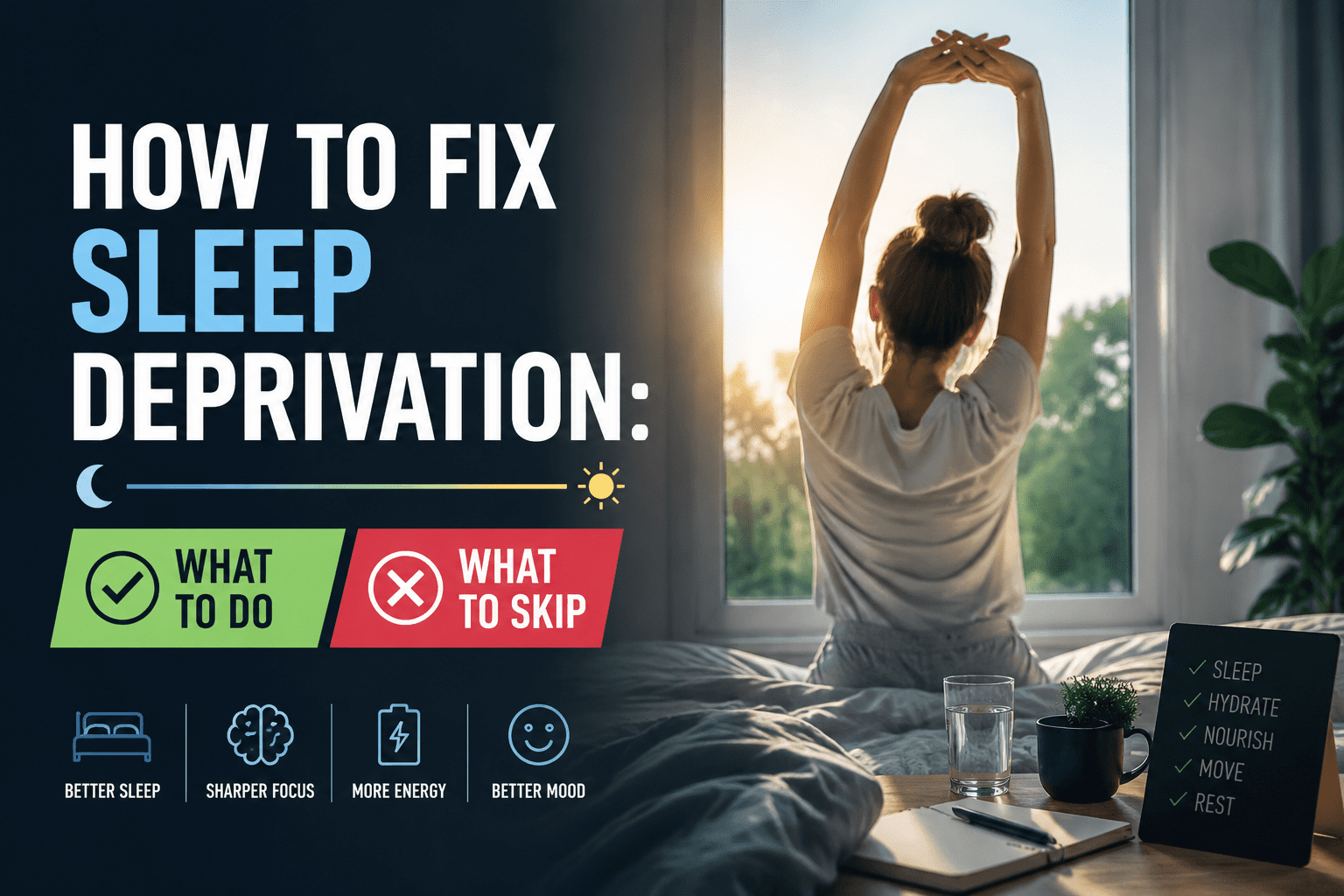
Quick Answer: You can start to fix sleep deprivation by prioritizing consistent sleep timing, allowing strategic short naps, and avoiding the common mistakes – like sleeping in too long on weekends – that reset your progress. Full recovery from significant sleep debt takes days to weeks, not one good night. The process is manageable, but it requires doing the right things in the right order.
Key Takeaways
- Sleep debt is real and it accumulates – one night of good sleep rarely fixes it
- A consistent wake time is more powerful than a consistent bedtime for resetting your sleep drive
- Short naps (20-25 minutes) help; long naps make nighttime sleep harder
- Alcohol, caffeine after 2pm, and bright screens at night actively block recovery
- Light exposure in the morning is one of the fastest ways to reset your circadian rhythm
- Sleeping in on weekends feels helpful but usually extends the problem
- If you’ve been sleep-deprived for weeks or months, expect a gradual recovery, not an overnight fix
- Some people need professional support – chronic sleep deprivation can signal an underlying disorder
What Does Sleep Deprivation Actually Do to You
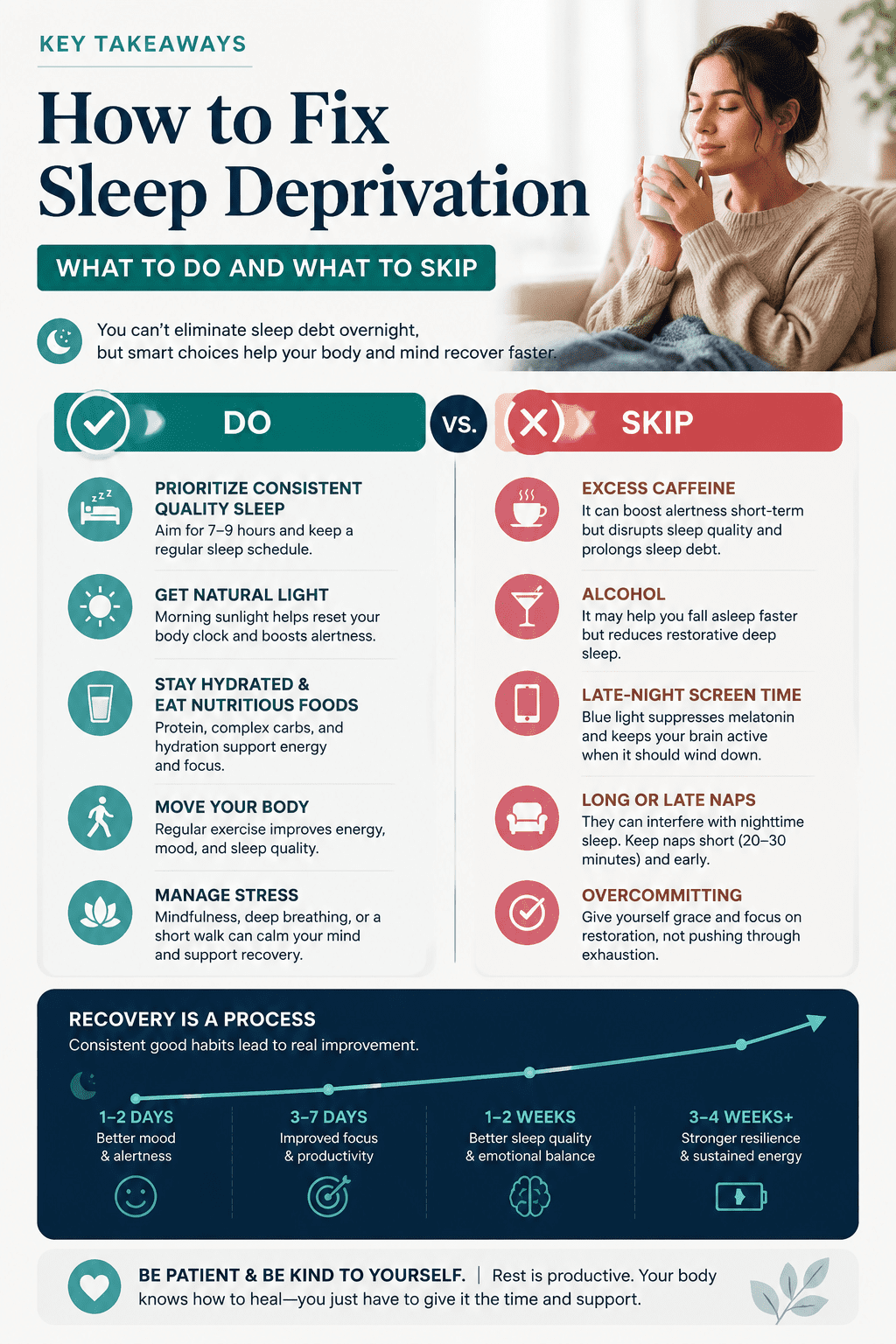
Sleep deprivation isn’t just feeling tired. It affects your memory, mood, immune function, metabolism, and decision-making – often in ways you don’t notice until you’ve recovered.
The CDC reports that more than 1 in 3 adults in the US don’t get enough sleep on a regular basis (CDC, 2016). And here’s what the research actually says: even losing 90 minutes of sleep per night for a week measurably impairs cognitive performance, similar to going without sleep for 24 hours straight (Van Dongen et al., 2003).
Most people who struggle with sleep underestimate how far behind they’ve fallen. You adapt to feeling bad. You stop remembering what rested feels like.
If you’ve been dealing with this for a while, the first thing to understand is that you’re not broken – you’re sleep-deprived, and there’s a difference. If you’re not sure what’s driving your sleep problems, this breakdown of what causes lack of sleep is worth reading first.
If you’re experiencing persistent symptoms of sleep deprivation or insomnia, consider taking a quick self-evaluation. This free, anonymous insomnia test asks you to evaluate how you’ve felt over the past two weeks – it takes just a few minutes and can help clarify whether what you’re dealing with goes beyond normal tiredness.
How Much Sleep Debt Do You Actually Have
Sleep debt is the cumulative difference between the sleep your body needs and the sleep it gets. It builds up faster than most people realize.
If you need 8 hours but regularly get 6, you’re adding 2 hours of debt per night. After a week, that’s 14 hours. You can’t pay that back in one Saturday morning lie-in.
A useful rough estimate:
- 1-2 nights of poor sleep – recoverable within a few days with consistent good sleep
- Several weeks of short sleep – may take 1-2 weeks of prioritized rest to feel normal again
- Months or years of chronic deprivation – recovery is longer and often requires addressing the root cause, not just sleeping more
The honest version is that most people in the third category are dealing with something more than just bad habits. If that sounds like you, reading about why you might be unable to sleep can help you figure out what’s actually going on.
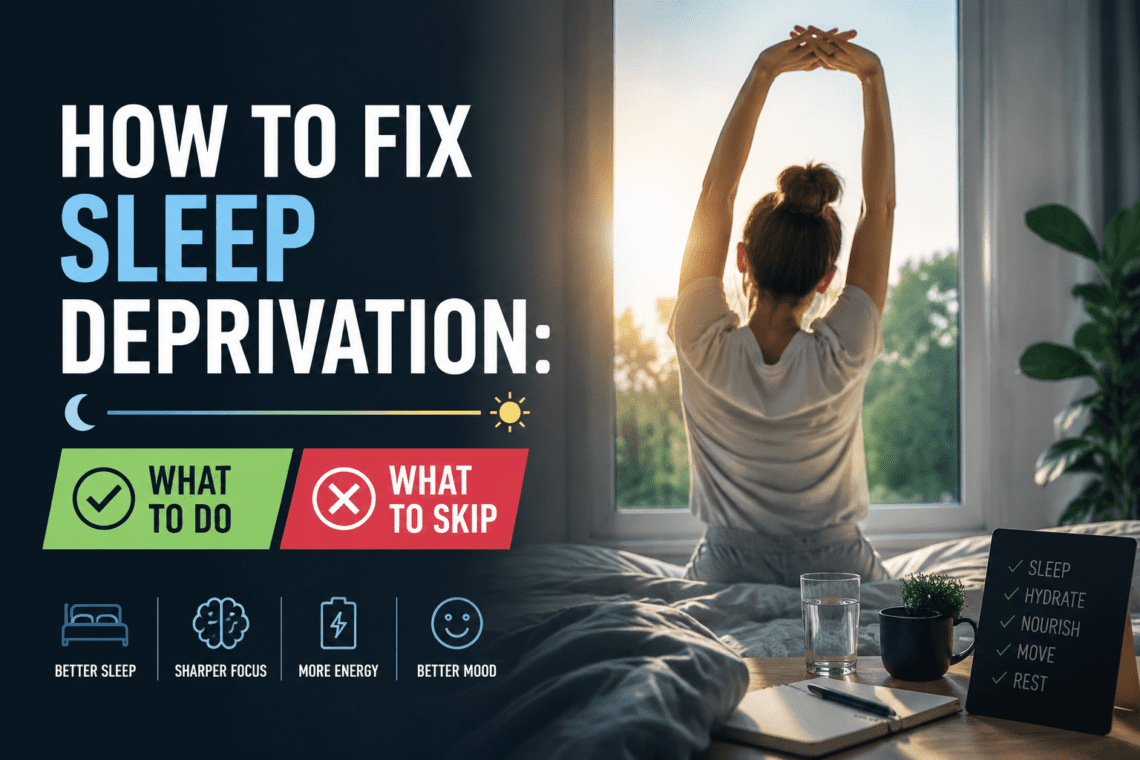
How to Fix Sleep Deprivation: What Actually Works
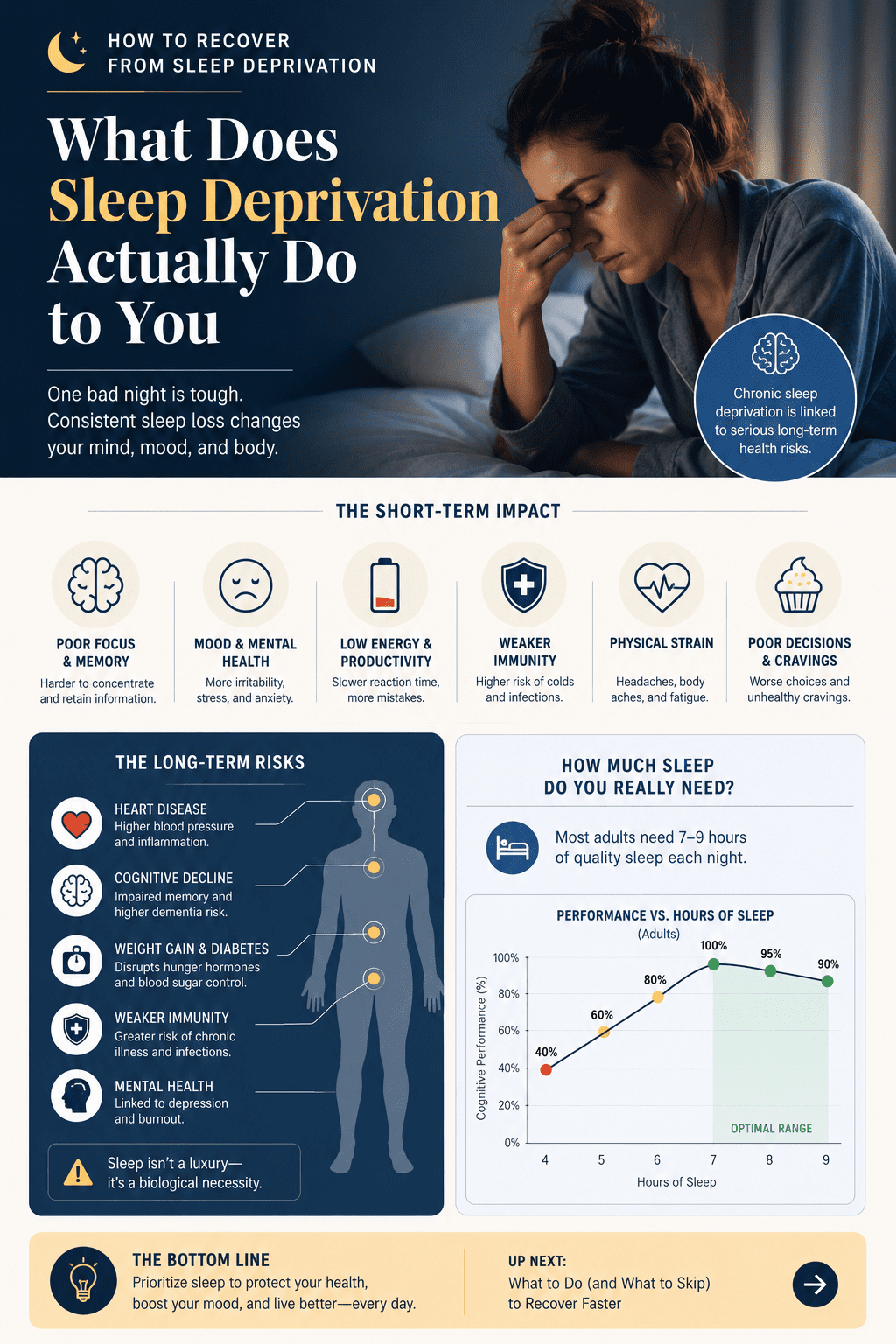
The most effective approach to fixing sleep deprivation combines consistent timing, strategic rest, and a few specific habits that support your body’s natural sleep pressure system.
1. Lock in a consistent wake time – even when you’re exhausted
This is the single most important thing. Your body builds sleep pressure (adenosine) throughout the day, and that pressure drives sleep quality at night. If you sleep in to compensate for a bad night, you reduce that pressure and make the next night harder.
Pick a wake time and hold it, even on weekends. In practice, this means setting an alarm and getting up – even if you slept terribly. It’s uncomfortable for a few days. It works.
2. Use short naps strategically
A 20-25 minute nap before 3pm can reduce cognitive impairment from sleep debt without disrupting nighttime sleep (Mednick et al., 2002). Set an alarm. Don’t nap past mid-afternoon. Don’t nap for more than 30 minutes unless you’re severely deprived and deliberately allowing a recovery day.
This is what worked for me during a particularly rough stretch of insomnia – a 20-minute nap around 1pm kept me functional without wrecking my night. Not perfect, but it helped.
3. Get morning light as early as possible
Light exposure within the first hour of waking helps anchor your circadian rhythm. This matters because a disrupted circadian clock is often what makes falling asleep at night so hard. Even 10-15 minutes of outdoor light – without sunglasses – makes a measurable difference.
4. Prioritize deep and REM sleep, not just total hours
Not all sleep is equal. If you want to understand how to actually improve the quality of what you’re getting, this guide to improving deep sleep covers what the research actually says about each stage.
5. Eat enough, especially protein
Sleep deprivation disrupts hunger hormones, making you crave sugar and carbs. But those foods spike and crash your blood sugar, which can wake you at night. Prioritizing protein and fat at dinner supports more stable sleep.
What to Skip When Recovering From Sleep Deprivation
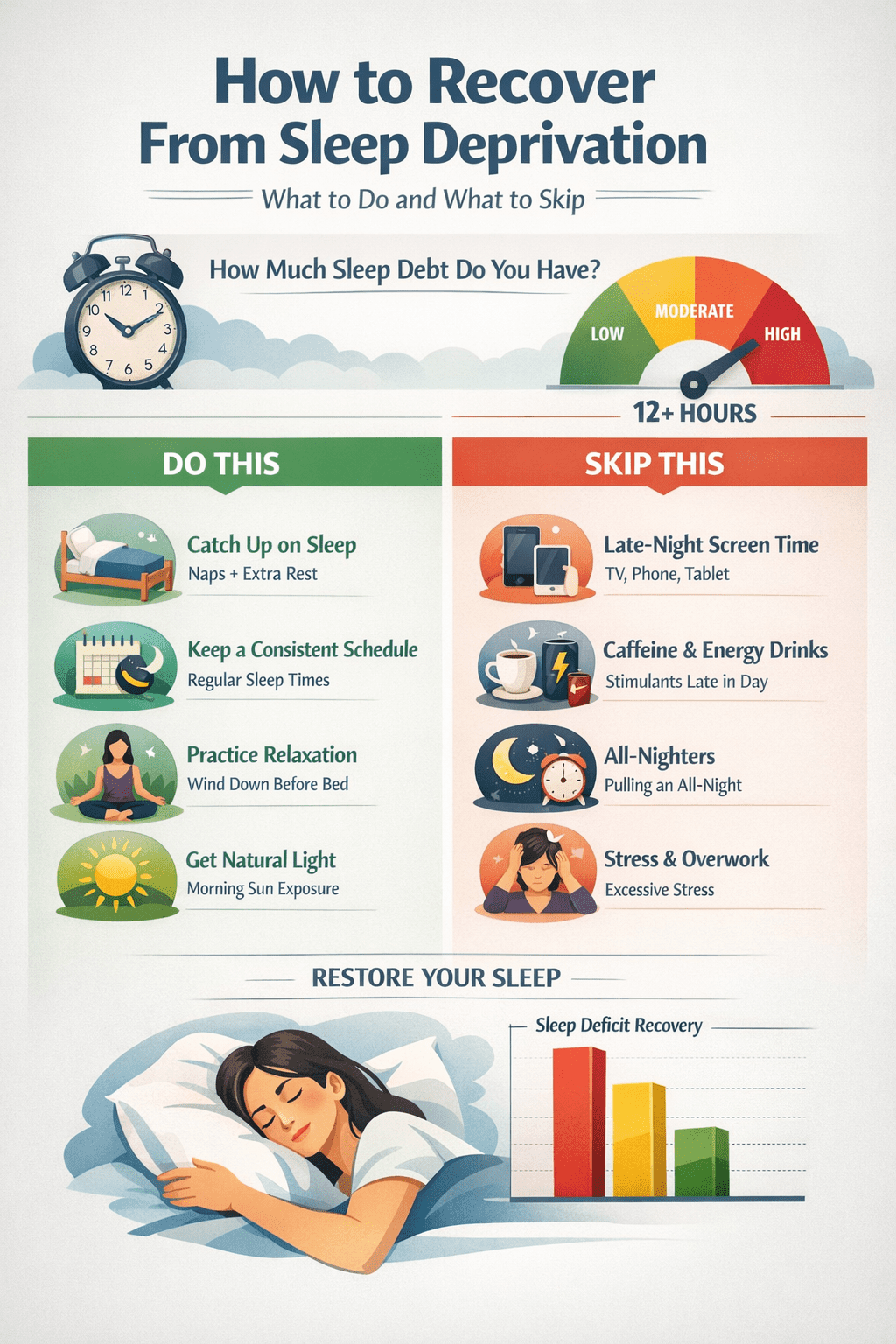
Knowing what not to do is just as important as knowing what helps. Several common “recovery” strategies actually make things worse.
Skip: Sleeping in more than 1 hour past your normal wake time
It feels logical. It’s counterproductive. Sleeping in significantly shifts your circadian rhythm and reduces sleep pressure for the next night. Worth trying if you’re severely deprived: one deliberate recovery day with extended sleep, then back to your fixed wake time the next morning.
Skip: Alcohol to help you fall asleep
Alcohol does help you fall asleep faster. It also fragments the second half of your sleep, suppresses REM, and leaves you feeling worse the next day. The Sleep Foundation is clear on this: alcohol is not a sleep aid (Sleep Foundation, 2023).
Skip: Caffeine after 2pm
Caffeine has a half-life of about 5-6 hours. A coffee at 3pm means half that caffeine is still in your system at 9pm. If you’re sleep-deprived and trying to recover, cutting caffeine earlier than you think is necessary.
Skip: Long naps late in the day
A 2-hour nap at 5pm will reduce your sleep drive enough to make falling asleep at 11pm genuinely difficult. It’s not just you – this is basic sleep physiology.
Skip: Lying in bed awake for hours
This one is counterintuitive. If you can’t sleep, staying in bed trains your brain to associate bed with wakefulness. Get up, do something quiet in dim light, and return when you feel sleepy. You don’t have to fall asleep – you just have to rest. But doing it in bed when your brain is wired is working against you.
How to Fix Sleep Deprivation When It’s Been Going On for Months
Chronic sleep deprivation is a different problem than a few bad nights. If you’ve been dealing with this for a while, the standard advice – better sleep hygiene, no screens before bed – has probably already failed you. That’s not because you’re doing it wrong. It’s because those tools weren’t designed for chronic cases.
Here’s what the research actually says about longer-term recovery:
- Cognitive Behavioral Therapy for Insomnia (CBT-I) is the most evidence-backed treatment for chronic insomnia and sleep deprivation. It outperforms sleep medication in long-term outcomes (Trauer et al., 2015). It’s not fast, but it’s the closest thing to a real fix.
- Addressing underlying anxiety or depression matters. Sleep deprivation and mental health problems feed each other. If racing thoughts are keeping you up, this piece on insomnia and overthinking is worth reading.
- Fixing your sleep schedule systematically – not just going to bed earlier, but resetting your entire rhythm – is covered step by step in this 7-day sleep schedule reset guide.
It’s not just you. Most people who’ve been dealing with chronic sleep deprivation have tried the basics. If they worked, you wouldn’t still be here. The next step is usually either CBT-I, a sleep study to rule out disorders like sleep apnea, or both.
If you haven’t already, take this free anonymous insomnia test – it evaluates how you’ve felt over the past two weeks and can help you understand whether your symptoms point toward something that needs more targeted support.
How Long Does It Take to Recover From Sleep Deprivation
Recovery time depends on how much sleep debt you’ve accumulated and how consistently you address it.
| Sleep Debt Level | Estimated Recovery Time | Key Strategy |
|---|---|---|
| 1-3 nights | 2-4 days | Consistent sleep timing |
| 1-2 weeks | 1-2 weeks | Fixed wake time + short naps |
| 1-3 months | 2-4+ weeks | CBT-I or structured sleep reset |
| Chronic (6+ months) | Varies – may need clinical support | Rule out sleep disorders first |
The reason this matters is that people often give up on recovery strategies after 2-3 days because they don’t feel better yet. That’s not failure – that’s just not enough time.
FAQ
Can you fully recover from long-term sleep deprivation?
Yes, for most people. Cognitive function, mood, and physical health improve significantly with consistent, quality sleep over time. Some studies suggest full recovery from chronic deprivation may take several weeks of prioritized sleep.
Is it better to sleep in or take a nap when sleep-deprived?
A short nap (20-25 minutes) before 3pm is usually better than sleeping in. Sleeping in disrupts your circadian rhythm and reduces sleep pressure for the following night.
Does one good night of sleep fix sleep deprivation?
No. One good night helps, but significant sleep debt – especially from weeks or months of short sleep – requires consistent recovery over multiple days or weeks.
What foods help with sleep deprivation recovery?
Foods that support stable blood sugar and contain tryptophan (an amino acid that supports melatonin production) are worth prioritizing – turkey, eggs, dairy, nuts. Avoid high-sugar meals close to bedtime.
Can sleep deprivation cause anxiety?
Yes. Sleep deprivation increases amygdala reactivity, which amplifies anxiety responses. The relationship goes both ways – anxiety disrupts sleep, and poor sleep worsens anxiety.
Should I take melatonin for sleep deprivation?
Melatonin is most useful for circadian rhythm disruption (jet lag, shift work) rather than sleep debt. For general sleep deprivation recovery, it’s less effective than fixing your sleep timing and environment.
When should I see a doctor about sleep deprivation?
If you’ve had consistent sleep problems for more than 3 months, if you snore loudly or wake gasping, or if your sleep problems are significantly affecting your daily functioning, it’s worth talking to a doctor. A sleep study can rule out conditions like sleep apnea.
Is caffeine okay during sleep deprivation recovery?
In moderation, and only before 2pm. Caffeine helps manage daytime impairment but will undermine nighttime recovery if used too late in the day.
Conclusion
Recovering from sleep deprivation isn’t complicated in theory – but it’s harder than most advice makes it sound, especially if you’ve been running on empty for a long time.
The core of it: hold a consistent wake time, use short naps carefully, get morning light, cut alcohol and late caffeine, and stop lying in bed awake. If those basics haven’t moved the needle after a few weeks, you’re probably dealing with something that needs a more structured approach – CBT-I, a sleep study, or both.
The honest version is that there’s no shortcut that works long-term. But there is a path forward, and it starts with understanding what your body actually needs – not just more hours in bed, but better-timed, higher-quality sleep.
If you’re not sure where to start, building a proper sleep routine is a practical first step. And if you suspect your sleep problems go deeper than habits, take the free insomnia self-test – it’s anonymous, takes a few minutes, and can help clarify what you’re actually dealing with.
You’ve been tired long enough. Let’s figure out what’s actually going to help.
References
- Centers for Disease Control and Prevention (CDC). (2016). 1 in 3 adults don’t get enough sleep. https://www.cdc.gov/media/releases/2016/p0215-enough-sleep.html
- Mednick, S., Nakayama, K., & Stickgold, R. (2002). Sleep-dependent learning: A nap is as good as a night. Nature Neuroscience, 6(7), 697-698. https://doi.org/10.1038/nn1078
- Sleep Foundation. (2023). Alcohol and sleep. https://www.sleepfoundation.org/nutrition/alcohol-and-sleep
- Trauer, J. M., Qian, M. Y., Doyle, J. S., Rajaratnam, S. M. W., & Cunnington, D. (2015). Cognitive behavioral therapy for chronic insomnia: A systematic review and meta-analysis. Annals of Internal Medicine, 163(3), 191-204. https://doi.org/10.7326/M14-2841
- Van Dongen, H. P. A., Maislin, G., Mullington, J. M., & Dinges, D. F. (2003). The cumulative cost of additional wakefulness: Dose-response effects on neurobehavioral functions and sleep physiology. Sleep, 26(2), 117-126. https://doi.org/10.1093/sleep/26.2.117