
Post Disclaimer
This post contains affiliate links. If you buy something through these links, I may earn a small commission at no extra cost to you. Full disclosure.
This article is for informational purposes only and does not constitute medical advice. Always consult a healthcare professional for personal health concerns. Full disclaimer.
Last updated: June 17, 2026
Quick Answer: Building a sleep routine that actually works means sending your brain consistent, repeated signals that it’s safe to wind down – not just following a checklist. The most effective bedtime routines work because they reduce physiological arousal and create predictable cues your nervous system learns to recognize. This takes time, but the process is learnable, even if you’ve struggled for years.
Key Takeaways
- Your brain can’t fall asleep if it perceives threat – the goal of any sleep routine is to lower that threat signal
- Consistency of timing matters more than the specific activities you choose
- Most people who struggle with sleep have a hyperactive arousal system, not a willpower problem
- It takes roughly 2-4 weeks of consistent behavior to begin resetting a disrupted sleep schedule
- Anxiety and stress physically block sleep onset by keeping cortisol elevated
- Small, cheap environmental changes (temperature, light, sound) have outsized effects on sleep quality
- Night shift workers need a modified routine that works against their social environment, not with it
- Natural alternatives to sleep aids exist and have real evidence behind them – but they work best inside a consistent routine
- Tracking your sleep can help, but obsessing over data can make insomnia worse
- You don’t have to fall asleep – you just have to rest. That reframe alone can reduce sleep anxiety significantly
What Exactly Happens in Your Brain When You Can’t Fall Asleep
Your brain won’t switch off because it doesn’t feel safe. That’s the short version.
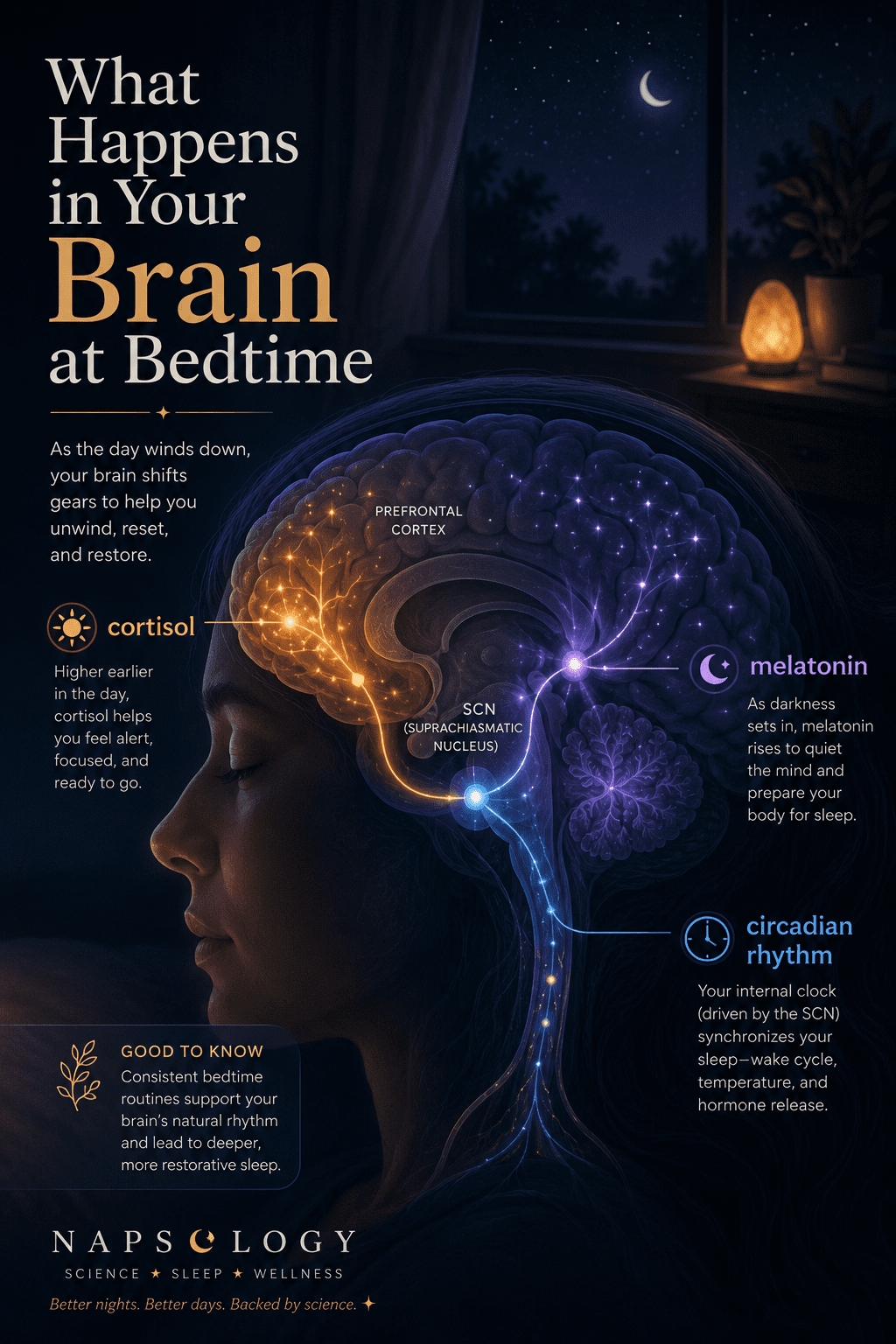
When you lie awake at night with your thoughts racing, your brain’s threat-detection system – the amygdala – is still running. It’s releasing cortisol and keeping your nervous system in a low-grade alert state. Melatonin, the hormone that signals darkness and promotes sleep onset, gets suppressed when cortisol is elevated. The two systems directly compete.
Here’s what the research actually says: sleep onset requires a drop in core body temperature, a rise in melatonin, and a reduction in cognitive arousal. If any one of those is disrupted, the others struggle to follow. For people with chronic insomnia or anxiety-driven sleep problems, the arousal system becomes conditioned – your bed itself can start triggering wakefulness because your brain has learned to associate it with the frustration of not sleeping [2].
This is why knowing how to build a sleep routine matters so much. You’re not just picking relaxing activities. You’re running a conditioning program on your own nervous system.
If you’re not sure whether what you’re experiencing crosses into clinical insomnia territory, take this free anonymous test – it only takes a few minutes and evaluates how you’ve felt over the past two weeks: Insomnia Self-Assessment Test
How Long Does It Take to Reset a Bad Sleep Schedule
Realistically, 2-4 weeks of consistent effort to see meaningful change – though some people notice a shift within 10 days.
The honest version is that there’s no overnight fix. Your circadian rhythm is a biological clock regulated by light exposure, meal timing, and behavioral cues. When it’s disrupted – by stress, irregular hours, travel, or years of bad sleep – it doesn’t snap back in a weekend. Research from Healthline’s sleep science coverage suggests that consistent wake times are the single most powerful lever for resetting your internal clock, because your wake time anchors your entire sleep-wake cycle [5].
In practice this means:
- Pick a wake time and hold it even on weekends – yes, even when you’ve had a bad night
- Avoid napping past 3pm, and keep naps under 30 minutes if you need them [1]
- Expect the first week to feel worse before it gets better – that’s normal, not a sign it’s not working
How to Build a Sleep Routine: Step-by-Step for Adults With Anxiety
For adults with anxiety, the goal of a bedtime routine isn’t relaxation for its own sake – it’s nervous system downregulation. Here’s a practical sequence that works.
60-90 minutes before bed:
- Dim the lights in your home. Bright overhead lighting signals daytime to your brain and delays melatonin release [3]
- Stop eating heavy meals – digestion keeps your body temperature elevated
- Set a “worry window” – write down tomorrow’s tasks so your brain stops rehearsing them
30-45 minutes before bed:
- Put your phone face-down or in another room. It’s not just the blue light – it’s the social and emotional stimulation [3]
- Do something low-demand: reading fiction, gentle stretching, or a warm shower (the post-shower temperature drop actually promotes sleep onset)
- Try a body scan or slow breathing exercise if your mind is still busy
At bedtime:
- Get into bed only when you feel sleepy – not just tired, but actually drowsy
- If you’re not asleep within 20 minutes, get up and do something quiet in dim light until you feel sleepy again. This is called stimulus control, and it’s one of the most evidence-backed techniques in CBT for insomnia
This is what worked for me: I stopped trying to force sleep and started treating my pre-bed hour as a signal-sending exercise. The goal wasn’t to feel calm. It was to do the same things in the same order until my brain started connecting those actions to sleep.
For more on bedtime routines for adults who struggle to wind down, there’s a deeper breakdown on Napsology that covers the timing in more detail.
How Stress Impacts Your Ability to Fall Asleep Quickly
Stress doesn’t just make you feel anxious at bedtime – it chemically blocks sleep. Cortisol, your primary stress hormone, has a natural rhythm: it should be lowest at night and peak in the morning. Chronic stress flattens that curve, keeping cortisol elevated when it should be dropping [1].
The reason this matters is that high cortisol directly suppresses melatonin production. You can do everything else right – dark room, cool temperature, no screens – and still lie awake if your stress response is running hot.
Practical ways to lower cortisol before bed:
- Progressive muscle relaxation – systematically tensing and releasing muscle groups signals safety to your nervous system
- Journaling – specifically writing down what’s worrying you, not just free-writing
- Cold-to-warm temperature shift – a warm bath or shower followed by a cool bedroom accelerates the body temperature drop that triggers sleep
If anxiety is the main driver of your sleep problems, this guide on why you can’t sleep even when you’re tired covers the anxiety-sleep loop in more detail.
Cheap Ways to Create a Bedroom Environment That Supports Sleep
Your bedroom environment doesn’t need to be expensive to be effective. The three variables that matter most are temperature, light, and sound – and all three can be addressed cheaply.
Temperature: Most sleep research points to 65-68°F (18-20°C) as the range that supports sleep onset [4]. A cheap fan or opening a window often does the job. If your partner runs hot, a dual-zone blanket costs less than most sleep gadgets.
Light: Blackout curtains are worth the investment – even small amounts of light can suppress melatonin. If you can’t afford them, a basic sleep mask works. Amber-tinted bulbs for bedside lamps cost a few dollars and reduce blue light exposure without requiring you to sit in the dark.
Sound: A free white noise app does the same job as a $60 machine. Brown noise or pink noise work better for some people than white noise – worth experimenting with.
One thing that’s often overlooked: clutter. A visually busy bedroom keeps your brain in a low-level processing state. Clearing your nightstand takes five minutes and costs nothing.
Is a Sleep Routine Different for Night Shift Workers
Yes – significantly. Night shift workers are fighting their own circadian biology, and a standard “go to bed at 10pm” routine is useless for them.
The core challenge is that your body’s melatonin release is tied to darkness and social cues that happen at conventional nighttime hours. If you’re sleeping during the day, you need to actively simulate nighttime conditions: blackout curtains, white noise to block daytime sounds, and telling people in your home when your “night” is.
For shift workers, the most important adjustment is protecting your sleep anchor – a consistent sleep and wake time relative to your shift, not relative to the clock. If you work nights and sleep from 8am to 4pm, treat 7:30am as your “pre-bed wind-down” and 4pm as your morning. Melatonin supplements (0.5-1mg, not the 10mg doses most products sell) taken about 30 minutes before your sleep window can help shift your internal clock [5].
Worth trying if you’re a shift worker: wearing blue-light-blocking glasses on your commute home, even in daylight. It signals to your brain that “night” is approaching.
Common Mistakes People Make When Trying to Improve Sleep
Most people who struggle with sleep make the same handful of mistakes – not because they’re not trying, but because the common advice is incomplete.
Mistake 1: Spending too much time in bed. If you’re in bed for 9 hours trying to get 6 hours of sleep, you’re training your brain to associate the bed with wakefulness. Sleep restriction therapy – counterintuitively – works by compressing your time in bed to build sleep pressure.
Mistake 2: Trying a new technique for three days and giving up. Behavioral sleep interventions take weeks, not nights.
Mistake 3: Checking the clock. Every time you look at the time when you can’t sleep, you’re measuring your failure. Turn the clock away.
Mistake 4: Catastrophizing a bad night. One poor night doesn’t ruin your health. The anxiety about not sleeping often does more damage than the lost sleep itself.
Mistake 5: Relying on alcohol to fall asleep. Alcohol helps you fall asleep but fragments the second half of your night, reducing REM sleep significantly [4].
For a broader look at what’s actually causing your sleep problems, why you can’t sleep at night covers 12 specific causes with explanations.
Natural Alternatives to Sleeping Pills
Natural sleep aids can help – but they work best as part of a consistent routine, not as a standalone fix.
Melatonin: Effective for circadian rhythm issues (jet lag, shift work) at low doses (0.5-1mg). Less effective for sleep maintenance insomnia. Most over-the-counter doses are far higher than needed [5].
Magnesium glycinate: Some evidence suggests it supports GABA activity, which promotes relaxation. Worth trying if you’re deficient – many adults are.
L-theanine: An amino acid found in green tea that promotes calm without sedation. Often combined with magnesium.
Ashwagandha: Has reasonable evidence for reducing cortisol and improving sleep quality in people with stress-related insomnia.
CBT-I (Cognitive Behavioral Therapy for Insomnia): Not a supplement, but it’s the most evidence-backed non-pharmaceutical intervention for chronic insomnia – more effective long-term than sleeping pills. Available through apps, online programs, or therapists.
For a deeper look at how to fall asleep naturally without pills, that page covers the evidence for each approach more thoroughly.
Medical disclaimer: This content is for informational purposes only and is not a substitute for professional medical advice. Consult a healthcare provider before starting any supplement.
If you’re still not sure whether your sleep difficulties are clinical, this free anonymous test can help you evaluate your symptoms over the past two weeks: Take the Insomnia Test
How Much Sleep Do You Actually Need Based on Your Age
The CDC recommends 7-9 hours for adults aged 18-60, with slightly more for teenagers and somewhat less variation in older adults [1]. But the honest version is that sleep need is partly individual.
| Age Group | Recommended Sleep |
|---|---|
| Teenagers (14-17) | 8-10 hours |
| Young adults (18-25) | 7-9 hours |
| Adults (26-64) | 7-9 hours |
| Older adults (65+) | 7-8 hours |
What matters more than hitting an exact number: waking without an alarm feeling rested, being able to stay alert through the day without caffeine, and not feeling the need to “catch up” on weekends. If you consistently need 10+ hours or feel unrefreshed after 8, that’s worth investigating – it may point to sleep quality problems rather than quantity.
Signs Your Current Sleep Routine Isn’t Working
Some of these are obvious. Some aren’t.
- You dread going to bed because you know you won’t sleep
- You feel more alert at 11pm than at 9pm
- You wake between 2-4am and can’t get back to sleep
- You feel fine until your head hits the pillow, then your mind starts racing
- You’re tired all day but “wired” at night
- You’ve tried every tip you’ve read and nothing has stuck
It’s not just you. These are signs of a conditioned arousal response – your nervous system has learned to activate at bedtime rather than wind down. The fix isn’t a new supplement or a better mattress. It’s retraining the association between bed and sleep through consistent behavioral cues.
If you’re unable to sleep despite going to bed on time, that’s a specific pattern worth reading about separately.
What Technology and Apps Can Help Track and Improve Sleep
Sleep tracking can be useful – with caveats. Wearables like the Oura Ring, Whoop, and Fitbit track sleep duration and rough sleep stages using heart rate and movement data. They’re not as accurate as clinical polysomnography, but they’re good enough to spot patterns: consistently short sleep, frequent wake periods, or poor sleep efficiency.
Apps worth knowing about:
- Sleepio – a CBT-I based program with solid clinical backing
- Calm / Headspace – useful for pre-bed wind-down, not sleep tracking
- Sleep Cycle – tracks sleep via microphone and wakes you in a lighter sleep stage
The risk with tracking: orthosomnia. That’s the term for when anxiety about your sleep data makes your sleep worse. If you find yourself checking your sleep score first thing every morning and feeling worse when it’s low, consider taking a break from tracking.
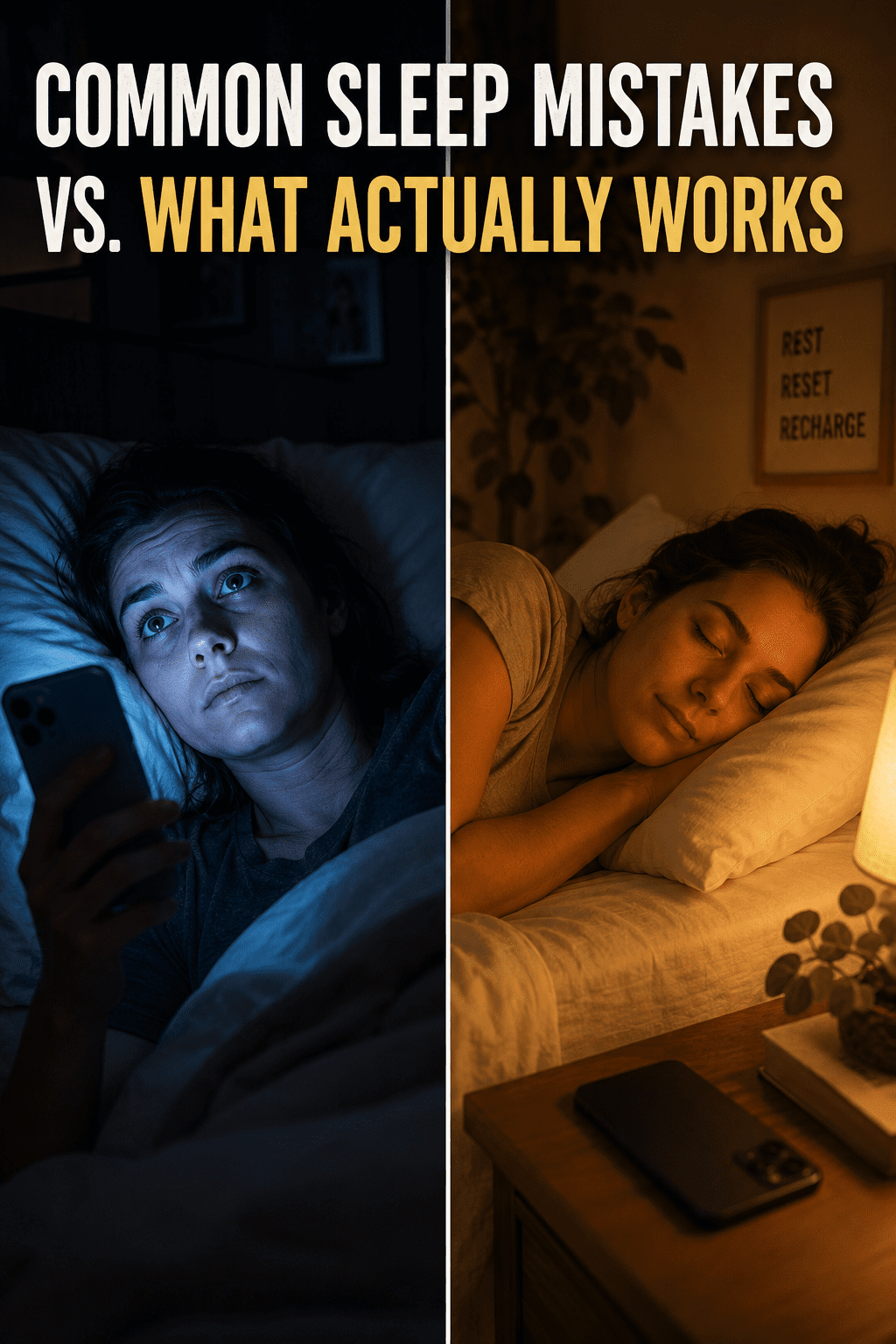
How to Build a Sleep Routine That Sticks Long-Term
Building a routine that lasts comes down to one thing: making it easy enough to do on a bad day.
If your wind-down routine requires 45 minutes of journaling, yoga, and herbal tea preparation, you’ll skip it when you’re exhausted or stressed – which is exactly when you need it most. Start with three things you can do in 15 minutes. Add to it once those three feel automatic.
Use a bedtime alarm – not just a morning alarm [6]. Set it 60-90 minutes before your target sleep time. When it goes off, that’s your cue to start winding down. It sounds simple, but having an external trigger removes the decision fatigue of remembering to start.
And remember: you don’t have to fall asleep – you just have to rest. Removing the pressure to perform sleep is often the thing that finally allows it to happen.
For more on how to fall asleep fast using methods that actually work in 2026, that page covers specific techniques with timings.
If you’re still struggling and want to understand whether your symptoms point to clinical insomnia, this free anonymous test takes only a few minutes: Evaluate Your Sleep Symptoms
FAQ
How long should a bedtime routine be?
15-60 minutes is the practical range. Shorter routines are easier to maintain. The consistency matters more than the length – doing the same three things every night for 15 minutes beats an elaborate 90-minute routine you skip half the time.
Can I build a sleep routine if I have an unpredictable schedule?
Yes, but anchor it to your wake time rather than your bedtime. A consistent wake time is the most powerful circadian signal you can give your body, even when your sleep time varies.
Does reading before bed actually help?
For most people, yes – especially physical books. Reading lowers cognitive arousal and gives your mind something low-stakes to focus on. Avoid anything that generates strong emotions or suspense right before sleep.
What if I do everything right and still can’t sleep?
That’s a sign the problem may be physiological rather than behavioral – sleep apnea, restless legs syndrome, or a mood disorder can all present as insomnia. A sleep study or conversation with your GP is the right next step.
Is it okay to use melatonin every night?
Short-term use is generally considered safe, but long-term nightly use isn’t well-studied. It’s better used as a timing tool (for shift work or jet lag) than a nightly sedative.
What’s the single most important part of a sleep routine?
A consistent wake time – every day, including weekends. Everything else builds on top of that foundation.
Why do I feel sleepy on the couch but wake up when I get to bed?
This is conditioned arousal – your brain has associated your bed with wakefulness rather than sleep. Stimulus control therapy (only going to bed when genuinely drowsy, leaving if you don’t sleep) is the most direct fix.
Can exercise help me sleep better?
Yes – regular aerobic exercise improves sleep quality significantly. The caveat is timing: vigorous exercise within 2-3 hours of bedtime can delay sleep onset for some people [1].
Conclusion
If you’ve been dealing with this for a while, you already know that “just relax” isn’t advice – it’s a dismissal. Building a sleep routine that actually works means understanding what your brain needs to feel safe enough to let go, and then providing those signals consistently, night after night, until they become automatic.
Start small. Pick a wake time and hold it. Dim your lights an hour before bed. Put your phone somewhere inconvenient. Do the same three things in the same order every night.
It won’t work immediately. That’s not failure – that’s how nervous system conditioning works. Give it three weeks before you judge it.
And if you’re not sure whether what you’re dealing with is beyond routine-building – if the sleep problems have been going on for months, if anxiety is severe, if you wake unrefreshed no matter what you try – that’s worth taking seriously. A free starting point is this insomnia self-assessment, which can help you understand what you’re actually dealing with before deciding on next steps.
You’ve tried the basics. Now you know why they sometimes don’t work – and what to do instead.
References
[1] Hq01387 – https://www.mayoclinic.org/health/sleep/HQ01387
[2] Bedtime Routines Part Of Survival Instinct – https://www.sleepfoundation.org/sleep-news/bedtime-routines-part-of-survival-instinct
[3] Sleep Hygiene – https://www.healthline.com/health/sleep-hygiene
[4] Your Sleep Checklist – https://www.webmd.com/sleep-disorders/your-sleep-checklist
[5] How To Fix Sleep Schedule – https://www.healthline.com/health/healthy-sleep/how-to-fix-sleep-schedule
[6] How To Build A Bedtime Alarm Habit For Better Sleep Consistency – https://www.healthline.com/health/sleep/how-to-build-a-bedtime-alarm-habit-for-better-sleep-consistency


![The Perfect Bedtime Routine for Adults Who Struggle to Wind Down Last updated: June 15, 2026 Quick Answer: A good bedtime routine for adults who struggle to sleep starts 30-60 minutes before bed and uses the same sequence of calming activities every night. The goal is not to force sleep - it is to signal to your nervous system that the threat is over and it is safe to rest. Consistency matters more than perfection. Key Takeaways A 30-60 minute wind-down window is the core structure recommended by sleep physicians and behavioral sleep specialists [4] Consistency in timing - same bedtime, same sequence - is more powerful than any single sleep hack Screens are not just a blue light problem; the content you consume (news, social media, work email) is equally disruptive to sleep onset People with anxiety need a slightly different approach - one that addresses racing thoughts directly, not just physical relaxation Supplements like low-dose melatonin and magnesium glycinate have some evidence behind them, but they work best alongside behavioral changes Night shift workers and people with irregular schedules can still build effective routines - they just need to anchor them to their sleep time, not the clock Most common mistake: lying in bed awake trying to fall asleep, which trains your brain to associate bed with wakefulness You don't have to fall asleep - you just have to rest. That reframe alone reduces sleep anxiety significantly What Is a Good Bedtime Routine That Actually Helps Adults Fall Asleep Faster A good bedtime routine for adults is a repeatable sequence of low-stimulation activities done in the 30-60 minutes before sleep, at roughly the same time each night. The Sleep Foundation describes it as a set of predictable actions that cue your brain sleep is coming [4]. It works because your nervous system responds to patterns - not commands. Here's what the research actually says: you cannot force sleep. What you can do is lower your physiological arousal enough that sleep becomes likely. That is the whole job of a wind-down routine. A simple structure that works for most people: 10 minutes - light tidying or preparing for tomorrow (reduces mental load) 10 minutes - bathroom hygiene, skincare, whatever signals "day is done" 10-20 minutes - gentle stretching or body scan 15-20 minutes - reading a physical book or listening to calm audio Sleep coaches and clinicians have been popularizing both 30-minute and 60-minute versions of this structure in 2025-2026, specifically because anxious sleepers do better with concrete timing rather than vague advice to "relax before bed" [1]. The honest version is: the specific activities matter less than the consistency. If you do the same things in the same order every night, your body starts anticipating sleep before you even get into bed. How Long Should a Bedtime Routine Actually Take For most adults, 30-60 minutes is the target. Sleep physicians interviewed by NPR in early 2026 specifically recommended a protected wind-down window of this length, devoted only to calming, predictable activities [4]. If you are severely overstimulated at night - high-stress job, anxiety, or a history of insomnia - 60 minutes is more realistic than 30. If your schedule is tight, even 20 minutes of consistent, low-stimulation activity beats nothing. The key word is protected. That window is not for checking one last email, scrolling for five minutes, or finishing a work task. Those things restart your stress response right when you need it to be winding down. Best Ways to Relax Before Bed Without Screens The most effective screen-free wind-down activities are reading physical books, gentle yoga or stretching, journaling, listening to calm audio (podcasts, audiobooks, ambient sound), and taking a warm bath or shower. A warm bath or shower about 90 minutes before bed has decent research behind it. The drop in body temperature that follows mimics the natural temperature drop your body uses to initiate sleep. It is one of the more underrated tools in a bedtime routine for adults. Other options worth trying: Progressive muscle relaxation - tensing and releasing muscle groups from feet to face Light journaling - not processing your whole day, just writing a short "done list" and a brief plan for tomorrow to offload mental loops Stretching - even 10 minutes of slow, floor-based stretching significantly reduces physical tension Herbal tea - chamomile, passionflower, and lemon balm have mild calming effects; the ritual itself is part of the benefit I keep a paperback on my nightstand specifically for this. Not because reading is magic, but because it gives my brain something absorbing that is not a screen and not my own anxious thoughts. That is the actual mechanism - displacement, not sedation. What Should You Avoid Doing Right Before Sleep Several common evening habits actively delay sleep onset, and most people who struggle with sleep are doing at least two or three of them without realizing it. Avoid these in the 60-90 minutes before bed: Checking work email or anything requiring a decision Watching stimulating content (thrillers, news, anything emotionally activating) Eating a large meal or anything high in sugar Alcohol - it may help you fall asleep faster but it fragments sleep in the second half of the night [6] Intense exercise (more on this below) Bright overhead lighting - switch to lamps or warm-toned bulbs after 9pm Cleveland Clinic specifically recommends keeping phones, tablets, and laptops out of the bedroom entirely and using the bed only for sleep and sex [9]. The reasoning is behavioral: if you use your bed for work, scrolling, or watching TV, your brain stops associating it with sleep. That association is harder to rebuild than most people expect. Sleepstation, a UK-based digital CBT-I provider, advises stopping all electronic devices at least two hours before bed for people who genuinely struggle to wind down [5]. That feels extreme until you try it for two weeks and notice the difference. Is It Bad to Exercise Right Before Bed For most people, vigorous exercise within 60-90 minutes of bedtime raises core body temperature and cortisol, both of which delay sleep onset. That said, light movement - walking, stretching, gentle yoga - is fine and often helpful. If your only available exercise window is evening, do not give it up entirely. The long-term sleep benefits of regular exercise outweigh the short-term disruption of late workouts for most people. Just try to finish anything intense at least 90 minutes before your target sleep time, and build a proper cool-down into your bedtime routine for adults. Worth trying if you are a late exerciser: a 10-minute cool-down walk followed by a warm shower. It accelerates the body temperature drop that signals sleep readiness. Bedtime Routine Differences for People With Anxiety If anxiety is driving your sleep problems, a standard wind-down routine is not quite enough on its own. The issue is not just stimulation - it is an overactive threat-detection system that does not switch off when the lights go out. For anxious sleepers, the routine needs to include something that directly addresses racing thoughts, not just physical relaxation. Insomnia and overthinking are closely linked, and ignoring the cognitive side of the problem is why most basic sleep hygiene advice fails this group. What works better for anxiety-driven insomnia: Scheduled worry time - 15 minutes earlier in the evening to write down worries and possible next steps, then close the notebook. The goal is to contain the worry, not eliminate it. Cognitive shuffle - a technique where you imagine random, unconnected images in sequence to interrupt the narrative thinking that keeps you awake Body scan meditation - shifting attention to physical sensations rather than thoughts (more on this below) Stimulus control - if you are lying awake for more than 20 minutes, get up and do something calm in dim light until you feel sleepy If you've been dealing with this for a while, it is worth evaluating whether what you are experiencing goes beyond normal sleep difficulty. If you recognize yourself in any of this - the racing thoughts, the dread of bedtime, the exhaustion that does not lead to sleep - consider taking this free anonymous insomnia test. It takes a few minutes and evaluates how you have been feeling over the past two weeks. It is not a diagnosis, but it can help clarify whether what you are dealing with needs more targeted support. Meditation Techniques to Calm Your Mind Before Bed Simple meditation works for sleep because it interrupts the rumination cycle - the loop of thoughts that keeps your nervous system activated. You do not need an app or experience. You need a technique you will actually use. Three that have the most practical evidence for sleep: 4-7-8 breathing - inhale for 4 counts, hold for 7, exhale for 8. The extended exhale activates the parasympathetic nervous system. Do 4 cycles. Body scan - starting at your feet, slowly move attention up through your body, noticing sensation without trying to change anything. It is boring by design. That is the point. Cognitive shuffle - developed by sleep researcher Luc Beaulieu-Prévost, this involves imagining a random word and then picturing unrelated images for each letter. It interrupts linear thinking, which is what keeps anxious minds awake. This is what worked for me: body scan, but only after I had done a short journaling session. Without offloading the day's mental residue first, I would just lie there narrating my worries instead of scanning my body. Sequence matters. What Supplements Actually Help With Sleep Quality Low-dose melatonin (0.5-3mg) and magnesium glycinate are the two supplements with the most consistent evidence for sleep, and both are relatively low-risk. Everything else requires more scrutiny. Melatonin - most useful for shifting sleep timing (jet lag, shift work, delayed sleep phase) rather than treating insomnia itself. The common mistake is taking too much - doses above 5mg are rarely more effective and can cause next-day grogginess [6]. Magnesium glycinate - some evidence for reducing sleep onset time and improving sleep quality, particularly in people who are deficient (which is more common than most people realize). The glycinate form is gentler on digestion than magnesium oxide. Ashwagandha - has some emerging evidence for reducing cortisol and improving sleep quality in stressed adults, but the research is less consistent. L-theanine - an amino acid found in green tea; may reduce anxiety and improve sleep quality at doses of 200-400mg. Generally well-tolerated. Medical disclaimer: Supplements can interact with medications and are not regulated the same way as pharmaceuticals. Talk to your doctor before starting anything new, especially if you take prescription medications. Worth trying if you want a starting point: magnesium glycinate (200-400mg) about an hour before bed. It is inexpensive, widely available, and has a reasonable evidence base. Why Do You Keep Waking Up in the Middle of the Night Waking up in the middle of the night is different from struggling to fall asleep, and the causes are often different too. Common drivers include: alcohol consumption in the evening, sleep apnea, blood sugar fluctuations, room temperature being too warm, and - especially in people with anxiety - conditioned arousal where the brain has learned to partially wake at certain times. If this is a persistent problem for you, these tips for sleeping through the night go deeper into the specific causes and fixes. The short version: alcohol is the most underestimated culprit, and keeping your bedroom cooler (around 65-68°F / 18-20°C) helps more than most people expect. The other thing worth knowing: waking briefly during the night is biologically normal. You have multiple sleep cycles per night, and light waking between them is common. The problem is when you cannot get back to sleep - which is usually a sign that your arousal threshold is too high, not that something is medically wrong. How to Build a Bedtime Routine If You Have an Irregular Work Schedule Night shift workers and people with variable schedules can still build an effective bedtime routine - they just need to anchor it to their sleep time, not the clock on the wall. The principle is the same: a consistent pre-sleep sequence that signals your brain sleep is coming. The difference is that "bedtime" might be 7am on some days and 11pm on others. That is genuinely harder, and it is not just you - shift work is one of the most disruptive things you can do to your circadian rhythm. Practical adjustments: Use blackout curtains and a sleep mask if sleeping during daylight hours Keep your pre-sleep routine identical regardless of what time it is Avoid bright light exposure in the 90 minutes before your target sleep time If possible, try to keep your sleep window consistent even on days off - large swings in sleep timing (social jet lag) undo a lot of the progress from a good routine [4] For people with truly erratic schedules, understanding why you can't sleep even when you're tired can help identify whether the issue is circadian disruption, sleep pressure, or something else. Common Mistakes That Ruin Your Sleep Routine Most people who struggle with sleep are not failing because they lack willpower. They are failing because they are making a few specific structural errors that undermine everything else. The biggest mistakes: Trying too hard to fall asleep - the effort itself raises arousal. Sleep is not something you do; it is something that happens when you stop interfering. Inconsistent wake times - sleeping in on weekends feels restorative but it shifts your circadian rhythm and makes Monday night harder [4] Using the bed for wakefulness - working, scrolling, or watching TV in bed trains your brain to be alert there [9] Giving up on a routine after one bad night - it takes 2-3 weeks of consistency before a new routine starts to produce reliable results Over-relying on supplements or alcohol - both can mask the underlying issue while making it worse over time If you have been doing everything "right" and still not sleeping, the problem might not be your routine - it might be an underlying issue driving the insomnia. Understanding why you have insomnia is sometimes the missing step. Cheap vs Expensive Sleep Aids: What Actually Works The honest version is that most expensive sleep aids do not outperform cheap ones. The most evidence-backed interventions for sleep are also free or nearly free: consistent sleep timing, a dark cool room, and a simple wind-down routine. Tool Cost Evidence Level Notes Consistent sleep/wake times Free Strong Most impactful single change Blackout curtains $20-60 Good Especially useful for shift workers White noise machine $30-80 Moderate Helpful if noise is a trigger Magnesium glycinate $15-25/month Moderate Worth trying for 4 weeks Melatonin (low dose) $10-15/month Moderate for timing Less useful for maintenance insomnia Sleep tracking devices $200-400 Variable Can increase sleep anxiety in some people CBT-I (online programs) $50-200 Very strong Best evidence-based treatment for insomnia CBT-I (Cognitive Behavioral Therapy for Insomnia) consistently outperforms sleep medication in long-term studies and is now recommended as the first-line treatment by most sleep medicine organizations. If you have not tried it, it is worth serious consideration - especially if you have been dealing with insomnia for more than a few months. Building Your Bedtime Routine for Adults: A Practical Starting Point You do not need a perfect routine. You need a consistent one. Start with 30 minutes, pick three or four activities that feel manageable, and do them in the same order at the same time for two weeks before judging whether it works. A simple starting template: 30-minute version: 10 min: dim lights, make herbal tea, light tidy 10 min: bathroom routine + change into sleep clothes 10 min: read a physical book in bed (or body scan) 60-minute version: 15 min: journal + write tomorrow's short task list 10 min: gentle stretching 10 min: bathroom routine 25 min: read or listen to calm audio in low light For more specific techniques on falling asleep faster once you are in bed, these methods for falling asleep fast cover what actually works beyond the routine itself. It's not just you if this feels harder than it should. Building a sleep routine as an adult - especially when you have been sleeping badly for months or years - is not a simple habit change. It is retraining a nervous system that has learned to be vigilant at night. That takes time and patience, not just a better checklist. If you are still unsure whether what you are experiencing is standard sleep difficulty or something that needs more support, take this free anonymous insomnia test. It evaluates how you have been feeling over the past two weeks and can help you understand what you are dealing with. FAQ How long does it take for a new bedtime routine to work?Most people see some improvement within 1-2 weeks of consistent practice, but meaningful change in sleep quality typically takes 3-4 weeks. Consistency matters more than perfection - one off night does not reset your progress. Can I use my phone if I use night mode or blue light glasses?Blue light filtering helps, but the bigger issue is the content - news, social media, and work email activate your stress response regardless of the screen's color temperature. Night mode is not a substitute for putting the phone down. What if I do my routine but still cannot fall asleep?If you have been lying awake for more than 20 minutes, get up. Go to a dim room and do something calm until you feel genuinely sleepy, then return to bed. Lying awake in bed trains your brain to associate bed with wakefulness, which makes the problem worse over time. Is it okay to nap if I had a bad night?A short nap (20 minutes) before 3pm is generally fine and will not significantly disrupt nighttime sleep. Longer naps or naps taken late in the afternoon reduce sleep pressure and can make it harder to fall asleep at night. Does alcohol help with sleep?Alcohol may reduce the time it takes to fall asleep, but it fragments sleep in the second half of the night by suppressing REM sleep and increasing awakenings. Regular evening drinking is one of the most common unrecognized causes of poor sleep quality. What is the best temperature for sleep?Most sleep research points to 65-68°F (18-20°C) as the range that supports sleep onset and maintenance for most adults. Your body needs to drop its core temperature slightly to initiate sleep, and a cool room supports that process. Do I need a different routine on weekends?Ideally, no. Sleeping in significantly on weekends - even by 90 minutes - shifts your circadian rhythm and creates what sleep researchers call social jet lag. A consistent wake time, even on days off, is one of the most impactful things you can do for sleep quality. What if my partner has a different sleep schedule?This is genuinely difficult. Practical options include separate alarm setups, using a sleep mask and earplugs, and negotiating a "quiet hour" before your target sleep time. It is worth the conversation - sleep deprivation affects mood, health, and the relationship itself. Conclusion A bedtime routine for adults is not a wellness trend. It is a practical tool for retraining a nervous system that has learned to stay alert when it should be winding down. Start small. Pick a consistent time. Do the same three or four things in the same order every night. Give it three weeks before you decide it is not working. And remember: you don't have to fall asleep - you just have to rest. That shift in expectation removes the performance pressure that keeps so many people awake. If you want to go deeper on the behavioral side of sleep, this sleep hygiene guide for adults covers the small nightly habits that support everything a routine is trying to do. And if you suspect your sleep problems go beyond what a routine can fix, understanding what is actually causing your insomnia is the right next step. If you are not sure where you fall on the spectrum of sleep difficulty, this free anonymous insomnia test takes a few minutes and evaluates your experience over the past two weeks. It is a useful starting point for understanding what you are actually dealing with. Sleep is not a personality trait. It is a skill - and most skills can be rebuilt with the right approach. References [1] Bedtime Routine For Adults - https://maevemag.com/sleep/bedtime-routine-for-adults/[2] Bedtime Routines For Adults Rcna117635 - https://www.today.com/health/sleep/bedtime-routines-for-adults-rcna117635[4] Bedtime Routine For Adults - https://www.sleepfoundation.org/sleep-hygiene/bedtime-routine-for-adults[5] Wind Down Routine - https://www.sleepstation.org.uk/articles/sleep-tips/wind-down-routine/[6] Nighttime Routine - https://www.healthline.com/health/nighttime-routine[9] Sleep Hygiene - https://health.clevelandclinic.org/sleep-hygiene Meta Title: Bedtime Routine for Adults Who Struggle to Wind DownMeta Description: A research-backed bedtime routine for adults who can't wind down at night. Covers timing, anxiety, supplements, shift work, and what actually works. Tags: bedtime routine adults, insomnia, sleep hygiene, wind down routine, sleep anxiety, sleep supplements, night shift sleep, meditation for sleep, falling asleep faster, sleep problems, CBT-I, adult sleep tips](https://napsology.com/wp-content/uploads/2026/06/slot-0-1781547799259-75x75.png)