Post Disclaimer
This post contains affiliate links. If you buy something through these links, I may earn a small commission at no extra cost to you. Full disclosure.
This article is for informational purposes only and does not constitute medical advice. Always consult a healthcare professional for personal health concerns. Full disclaimer.
Last updated: June 10, 2026
Quick Answer: The fastest ways to fall asleep faster involve calming your nervous system — not forcing sleep. Techniques like controlled breathing, dropping your room temperature, and stopping clock-watching can cut sleep onset time significantly. Most of these take under five minutes to start and cost nothing.
Key Takeaways
- Normal sleep onset is 10–20 minutes. Consistently taking longer is worth paying attention to.
- Your room temperature has a measurable impact — 60–67°F (15.6–19.4°C) is the research-backed sweet spot [3].
- Breathing techniques like 4-7-8 can activate your parasympathetic nervous system in minutes [3].
- The 3-2-1 rule (stop eating 3 hours before bed, stop working 2 hours before, stop screens 1 hour before) is one of the most practical pre-sleep frameworks [2].
- Racing thoughts at night respond better to scheduled “worry time” earlier in the evening than to willpower alone.
- Checking the clock during the night actively makes sleep harder — turn it away [1].
- Caffeine has a half-life of around 5–6 hours, meaning a 3pm coffee is still partly active at 9pm.
- Apps and white noise tools can help, but they work best as part of a broader wind-down routine.
- If you’ve been struggling for more than a few weeks, the problem may be deeper than sleep hygiene.
- You don’t have to fall asleep — you just have to rest. That shift in pressure can itself reduce sleep onset time.
What Actually Causes Trouble Falling Asleep in the First Place
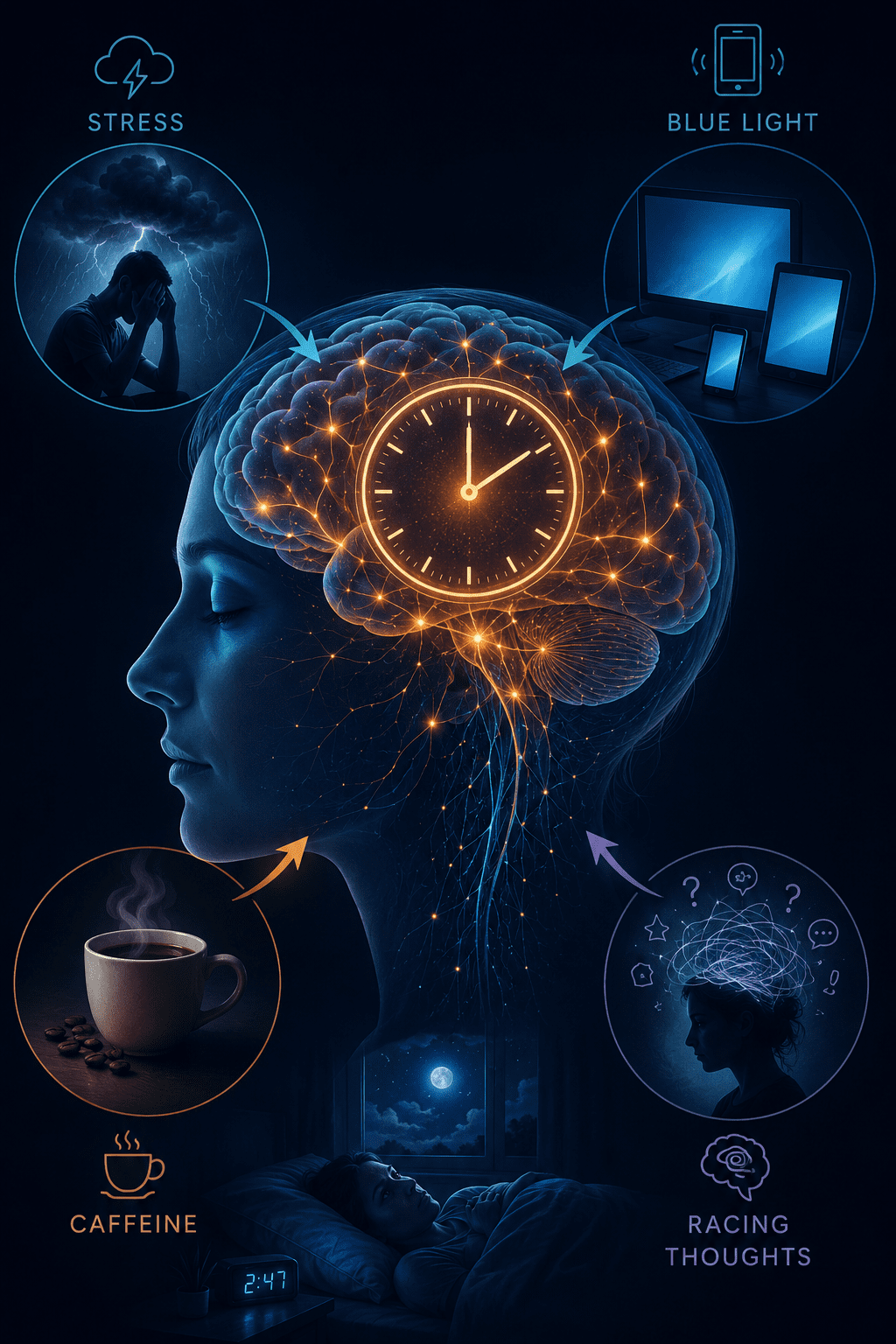
Trouble falling asleep is almost always a nervous system problem, not a willpower problem. Your brain is stuck in alert mode — scanning for threats, replaying the day, running calculations about tomorrow — when it should be winding down. Understanding why that happens is the first step toward finding ways to fall asleep faster that actually stick.
The most common culprits include why you can’t sleep even when you’re tired:
- Hyperarousal — a chronically elevated stress response that keeps cortisol elevated at night
- Irregular sleep timing — shifting your bedtime even by an hour or two disrupts your circadian rhythm
- Light exposure — blue light from screens suppresses melatonin production in the evening
- Caffeine timing — most people underestimate how long caffeine stays active in their system
- Conditioned wakefulness — if you’ve spent enough nights lying awake in bed, your brain starts associating bed with alertness rather than sleep
If you want a deeper breakdown of what’s driving your specific pattern, this guide to surprising reasons you can’t sleep covers a lot of ground.
How Long Should It Actually Take to Fall Asleep?
The clinical term is “sleep onset latency,” and the normal range is roughly 10–20 minutes. Less than 5 minutes can actually indicate sleep deprivation — your body is so exhausted it crashes fast. Consistently taking 45 minutes or more is worth taking seriously.
It’s not just you. A lot of people who struggle with sleep have been told they’re “overthinkers” or “light sleepers” as if it’s a personality trait. Sometimes it is situational. Sometimes it’s a sign of something like insomnia that responds well to specific interventions.
Why Do Some People Fall Asleep Instantly While Others Struggle?
People who fall asleep fast typically have lower baseline arousal levels at night — their nervous system transitions smoothly from alert to rest. For people with insomnia or anxiety, that transition is interrupted. The brain keeps firing.
Genetics plays a role. So does sleep history, stress load, and whether you’ve accidentally trained your brain to associate bedtime with lying awake. The honest version is: it’s not a character flaw, and it’s not permanent. But it does require deliberate intervention — not just “trying harder to relax.”
The 15 Ways to Fall Asleep Faster (Starting Tonight)
These aren’t ranked by importance — they’re grouped by how quickly you can implement them. Start with one or two that feel doable tonight.
1. Try the 4-7-8 Breathing Technique
Inhale for 4 seconds, hold for 7, exhale slowly for 8. Repeat four cycles. This activates your parasympathetic nervous system — the “rest and digest” branch — which directly counters the alert state keeping you awake [3]. I’ve used this on nights when my mind is running hard, and it doesn’t knock me out, but it does take the edge off.
2. Use Progressive Muscle Relaxation
Starting from your feet, tense each muscle group for 5 seconds, then release. Work your way up to your face. The Sleep Foundation notes this technique reduces physical tension that builds up during the day and often goes unnoticed until you’re lying in the dark [4].
3. Try the Military Sleep Method
Developed for U.S. Navy pilots, this involves systematically relaxing your face, shoulders, arms, chest, and legs, then clearing your mind for 10 seconds by imagining a still scene [5]. It takes practice — don’t expect it to work on night one. For the full breakdown, see how to fall asleep in 2 minutes using the military method.
4. Apply the 3-2-1 Rule
Stop heavy meals 3 hours before bed, stop work 2 hours before, stop screens 1 hour before. This isn’t about being rigid — it’s about giving your body time to shift gears. The 3-2-1 rule works because it addresses three separate systems: digestion, mental activation, and melatonin suppression [2].
5. Drop Your Room Temperature
Keep your bedroom between 60–67°F (15.6–19.4°C). Your core body temperature needs to drop slightly to initiate sleep, and a cool room accelerates that process [3]. If you can’t control your thermostat, a cool shower before bed achieves a similar effect.
6. Stop Checking the Clock
Turn your clock away. Put your phone face-down. Every time you check the time at night, you’re calculating how much sleep you’ll get — and that calculation creates anxiety that delays sleep further [1]. This is one of the simplest changes with a disproportionately large effect.
7. Use Guided Imagery
Pick a calm, familiar place — a beach, a forest, a childhood bedroom — and mentally walk through it in detail. What do you see? What do you hear? This isn’t woo. It’s a distraction technique that occupies the narrative part of your brain so it stops replaying your to-do list [4].
8. Try Lavender Aromatherapy
A pillow spray or a few drops of lavender oil on a tissue near your pillow can create a sensory cue for sleep. The research on lavender is modest but consistent enough to be worth trying — especially if you’re building a wind-down routine [1].
9. Schedule Your Worry Time
If racing thoughts are your main problem, try this: set aside 15 minutes earlier in the evening to write down everything you’re anxious about. When those thoughts show up at bedtime, you can tell yourself “I already dealt with that.” It sounds too simple. It works more often than it should.
10. Drink Something Warm and Caffeine-Free
Chamomile tea, warm milk, or even just warm water signals to your brain that the day is winding down [1]. The warmth itself has a mild relaxing effect. More importantly, it’s a ritual — and rituals tell your nervous system what’s coming next.
11. Dim Your Lights an Hour Before Bed
Bright overhead lights in the evening suppress melatonin. Switching to lamps or warm-toned bulbs after 8pm is a small change that compounds over time [1]. If you use your phone in the evening, enable night mode — it’s not perfect, but it helps.
12. Keep a Consistent Wake Time (Even on Weekends)
This is the one piece of sleep hygiene advice that actually has strong evidence behind it. Your wake time anchors your entire circadian rhythm. Sleeping in on weekends shifts your internal clock — the same mechanism as mild jet lag.
13. Get Out of Bed If You Can’t Sleep
If you’ve been lying awake for more than 20 minutes, get up. Go to another room, do something quiet and low-stimulation, and return when you feel sleepy. This is stimulus control — it stops your brain from cementing the association between bed and wakefulness.
14. Use White Noise or a Sleep App
Apps like Calm, Sleep Cycle, or even a basic white noise machine can mask disruptive sounds and create a consistent audio environment. Worth trying if you live somewhere noisy or if silence itself feels activating.
15. Try Meditation Before Bed
Even five minutes of simple breath-focused meditation before sleep can reduce pre-sleep arousal [4]. You don’t need an app or a specific technique — just sit quietly, notice your breath, and let thoughts pass without following them.
💤 If you’ve been dealing with this for a while and nothing seems to stick, it may be worth evaluating whether what you’re experiencing goes beyond general sleep difficulty. This free, anonymous insomnia test takes only a few minutes and can help you understand whether your symptoms align with clinical insomnia. Evaluate the statements based on how you’ve felt over the past two weeks — no sign-up required.
Best Natural Remedies to Help You Sleep Faster Without Medication
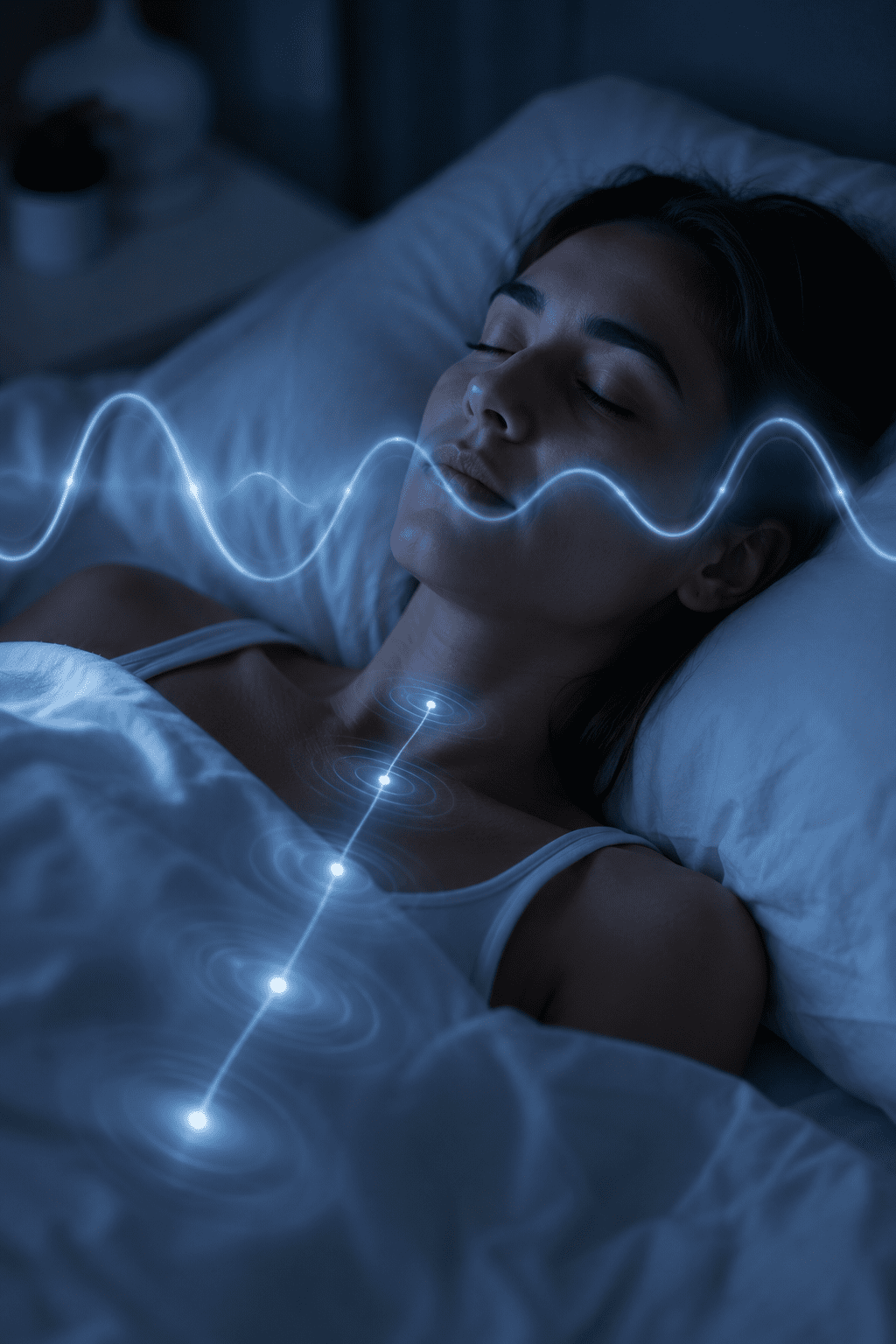
The most evidence-backed natural approaches are behavioral, not supplemental. Breathing techniques, progressive muscle relaxation, consistent sleep timing, and temperature regulation all have solid research behind them [3][4]. Melatonin can help with circadian shifts (like jet lag or shift work) but has limited evidence for chronic insomnia.
Magnesium glycinate is worth mentioning — some people find it helpful for sleep quality, and it’s generally well-tolerated. But it’s not a substitute for addressing the behavioral patterns that are keeping you awake.
Which Sleep Techniques Work Fastest for People With Anxiety
For anxiety-driven sleeplessness, the fastest-acting techniques are those that interrupt the thought loop — not ones that ask you to “calm down.” Breathing techniques work because they give your nervous system something concrete to do. Guided imagery works because it occupies the same mental space that anxious thoughts use.
Scheduled worry time is underused and genuinely effective. The goal isn’t to solve your problems at 10pm — it’s to give your brain permission to stop processing them until tomorrow.
If anxiety is your primary driver, understanding why you have insomnia and what triggers it is a useful starting point.
How Room Temperature Really Impacts Falling Asleep
Room temperature directly affects your core body temperature, which needs to fall by about 1–2°F to initiate sleep. A room that’s too warm prevents that drop and keeps you in a lighter, more fragmented sleep state [3].
The 60–67°F range is the research-backed target. In practice this means: if you’re waking up sweaty or kicking off covers, your room is probably too warm. If you’re cold enough to tense up, it’s too cold. A cool room with a warm blanket is the combination most people sleep best in.
What Foods and Drinks to Avoid Before Bedtime
Caffeine is the obvious one, but the timing matters more than most people realize. With a half-life of 5–6 hours, a coffee at 3pm still has roughly half its caffeine active at 9pm. Alcohol is the other major one — it helps you fall asleep faster initially, but it fragments sleep in the second half of the night, leaving you feeling unrefreshed.
Heavy meals within 2–3 hours of bed force your digestive system to stay active, which competes with sleep onset. Spicy food in particular can raise core body temperature — the opposite of what you need [2].
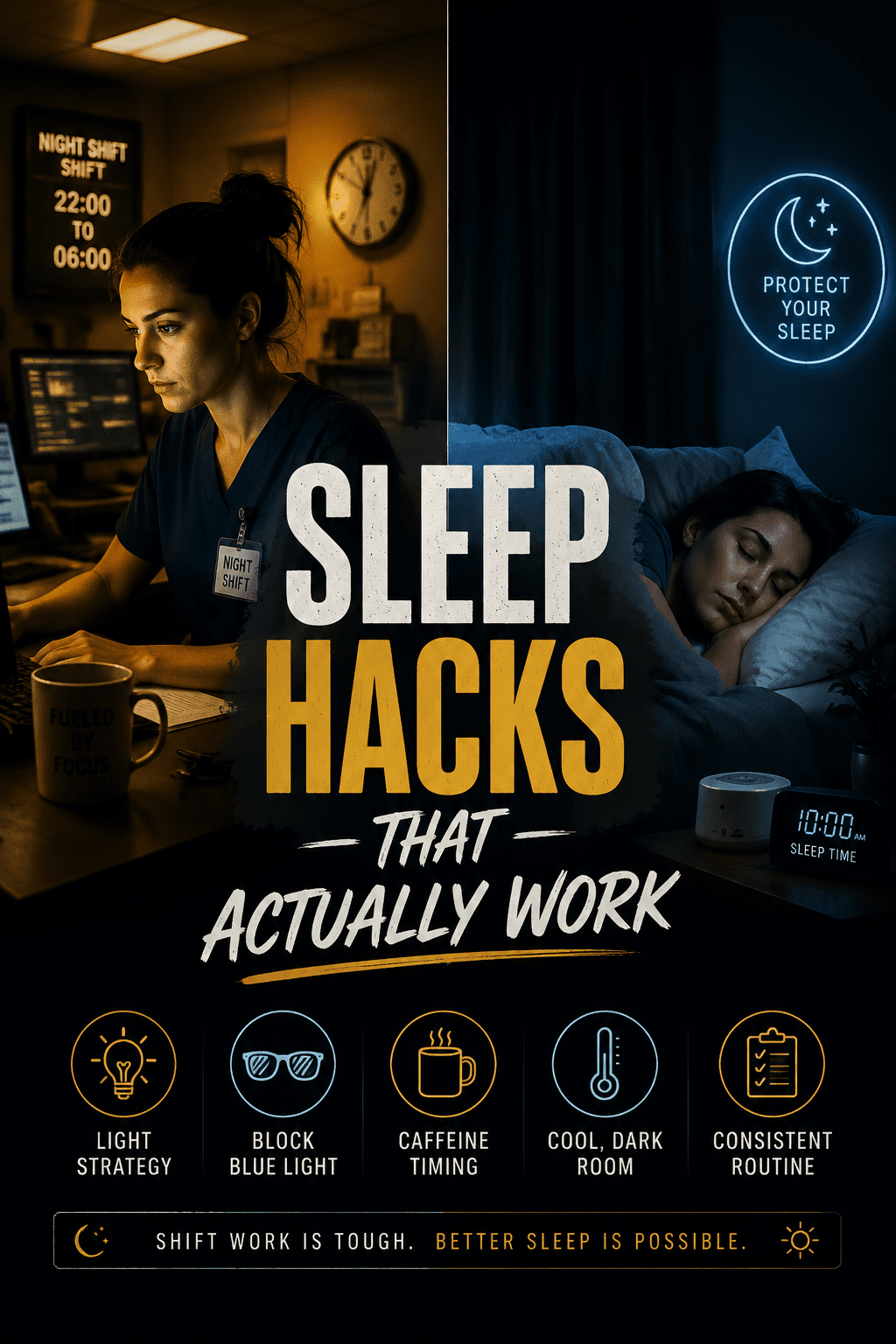
Sleep Hacks That Actually Work for Night Shift Workers
Shift workers face a fundamentally different problem — they’re trying to sleep when their circadian rhythm is signaling wakefulness. The most effective approaches involve controlling light exposure aggressively: blackout curtains, a sleep mask, and avoiding bright light on the commute home.
Keeping a consistent sleep schedule even on days off helps. So does eating at consistent times relative to your sleep window — meal timing is a secondary circadian cue. If you’re rotating shifts, the adjustment period is real and unavoidable, but keeping your sleep environment as dark and cool as possible shortens it.
Common Mistakes That Make Falling Asleep Harder
Most people who struggle with sleep make at least one of these:
- Trying too hard to sleep — effort creates arousal, which delays sleep
- Napping late in the day — reduces sleep pressure at night
- Using bed for non-sleep activities — watching TV, scrolling, working in bed
- Inconsistent wake times — even one late morning can shift your rhythm
- Checking the clock repeatedly — each check increases anxiety [1]
- Going to bed too early — if you’re not sleepy, you’ll just lie awake
The most counterintuitive one is the first. You don’t have to fall asleep — you just have to rest. Removing the pressure to sleep is often what finally allows it to happen.
How Do You Know If Your Sleep Problems Are Serious?
Sleep problems become clinically significant when they occur three or more nights per week, last more than three months, and cause daytime impairment — difficulty concentrating, mood changes, fatigue that doesn’t lift. That pattern fits the diagnostic criteria for insomnia disorder.
If you’ve been dealing with this for a while and the standard sleep hygiene advice hasn’t moved the needle, it’s worth getting a proper assessment. Cognitive Behavioral Therapy for Insomnia (CBT-I) is the first-line treatment recommended by sleep medicine bodies — it outperforms medication in long-term outcomes.
You can start by taking this free insomnia assessment — it’s anonymous, takes a few minutes, and asks you to evaluate how you’ve felt over the past two weeks. It won’t diagnose you, but it can help you understand whether what you’re experiencing warrants more than a few sleep tips.
For more context on what’s driving your specific pattern, this overview of common causes of poor sleep is worth reading.
Best Techniques for People Who Can’t Stop Thinking at Night
Racing thoughts at night are one of the most common — and most frustrating — sleep complaints. The mistake most people make is trying to suppress the thoughts, which tends to amplify them.
More effective approaches:
- Cognitive shuffling — intentionally think of random, unconnected images (a spoon, a mountain, a red door) to disrupt narrative thinking
- The “worry dump” — write everything down before bed so your brain stops holding it in working memory
- Scheduled worry time earlier in the evening
- Guided imagery to redirect mental activity toward something neutral
Here’s what the research actually says: the goal isn’t an empty mind. It’s a mind that’s occupied with something boring enough to let sleep in.
What Technology and Apps Can Help You Fall Asleep Faster
Apps and devices can be useful tools — but they work best as part of a routine, not as standalone fixes. The most consistently helpful categories are:
- White noise apps (myNoise, White Noise Lite) — useful for masking environmental sounds
- Guided meditation apps (Calm, Headspace) — good for structured wind-down routines
- Sleep tracking (Sleep Cycle, Oura Ring) — helpful for identifying patterns, but avoid obsessing over the data
- Blue light blocking glasses — modest evidence, but low cost and no downside
Worth trying if you’re a data-oriented person who wants to understand your sleep patterns. Not worth trying if tracking your sleep score is going to create more anxiety.
Conclusion
Most of the ways to fall asleep faster that actually work aren’t dramatic. They’re small adjustments — a cooler room, a consistent wake time, a breathing pattern, a cup of chamomile tea — that compound over days and weeks into a nervous system that knows how to wind down.
Start with one thing tonight. Not fifteen. Pick the one that feels most relevant to your specific problem — racing thoughts, physical tension, a room that’s too warm — and do just that.
If you’ve been struggling for months and nothing has worked, that’s a different situation. It’s not just you, and it’s not a character flaw. CBT-I, a sleep specialist, or even a structured online program can make a real difference when self-help has hit its ceiling.
And if you’re not sure where you fall on the spectrum, the free insomnia test here is a reasonable place to start. It’s anonymous, takes a few minutes, and asks you to reflect on the past two weeks — no commitment required.
For more on what might be driving your sleep problems, see why you’re unable to sleep and what your body is telling you.
FAQ
How long does it normally take to fall asleep?
The normal range is 10–20 minutes. Consistently taking longer than 30–45 minutes is worth addressing.
Does the 4-7-8 breathing technique actually work?
It works for many people by activating the parasympathetic nervous system. It’s not a cure for chronic insomnia, but it can reduce pre-sleep arousal enough to help on difficult nights [3].
Is it bad to take melatonin every night?
Melatonin is generally considered safe for short-term use. It’s most effective for circadian disruptions (shift work, jet lag) rather than chronic insomnia. Long-term nightly use isn’t well-studied.
Why do I fall asleep on the couch but not in bed?
This is conditioned wakefulness — your brain has learned to associate your bed with lying awake. Stimulus control (only using bed for sleep) is the main fix.
Does alcohol help you sleep?
Alcohol can speed up sleep onset but disrupts sleep architecture in the second half of the night, reducing REM sleep and leaving you feeling unrefreshed.
What’s the best sleep position for falling asleep faster?
There’s no strong evidence that one position is universally better. Side sleeping is associated with better airway openness, which matters if snoring or apnea is a factor.
Can exercise help me fall asleep faster?
Yes — regular physical activity improves sleep quality. Timing matters less than often claimed, though very intense exercise within an hour of bed may delay sleep for some people.
What’s the difference between insomnia and just a bad sleep patch?
Duration and frequency. A bad patch is a few nights tied to a specific stressor. Insomnia is three or more nights per week for three or more months, with daytime impairment.
Should I get out of bed if I can’t sleep?
Yes, after about 20 minutes of lying awake. This is stimulus control — it prevents your brain from cementing the association between bed and wakefulness.
Do sleep tracking apps improve sleep?
They can help identify patterns, but obsessing over sleep scores can increase anxiety and worsen sleep. Use them as a tool, not a report card.
References
[1] 4 Things An Insomnia Expert Does Before Bed To Fall Asleep Fast And Sleep Through The Night – https://www.tomsguide.com/wellness/sleep/4-things-an-insomnia-expert-does-before-bed-to-fall-asleep-fast-and-sleep-through-the-night
[2] Forget The Military Method The 3 2 1 Rule Helps Me Fall Asleep In Minutes And Its Easier To Use – https://www.tomsguide.com/wellness/sleep/forget-the-military-method-the-3-2-1-rule-helps-me-fall-asleep-in-minutes-and-its-easier-to-use
[3] Ways To Fall Asleep – https://www.healthline.com/nutrition/ways-to-fall-asleep
[4] How To Fall Asleep Fast – https://www.sleepfoundation.org/sleep-hygiene/how-to-fall-asleep-fast
[5] Fall Asleep Fast – https://www.healthline.com/health/healthy-sleep/fall-asleep-fast