Post Disclaimer
This post contains affiliate links. If you buy something through these links, I may earn a small commission at no extra cost to you. Full disclosure.
This article is for informational purposes only and does not constitute medical advice. Always consult a healthcare professional for personal health concerns. Full disclaimer.
Last updated: June 17, 2026
Quick Answer: The hour before bed is when your nervous system decides whether tonight is safe enough to sleep. The things you do before bed in that window – what you eat, look at, think about, and do with your body – directly shape how quickly you fall asleep and how well you stay asleep. These 10 habits are backed by research and chosen specifically for people who have already tried the basics.
Key Takeaways
- Blue light from screens suppresses melatonin production – put devices away at least 60 minutes before sleep [4]
- Caffeine has a half-life of around 5-6 hours, meaning an afternoon coffee is still active at midnight [5]
- A warm shower or bath 1-2 hours before bed can lower your core body temperature and speed up sleep onset [6]
- Gentle stretching and breathing exercises reduce cortisol and signal the nervous system to downshift
- Reading physical books (not e-readers) is one of the most consistently effective pre-sleep activities
- Heavy meals within 2-3 hours of bedtime increase the risk of disrupted sleep and acid reflux [5]
- Familiar, low-stakes TV re-runs may be less harmful than new, stimulating content – but screens still carry risk [2]
- Meditation and body scan techniques have measurable effects on sleep onset time, especially for anxiety-driven insomnia
- Brushing your teeth right before sleep may actually raise alertness – doing it earlier in the evening helps [1]
- A consistent pre-sleep routine trains your brain to recognize when sleep is coming [4]
What Are the Best Things to Do Before Bed to Fall Asleep Faster
The most effective pre-sleep activities share one thing in common: they lower physiological arousal. That means reducing heart rate, cooling the body slightly, and signaling to your nervous system that the threat level is zero.
Here’s what the research actually says: there is no single magic habit. What works is a sequence of low-stimulation activities done consistently at the same time each night [4]. Your brain learns the pattern. Over time, the routine itself becomes a sleep trigger.
The 10 things that follow are not ranked by importance – they work best when layered together in the final hour before bed.
How Does Screen Time Affect Sleep Quality Before Bed
Screens are the single most common thing disrupting the pre-sleep hour for most adults. The issue is not just the blue light – though that is real. It is also the content itself: notifications, news, social media, and anything emotionally activating keeps your brain in a vigilant state when it needs to be winding down [4].
Here’s why sleep experts recommend no electronics an hour before sleeping: blue light suppresses melatonin, the hormone your body uses to initiate sleep. Less melatonin means a delayed sleep onset, lighter sleep architecture, and more nighttime waking. The Sleep Foundation notes that the bedroom should be reserved for sleep and sex – not scrolling [4].
If you’ve been dealing with this for a while and still can’t give up the phone entirely, try this: switch to a physical alarm clock so your phone can charge in another room. That one change removes the temptation entirely.
Worth trying if you genuinely cannot stop screen use: switch to a warm-toned light filter, turn brightness to minimum, and avoid anything emotionally activating. It is not as good as no screens, but it is better than nothing.
If you’re not sure whether your sleep struggles go beyond habits, take this free, anonymous insomnia test. It evaluates how you’ve felt over the past two weeks and can help clarify what you’re actually dealing with.
Is Reading a Good Pre-Sleep Activity
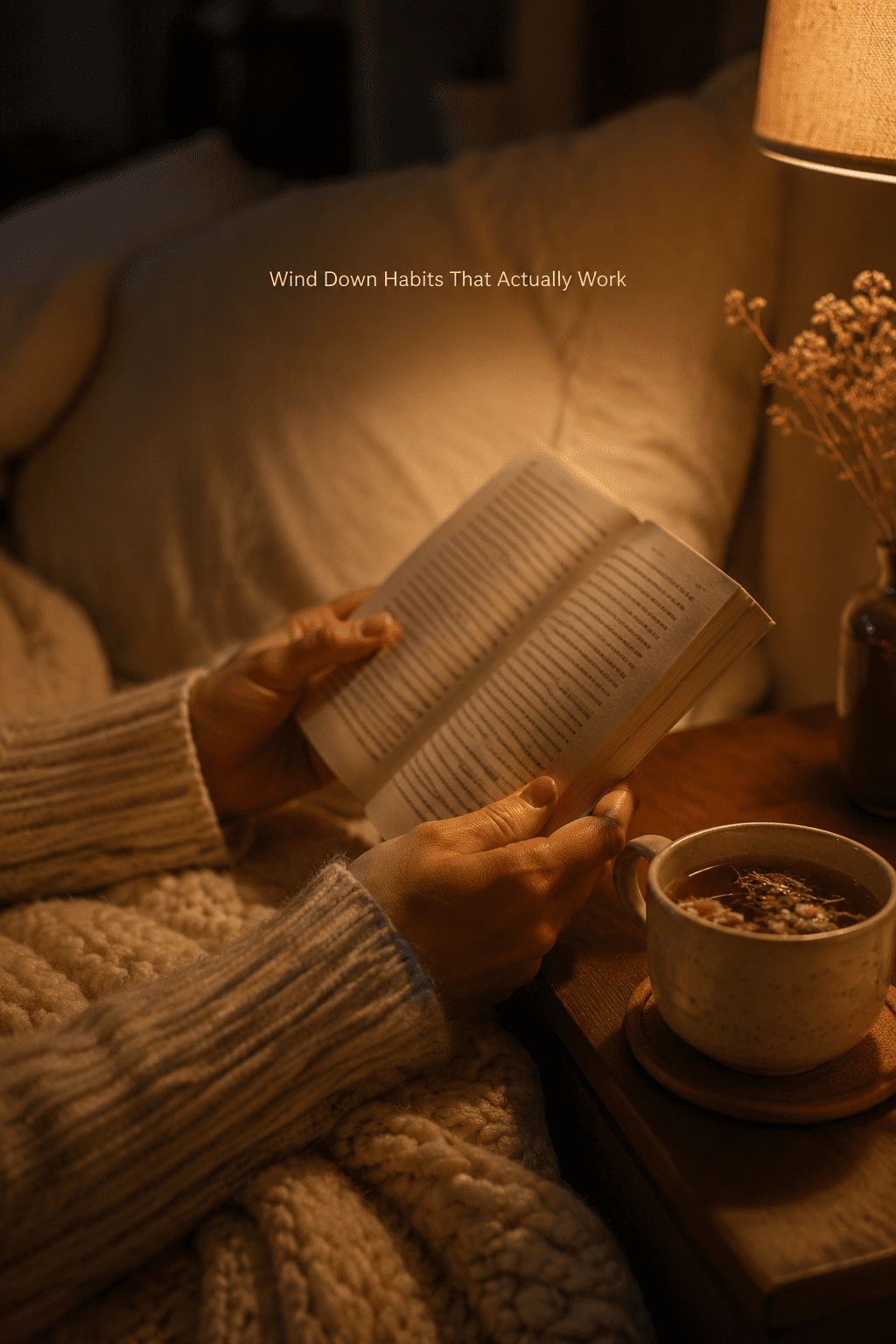
Yes – reading a physical book is one of the most consistently supported pre-sleep habits. A 2009 study from the University of Sussex found that just six minutes of reading reduced stress levels by 68%. Physical books don’t emit blue light, don’t send notifications, and don’t algorithmically serve you something more stimulating than what you chose.
The honest version is: not all reading is equal. A thriller that keeps you turning pages until 2am is not a wind-down tool. Choose something you enjoy but that doesn’t spike your heart rate – narrative non-fiction, essays, slower fiction. The goal is engagement without arousal.
For people with a racing mind at bedtime, reading is also useful because it gives your brain something specific to focus on – which interrupts the loop of anxious thought. See also: Insomnia Overthinking: How to Quiet Your Mind at Night.
What Stretches and Relaxation Techniques Help You Wind Down
Gentle movement before bed – not vigorous exercise – is one of the most underused things to do before bed. The goal is to release physical tension that accumulates in your neck, shoulders, and hips throughout the day.
A simple 10-minute pre-sleep stretch sequence:
- Child’s pose: 60 seconds, slow nasal breathing
- Supine spinal twist: 45 seconds each side
- Legs-up-the-wall pose: 3-5 minutes (genuinely calming for the nervous system)
- Neck rolls: slow, controlled, 30 seconds each direction
Pair this with 4-7-8 breathing (inhale 4 counts, hold 7, exhale 8) and you’ve given your nervous system a clear signal that it’s time to downshift. This is not yoga-influencer content – it’s basic parasympathetic activation. The reason this matters is that most insomnia is a state of hyperarousal, and you can’t force sleep into a body that still thinks it’s on alert.
Avoid vigorous exercise within 2-3 hours of bed – it raises core body temperature and increases cortisol, both of which delay sleep onset [6].
Can Meditation Really Improve Sleep Quality
For people with anxiety-driven insomnia, meditation is one of the more evidence-supported interventions available without a prescription. Research published in JAMA Internal Medicine found that mindfulness meditation improved sleep quality in older adults with moderate sleep disturbances. In practice this means: body scan meditations, guided breathing, and progressive muscle relaxation all have measurable effects on sleep onset time.
I’ll be honest – I resisted this one for years. It felt like being told to “just relax,” which is the most useless advice you can give someone who can’t sleep. What changed for me was treating it as a physical practice rather than a mental one. You’re not trying to clear your mind. You’re just noticing your body, one part at a time, until your nervous system stops bracing.
Apps like Insight Timer have free guided body scans. Start with 10 minutes. If your mind wanders, that’s normal – you’re not doing it wrong.
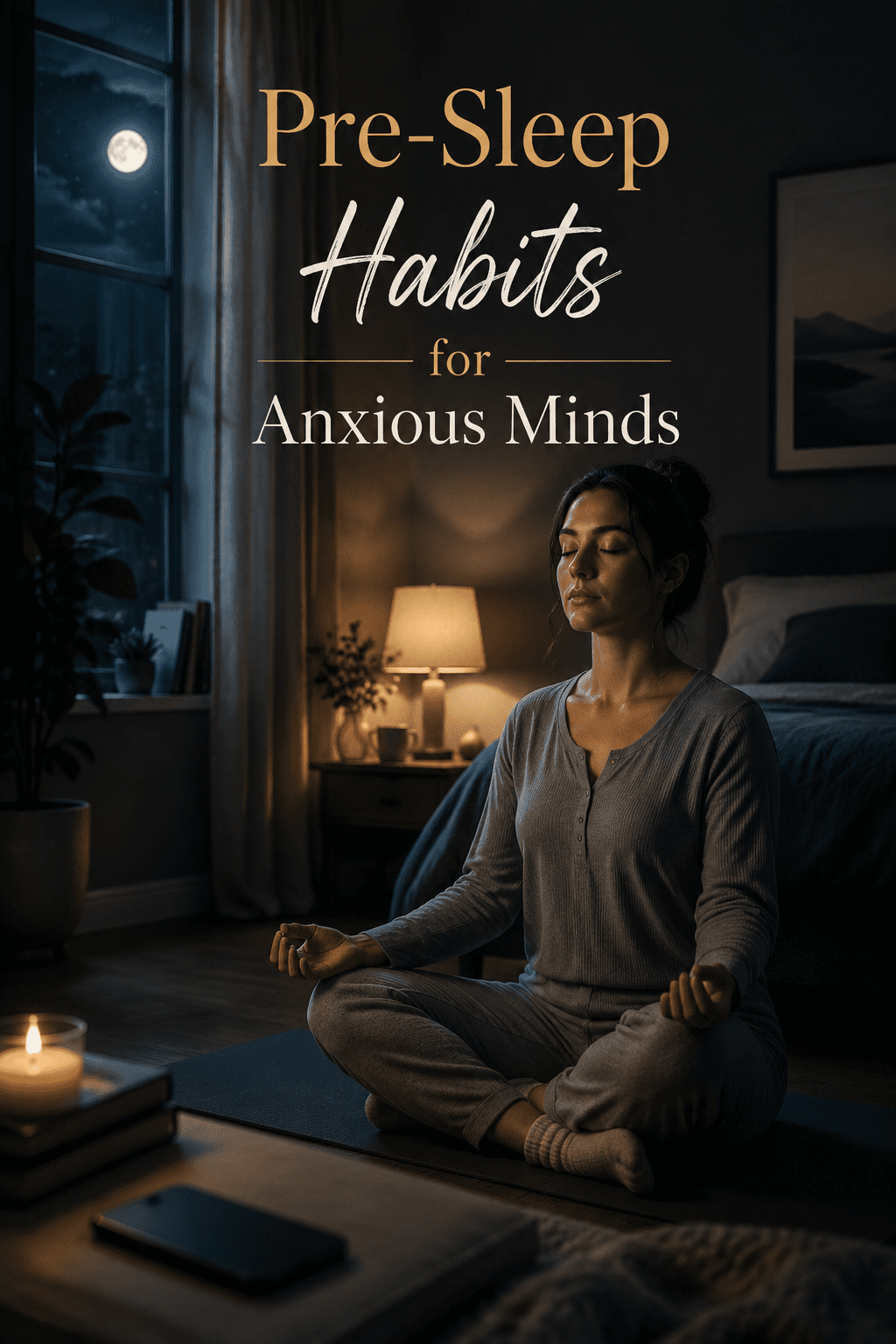
Pre-sleep habits that work best for people with anxiety specifically:
- Body scan meditation (focus on physical sensation, not thoughts)
- Box breathing (4 counts in, 4 hold, 4 out, 4 hold)
- Journaling a short “brain dump” to offload tomorrow’s to-do list
- Progressive muscle relaxation – tense and release each muscle group from feet upward
What Foods and Drinks Should You Avoid Before Bed – and How Long Before
The general rule: stop eating 2-3 hours before bed, and avoid caffeine for at least 6 hours before sleep. Heavy, spicy, or high-fat meals close to bedtime increase the risk of acid reflux, raise core body temperature during digestion, and disrupt sleep architecture [5].
Caffeine is the bigger issue for most people. Its half-life is roughly 5-6 hours, which means a 3pm coffee still has half its caffeine active at 9pm [5]. If you’re a slow caffeine metabolizer – which is genetic – that window extends even further.
What to avoid in the pre-sleep hour:
- Alcohol (it fragments sleep in the second half of the night, even if it helps you fall asleep initially)
- Spicy or acidic foods
- High-sugar snacks (cause blood sugar spikes that can wake you)
- Large amounts of liquid (reduces nighttime bathroom trips) [6]
Worth trying if you’re genuinely hungry before bed: a small snack with complex carbs and a little protein – like a few crackers with nut butter – is less disruptive than going to bed uncomfortably hungry.
Does a Warm Shower Actually Help You Sleep Better
Yes, and the mechanism is specific. A warm shower or bath taken 1-2 hours before bed raises your skin temperature, which then triggers a drop in core body temperature as you cool down afterward. That drop in core temperature is one of the signals your body uses to initiate sleep [6].
This is not just anecdotal. A 2019 meta-analysis in Sleep Medicine Reviews found that bathing in water between 40-42°C, about 1-2 hours before bed, reduced the time to fall asleep by an average of 10 minutes.
In practice this means: don’t shower right before getting into bed. Give yourself 60-90 minutes between the shower and lights out. The cooling-down phase is where the benefit happens.
What’s the Difference Between a Good and Bad Pre-Sleep Routine
A good pre-sleep routine reduces arousal. A bad one maintains or increases it – even when it feels relaxing in the moment.
Good pre-sleep routine looks like:
- Consistent timing (same sequence, same hour, every night)
- Low stimulation: dim light, quiet, no new information
- Physical signals to the body: warmth, gentle movement, slow breathing
- Emotional neutrality: no difficult conversations, no work email, no news [4]
Common mistakes people make in their nighttime routine:
- Watching emotionally activating content and calling it “winding down”
- Drinking alcohol thinking it helps sleep (it doesn’t – it fragments it)
- Brushing teeth immediately before getting into bed – this can raise alertness by stimulating the nervous system and affecting melatonin [1]
- Using the bed for non-sleep activities, which weakens the mental association between bed and sleep
- Checking the clock repeatedly when you can’t fall asleep (this increases anxiety and extends wakefulness)
The honest version is: most people who struggle with sleep have a routine that feels relaxing but is actually keeping the brain alert. The difference is subtle but consistent.
For a deeper look at building something that actually sticks, read How to Build a Sleep Routine That Calms Your Brain.
One Unusual Thing Worth Trying: Familiar TV Re-Runs
This one surprises people. A sleep researcher cited by Tom’s Guide [2] noted that re-watching familiar, low-stakes TV shows – think comfort sitcoms you’ve seen before – can actually help some people fall asleep faster. The logic: your brain isn’t processing new information or building suspense. It’s just passively receiving something predictable and safe.
The catch: this still involves a screen, which means blue light and the risk of staying up longer than planned. If you go this route, use a TV across the room rather than a phone or tablet in bed, set a sleep timer, and keep the brightness low.
It’s not my first recommendation. But if you’ve tried everything else and you genuinely can’t fall asleep without some background noise, a familiar show is better than doomscrolling.
Not sure if what you’re experiencing is clinical insomnia or situational sleep disruption? This free anonymous test takes about 5 minutes and evaluates your symptoms over the past two weeks. It’s a good starting point before deciding whether to seek professional support.
The One Pre-Sleep Habit Most People Skip: Preparing Your Environment
Your bedroom environment is not a passive backdrop – it actively shapes your sleep quality. The Sleep Foundation recommends a cool (around 65-68°F / 18-20°C), dark, and quiet room as baseline conditions for good sleep [7].
Quick environment checklist for the hour before bed:
- Dim lights or switch to warm-toned bulbs 60 minutes before sleep
- Set the thermostat down or crack a window
- Use blackout curtains or a sleep mask if there’s light intrusion
- Add a white noise machine or earplugs if noise is an issue
- Consider a lavender pillow spray – some insomnia experts use aromatherapy as part of their pre-sleep ritual [3]
This is also the time to do the small logistical things that prevent a racing mind at 2am: lay out tomorrow’s clothes, write down anything you’re worried about forgetting, set your alarm. Getting those tasks done before bed removes the low-level anxiety that keeps a lot of people awake.
For more on what might be keeping you up despite doing everything right, see Why Am I Not Getting Sleep Even When I Go to Bed on Time.
A Full Hour-Before-Bed Routine: What It Looks Like in Practice
Here is what the full hour can look like when you put it together. This isn’t a rigid prescription – it’s a template you adjust to what works for you.
| Time Before Bed | Activity |
|---|---|
| 60 minutes | Dim lights, put phone in another room, brush teeth |
| 50 minutes | Warm shower or bath |
| 35 minutes | Light reading (physical book) or journaling |
| 20 minutes | Gentle stretching or body scan meditation |
| 10 minutes | Get into bed, practice slow breathing |
| 0 minutes | Lights out |
You don’t have to fall asleep – you just have to rest. That reframe alone removes a lot of the performance anxiety that makes insomnia worse. If you’re lying there awake, you’re still resting. That counts.
For people who are still waking up in the middle of the night despite a solid pre-sleep routine, this guide on 10 Tips for Sleeping Through the Night Without Waking Up is worth reading next.
FAQ
How long before bed should I stop using my phone?
At least 60 minutes. The Sleep Foundation recommends avoiding screens for a full hour before sleep to allow melatonin levels to rise naturally [4]. If that’s not realistic, use a warm light filter and avoid emotionally activating content.
Is it okay to drink herbal tea before bed?
Yes – caffeine-free herbal teas like chamomile, valerian root, or passionflower are low-risk and may have mild calming effects. Just keep the volume small to avoid nighttime bathroom trips [6].
Should I go to bed at the same time every night?
Yes. Consistency in your sleep and wake times is one of the most evidence-supported things you can do for sleep quality. It anchors your circadian rhythm and makes falling asleep easier over time [4].
What if I can’t stop my mind from racing when I get into bed?
Try a “brain dump” journal before bed – write down everything on your mind, including tomorrow’s tasks. This offloads working memory and reduces the cognitive loop that keeps anxious minds awake. See Insomnia Overthinking: How to Quiet Your Mind at Night.
Is melatonin worth taking before bed?
Melatonin is most useful for circadian rhythm disruptions (jet lag, shift work) rather than chronic insomnia. It’s low-risk at low doses (0.5-1mg), but it’s not a substitute for fixing the behavioral patterns that cause poor sleep.
Can I exercise before bed?
Light movement like stretching or yoga is fine and helpful. Vigorous cardio or strength training within 2-3 hours of bed raises cortisol and core temperature, which delays sleep onset [6].
What should I do if I wake up at 3am and can’t get back to sleep?
Don’t lie in bed awake for more than 20-25 minutes. Get up, go to a dim room, do something quiet and non-stimulating, and return to bed when you feel sleepy. This is called stimulus control and it’s a core technique in CBT-I.
Does alcohol help with sleep?
No – it helps you fall asleep faster but significantly fragments sleep in the second half of the night, reducing REM sleep and leaving you feeling unrefreshed.
How do I know if my sleep problem is clinical insomnia?
If you’ve had difficulty falling or staying asleep at least 3 nights per week for more than 3 months, and it’s affecting your daytime functioning, that meets the clinical threshold for insomnia disorder. This free anonymous test can help you evaluate your symptoms.
Conclusion
The hour before bed is not wasted time. It’s the window where your nervous system decides whether tonight is going to be a fight or a rest. The things you do before bed in that hour – the light you’re exposed to, the food you’ve eaten, the thoughts you’re carrying, the temperature of your room – all of it feeds into whether sleep comes easily or not at all.
It’s not you. It’s not a character flaw. Most people who struggle with sleep are doing things in that final hour that feel fine but are quietly keeping their brain alert.
Start with two or three changes from this list. Pick the ones that feel most manageable. Give them two weeks before deciding they don’t work – your nervous system needs repetition to learn a new pattern.
If you’ve been at this for a while and nothing seems to stick, it may be worth looking at what’s underneath the habits. Why Can’t I Sleep at Night Even When I’m Tired? is a good next read. And if you want to go deeper on building a routine that actually holds, Bedtime Routine for Adults Who Struggle to Wind Down covers the structural side in more detail.
You don’t have to fix everything tonight. You just have to make the next hour a little quieter than the last one.
References
[1] Trouble Falling Asleep? Brushing Your Teeth Right Before Bed Could Be To Blame, Expert Says – https://www.tomsguide.com/wellness/sleep/trouble-falling-asleep-brushing-your-teeth-right-before-bed-could-be-to-blame-expert-says
[2] Sleep Researcher Shares 4 Unusual Tips For Falling Asleep Quickly And They Include Watching Re-Runs Of Your Fave TV Show – https://www.tomsguide.com/wellness/sleep/sleep-researcher-shares-4-unusual-tips-for-falling-asleep-quickly-and-they-include-watching-re-runs-of-your-fave-tv-show
[3] 4 Things An Insomnia Expert Does Before Bed To Fall Asleep Fast And Sleep Through The Night – https://www.tomsguide.com/wellness/sleep/4-things-an-insomnia-expert-does-before-bed-to-fall-asleep-fast-and-sleep-through-the-night
[4] Bedtime Routine For Adults – Sleep Foundation – https://www.sleepfoundation.org/sleep-hygiene/bedtime-routine-for-adults
[5] About Sleep – SUNY Upstate Medical University Sleep Center – https://www.upstate.edu/sleep-center/about-sleep/10.php
[6] 17 Tips To Sleep Better – Healthline – https://www.healthline.com/nutrition/17-tips-to-sleep-better
[7] Healthy Sleep Tips – Sleep Foundation – https://www.sleepfoundation.org/sleep-hygiene/healthy-sleep-tips