Post Disclaimer
This post contains affiliate links. If you buy something through these links, I may earn a small commission at no extra cost to you. Full disclosure.
This article is for informational purposes only and does not constitute medical advice. Always consult a healthcare professional for personal health concerns. Full disclaimer.
Last updated: June 12, 2026
Quick Answer: Insomnia overthinking happens when your brain shifts into problem-solving mode the moment your head hits the pillow — replaying the day, rehearsing tomorrow, and generating worry on a loop. It’s one of the most common drivers of chronic sleep problems, and it responds well to specific techniques, particularly cognitive behavioral therapy for insomnia (CBT-I). The good news is that you don’t need to silence your mind completely — you just need to interrupt the cycle enough to let sleep happen.
Key Takeaways
- Overthinking at night is a physiological stress response, not a character flaw or personal failing
- Around 30–35% of adults experience insomnia symptoms at some point [1]
- CBT-I is the first-line, evidence-backed treatment for chronic insomnia — not sleeping pills [2]
- Racing thoughts at bedtime are strongly linked to anxiety and depression, but they’re also common in ADHD
- Breathing exercises and structured worry time can reduce nighttime rumination in the short term
- Sleep restriction and stimulus control — both CBT-I components — are more effective long-term than medication [4]
- If overthinking has disrupted your sleep for more than three months, it’s worth talking to a doctor
- You don’t have to fall asleep — you just have to rest. That shift in thinking alone can reduce sleep anxiety
Why Do You Overthink Everything at Night?
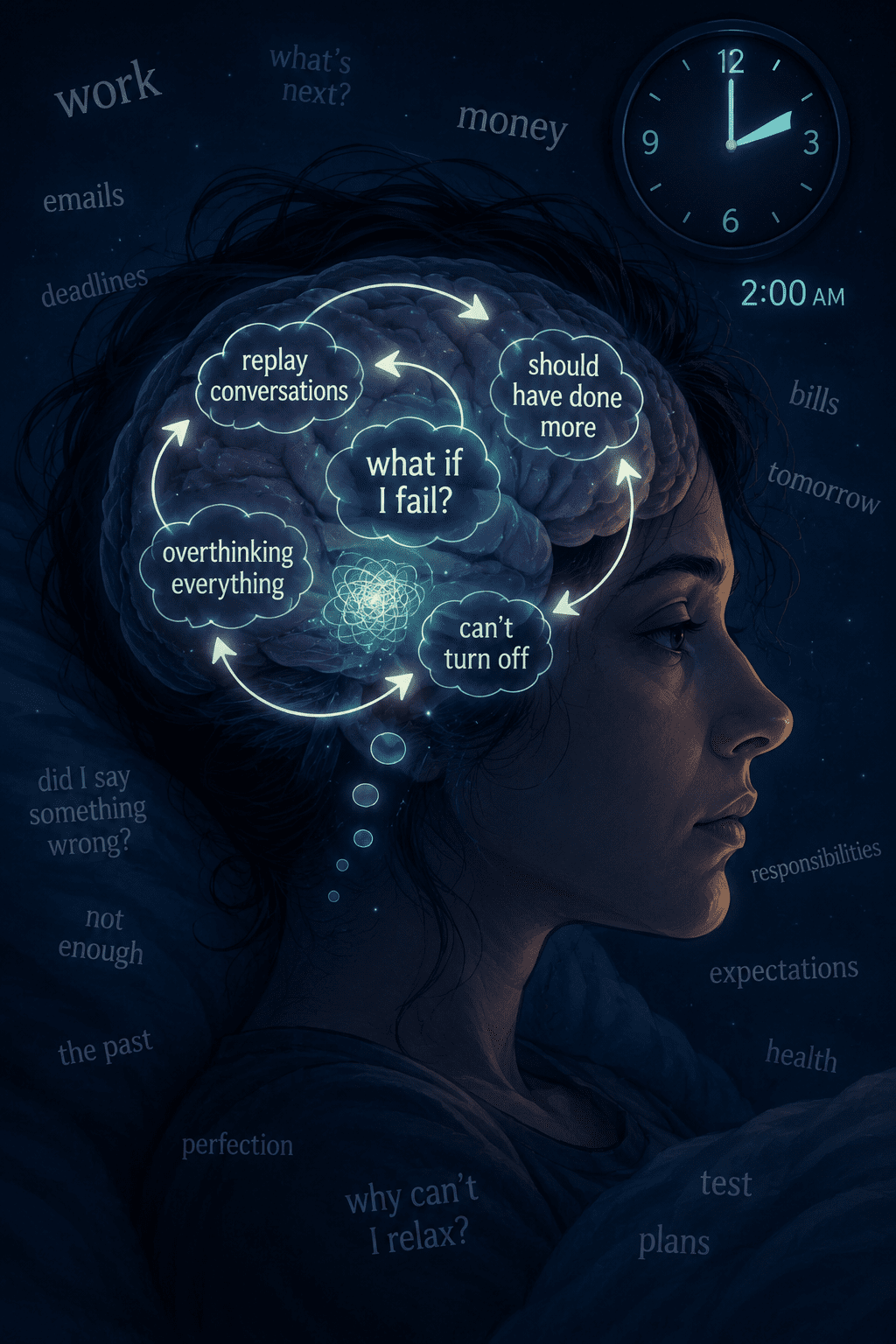
During the day, your brain has dozens of things competing for its attention. At night, that competition disappears — and whatever you’ve been avoiding rises to the surface. This is the core mechanism behind insomnia overthinking.
Here’s what the research actually says: your nervous system doesn’t automatically switch off when you get into bed. If you’ve been running on stress hormones all day, your brain stays in a state of hyperarousal — scanning for threats, processing unresolved problems, rehearsing conversations that haven’t happened yet. It’s not irrational. It’s your threat-detection system doing exactly what it’s designed to do, just at the wrong time.
The honest version is that nighttime isn’t when overthinking starts — it’s when you finally notice it, because there’s nothing left to drown it out.
This pattern is especially common if you’ve been dealing with this for a while. The longer it goes on, the more your brain starts to associate your bed with wakefulness and anxiety rather than rest. That association becomes its own problem, separate from whatever you were originally worried about. If you’re not sure what’s driving your sleeplessness, this breakdown of why you might be unable to sleep covers the most common underlying causes.
The Difference Between Normal Worrying and Harmful Overthinking
Not all nighttime thinking is a problem. Normal worrying is brief, somewhat productive, and resolves — you think through a real concern, reach some kind of conclusion, and move on. Harmful overthinking is circular. You keep returning to the same thought without getting anywhere new.
A few markers that separate the two:
- Duration: Normal worry passes within a few minutes. Harmful overthinking can last hours
- Content: Normal worry is usually tied to a specific, solvable problem. Harmful overthinking often spirals into “what if” scenarios with no clear endpoint
- Physical response: Harmful overthinking tends to come with a racing heart, muscle tension, or a feeling of dread that doesn’t ease
- Daytime impact: If your nighttime thinking is affecting how you function during the day, that’s a signal it’s crossed into territory worth addressing
The reason this matters is that treating normal worry and chronic rumination require different approaches. If you’re in the harmful overthinking category, basic relaxation tips probably haven’t worked — and there’s a reason for that.
Is Overthinking a Sign of Anxiety or Depression?
Overthinking at night is strongly associated with both anxiety and depression, but it shows up differently in each.
With anxiety, the thoughts tend to be future-focused — anticipating problems, rehearsing worst-case scenarios, feeling like something bad is about to happen. With depression, nighttime rumination is more often backward-looking — replaying past mistakes, feeling regret, questioning your own worth. Both can cause insomnia, and both can exist at the same time.
It’s not just you — this overlap is extremely common. A significant portion of people with chronic insomnia also meet criteria for an anxiety or mood disorder, and the relationship runs both ways: poor sleep makes both conditions worse, and both conditions make sleep harder.
If you suspect anxiety or depression is driving your sleep problems, a brief screening tool can help clarify what you’re dealing with. This free, anonymous insomnia and mood test asks about your experience over the past two weeks and takes only a few minutes. It won’t diagnose you, but it can help you understand the pattern better before deciding on next steps.
How to Stop Racing Thoughts When Trying to Sleep
There’s no single switch. But there are techniques with real evidence behind them — and a few that work faster than others.
Scheduled worry time is one of the most counterintuitive and effective. Instead of trying to suppress anxious thoughts at night, you set aside 15–20 minutes earlier in the evening — not right before bed — to deliberately think through your worries. Write them down. When those same thoughts appear at 1am, you can tell yourself: “I already dealt with that. It’s not my job right now.” In practice, this means you’re not suppressing the thoughts — you’re relocating them.
Cognitive defusion is a technique from acceptance-based therapy. Instead of engaging with a thought (“I’m going to fail that presentation”), you observe it from a distance (“There’s that thought about the presentation again”). It sounds simple, but it changes your relationship to the thought without requiring you to resolve it.
The body scan works by redirecting attention from mental content to physical sensation — slowly moving your awareness from your feet upward, noticing tension, heaviness, temperature. Most people don’t make it past their knees before their mind quiets. I’ve used this on nights when nothing else was working, and it’s the one technique I keep coming back to.
For a broader set of practical methods, this guide on how to fall asleep fast covers ten approaches with honest assessments of what actually works.
Best Techniques for Calming an Anxious Mind Before Bed
The goal before bed isn’t to feel happy — it’s to lower physiological arousal enough that sleep becomes possible.
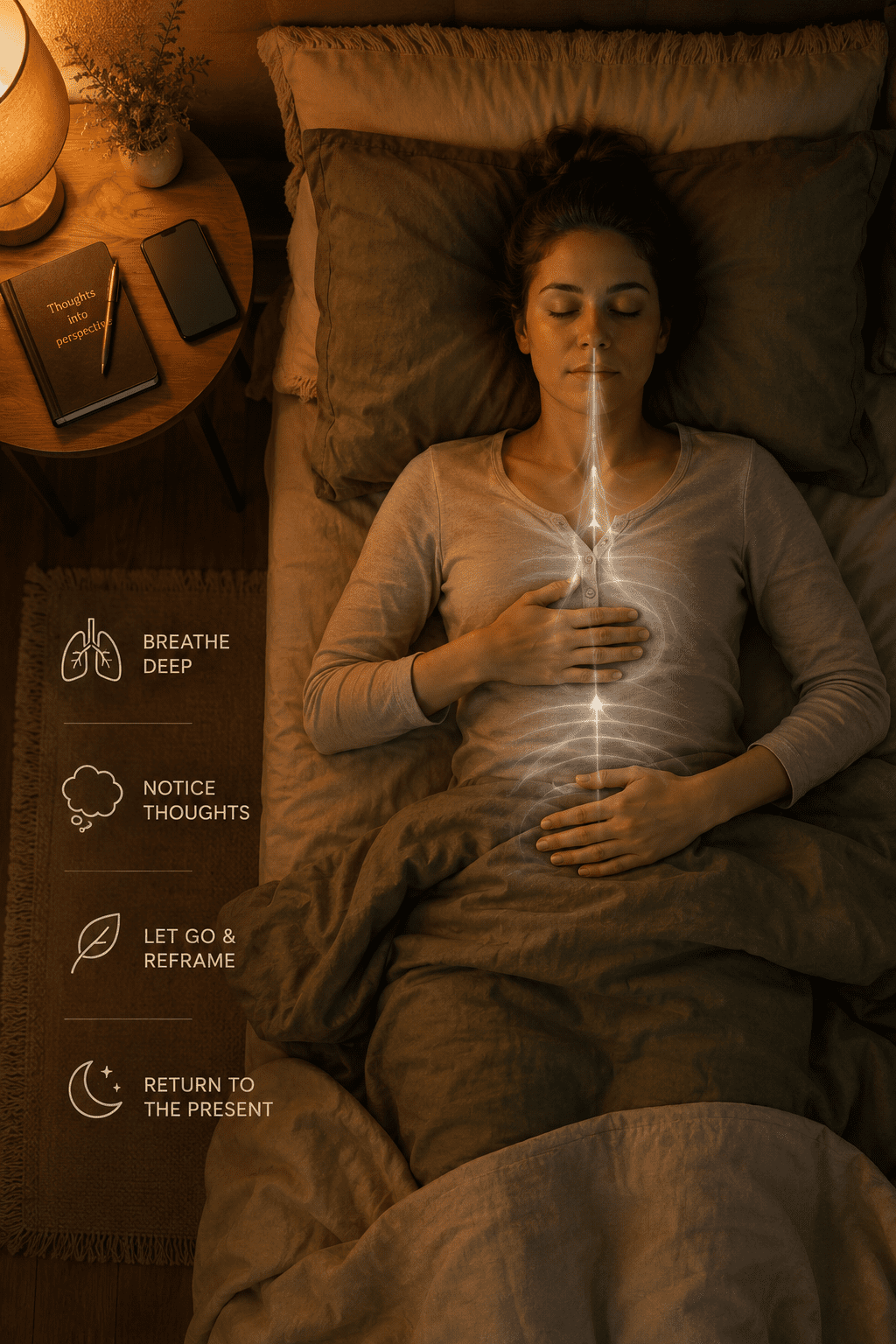
Breathing exercises are worth trying if you want something immediate and free. The 4-7-8 method (inhale for 4 counts, hold for 7, exhale for 8) activates the parasympathetic nervous system and reduces the physical symptoms of anxiety. It doesn’t require belief in it to work — it’s a mechanical intervention on your nervous system.
Progressive muscle relaxation (PMR) involves tensing and releasing muscle groups from feet to face. Mayo Clinic includes it among evidence-supported relaxation techniques for insomnia [4]. It works partly because it gives your mind a structured task — which is often enough to break the overthinking loop.
Journaling — specifically writing out tomorrow’s to-do list before bed — has been shown in research to reduce the time it takes to fall asleep. The act of externalizing the mental load onto paper seems to signal to your brain that it doesn’t need to hold onto everything anymore.
What doesn’t help: trying to force yourself to relax, watching stimulating content “to wind down,” or lying in bed awake for long stretches hoping sleep will come. That last one is worth addressing directly in the next section.
Cognitive Behavioral Therapy Techniques for Nighttime Anxiety and Insomnia Overthinking
CBT-I is the most evidence-backed treatment for chronic insomnia overthinking — and it’s not just therapy in the traditional sense. It’s a structured set of techniques, typically delivered over four to eight sessions [2].
The core components:
- Cognitive restructuring: Identifying and challenging unhelpful beliefs about sleep (“I need 8 hours or I can’t function,” “I’ll never sleep normally again”). These beliefs increase anxiety, which increases arousal, which prevents sleep — a self-fulfilling loop
- Stimulus control: Using your bed only for sleep and sex, getting out of bed if you’re awake for more than 20 minutes. This rebuilds the mental association between bed and sleep
- Sleep restriction: Temporarily limiting time in bed to match actual sleep time, then gradually expanding it. This sounds counterproductive but it consolidates sleep and reduces the frustration of lying awake [5]
- Relaxation training: Structured techniques like PMR and breathing exercises, practiced consistently
Studies show CBT-I leads to long-term improvements in sleep quality and daytime functioning — and it outperforms sleeping pills for most people with chronic insomnia, without the dependency risks [2][4]. It’s also available in digital formats now, which makes it more accessible than it used to be.
If you’ve been trying sleep hygiene tips for months without results, CBT-I is the actual next step — not a stronger version of the same tips. You can also read more about why you might not be sleeping even when you go to bed on time, which often comes down to the same cognitive patterns CBT-I addresses.
Can Meditation or Breathing Exercises Really Stop Overthinking?
They can reduce it — but “stop” is the wrong expectation. Meditation and breathing exercises lower physiological arousal, which makes it easier for sleep to happen. They don’t eliminate thoughts.
The mistake most people make is treating meditation as a performance. You sit down, a thought appears, and you feel like you’ve failed. That’s not how it works. The practice is noticing the thought and returning your attention to your breath — not preventing the thought from arriving.
Worth trying if you’re new to this: guided body scan meditations (available free on apps like Insight Timer), 10 minutes of slow diaphragmatic breathing before bed, or even just sitting quietly without a screen for five minutes. The bar is low. The consistency matters more than the technique.
Natural Remedies to Help Quiet Your Brain at Bedtime
A few options with reasonable evidence behind them — and a few to be skeptical of.
Magnesium glycinate is one of the more credible options. Magnesium plays a role in regulating the nervous system, and many adults are deficient. Some people notice a meaningful difference in sleep quality. It’s not a sedative — it’s more like removing a deficiency that was making things worse.
L-theanine, an amino acid found in green tea, promotes relaxation without sedation. It’s often combined with magnesium. The evidence is modest but it’s low-risk.
Melatonin is useful for circadian rhythm issues (jet lag, shift work, delayed sleep phase) but it’s not particularly effective for anxiety-driven insomnia. Most people take too much — 0.5mg is often enough; most supplements contain 5–10mg.
Valerian root, lavender, and chamomile have some supporting evidence but the effect sizes are small. They’re not going to fix chronic overthinking, but they’re not harmful either.
For a fuller look at non-pharmaceutical options, this guide to falling asleep naturally without pills is worth reading.
What Medications Can Help With Sleep and Overthinking?
Medication can help in the short term, but it’s rarely the right long-term answer for insomnia overthinking specifically.
For sleep, the most commonly prescribed options include:
- Z-drugs (zolpidem/Ambien, eszopiclone): Effective short-term but carry dependency risks and can impair memory
- Low-dose doxepin: An older antidepressant approved for sleep maintenance insomnia — less dependency risk than z-drugs
- Melatonin receptor agonists (ramelteon): Mild, low-risk, better for sleep onset than maintenance
For the anxiety component driving the overthinking:
- SSRIs/SNRIs: First-line for anxiety disorders — they don’t work overnight but can significantly reduce baseline rumination over weeks
- Buspirone: Non-sedating anti-anxiety medication, useful for generalized anxiety
- Short-term benzodiazepines: Effective but high dependency risk — not recommended for ongoing use
The honest version is that medication and CBT-I together tend to work better than either alone for people with anxiety-driven insomnia. Sleeping pills address the symptom; CBT-I addresses the cause [4].
Medical disclaimer: This is general information, not medical advice. Talk to your doctor before starting or stopping any medication.
How Much Sleep Do You Actually Need When You’re Constantly Overthinking?
Most adults need 7–9 hours, and that doesn’t change because you’re an overthinker. What does change is sleep efficiency — the percentage of time in bed that you’re actually asleep.
If you’re spending 9 hours in bed and sleeping 5, the solution isn’t more time in bed. That’s actually one of the things sleep restriction therapy addresses directly. Counterintuitively, spending less time in bed (initially) can improve sleep quality faster than trying harder to sleep longer.
The more useful question isn’t “how much sleep do I need?” — it’s “what’s my sleep efficiency, and why is it low?” Understanding what causes lack of sleep often reveals that the problem is behavioral and cognitive, not just physiological.
How People With ADHD Manage Racing Thoughts at Night
ADHD and nighttime overthinking overlap significantly — but the mechanism is slightly different. In ADHD, the racing thoughts at night are often less anxiety-driven and more stimulation-driven. The brain resists the transition to lower arousal because it’s still seeking input.
What tends to help for ADHD-related sleep issues:
- White noise or low-stimulation audio (podcasts, audiobooks at low volume) — gives the brain just enough input to stop seeking more
- Later sleep timing — many people with ADHD have a naturally delayed circadian rhythm; fighting it often makes things worse
- Physical activity earlier in the day — not right before bed, but regular exercise significantly reduces hyperarousal
- Medication timing — if you take stimulant medication, the timing matters a lot for sleep; worth discussing with your prescriber
CBT-I techniques also work for ADHD, but they often need to be adapted — strict sleep restriction, for example, can be harder to stick to without support.
Signs That Your Overthinking Is Becoming a Serious Sleep Disorder
Most people experience a few nights of racing thoughts without it becoming chronic. The line into a sleep disorder is crossed when the pattern becomes consistent and starts affecting your waking life.
Signs worth paying attention to:
- You’ve had trouble sleeping at least three nights per week for more than three months [1]
- You dread going to bed because you know you won’t sleep
- You’re relying on alcohol or sleep aids regularly to fall asleep
- Daytime fatigue is affecting your work, relationships, or mood
- You feel anxious about sleep itself — not just the things you’re thinking about
If you recognize several of these, understanding why you have insomnia and finding your specific trigger is a useful starting point. And if you want a clearer picture of where you stand, this free anonymous insomnia test evaluates your symptoms over the past two weeks and can help you see the pattern more clearly.
When Should You Talk to a Doctor About Your Overthinking?
If your sleep problems have lasted more than a month, are getting worse, or are affecting your daily functioning — that’s when to make the appointment. You don’t need to wait until you’re in crisis.

A GP can rule out physical causes (thyroid issues, sleep apnea, medication side effects) and refer you to a sleep specialist or therapist trained in CBT-I. Be specific when you go: tell them how long it’s been happening, how many nights per week, and whether anxiety or racing thoughts are the primary driver. That information shapes the treatment approach.
Most people who struggle with sleep wait too long before asking for help — often because they’ve convinced themselves it’s just who they are. It’s not. It’s a treatable pattern. But the longer it goes on, the more entrenched the behavioral and cognitive components become, which is why earlier intervention tends to produce faster results.
Conclusion
Insomnia overthinking is one of the most frustrating sleep problems precisely because the harder you try to fix it, the worse it gets. The brain doesn’t respond well to force.
What actually helps is a combination of things: understanding why your brain does this at night, using specific techniques to interrupt the loop (breathing, scheduled worry time, cognitive defusion), and — if the problem is chronic — working through a structured CBT-I program rather than relying on sleep hygiene tips that were never designed for this level of difficulty.
Actionable next steps:
- Try scheduled worry time tonight — 15 minutes before 9pm, write down what’s on your mind and set it aside
- Practice 4-7-8 breathing when you get into bed, regardless of whether you feel anxious
- If you’ve been struggling for more than a month, take this free anonymous insomnia test to evaluate your symptoms and understand the pattern
- If basic techniques aren’t working, look into CBT-I — either through a therapist or a digital program
- Talk to your doctor if you’ve been dealing with this for more than three months
You don’t have to fall asleep — you just have to rest. Start there.
Frequently Asked Questions
Q: Why does my brain suddenly start overthinking the moment I lie down?
During the day, mental noise masks your underlying thoughts. At night, with no distractions, unresolved worries rise to the surface. Your brain also associates bed with wakefulness if you’ve had insomnia for a while, which triggers arousal automatically.
Q: Is insomnia overthinking the same as anxiety?
Not exactly. Overthinking is a symptom that appears in anxiety, depression, ADHD, and stress. It can also occur without a diagnosable condition. If it’s persistent and impairing your sleep, it’s worth evaluating whether an underlying anxiety disorder is present.
Q: What’s the fastest way to stop racing thoughts at night?
Diaphragmatic breathing (slow, deep breaths with a longer exhale) is the fastest physiological intervention. It activates the parasympathetic nervous system within minutes. Combine it with a body scan to redirect attention away from thought content.
Q: Does melatonin help with overthinking-related insomnia?
Melatonin helps with circadian rhythm issues but is not particularly effective for anxiety-driven insomnia. If your problem is racing thoughts rather than poor sleep timing, melatonin is unlikely to make a meaningful difference.
Q: How long does CBT-I take to work?
Most people see meaningful improvement within four to eight weeks of consistent CBT-I practice [2]. Some techniques, like stimulus control, can show results within two weeks.
Q: Can I do CBT-I on my own without a therapist?
Yes — self-guided CBT-I programs and apps (such as Sleepio or the Somryst app) have evidence supporting their effectiveness. They’re a reasonable starting point if access to a therapist is limited.
Q: Is it normal to wake up at 3am with racing thoughts?
Very common. Early morning waking with rumination is particularly associated with depression and anxiety. If it happens regularly, it’s worth discussing with a doctor — it’s a specific pattern that responds to specific treatments [5].
Q: Should I get out of bed if I can’t stop overthinking?
Yes, if you’ve been awake for more than 20 minutes. Lying in bed awake reinforces the association between bed and wakefulness. Get up, do something quiet and low-stimulation, and return when you feel sleepy.
Q: Can exercise help reduce nighttime overthinking?
Regular aerobic exercise reduces anxiety and improves sleep quality over time. The timing matters — vigorous exercise within two to three hours of bed can increase arousal for some people. Morning or early afternoon is generally better.
Q: When does overthinking become a diagnosable sleep disorder?
When sleep difficulty occurs at least three nights per week for more than three months and causes significant daytime impairment, it meets the criteria for chronic insomnia disorder [1].
References
[1] Infographic Facts Stats On Insomnia – https://www.healthline.com/health/insomnia/infographic-facts-stats-on-insomnia?utm_source=openai
[2] Cognitive Behavioral Therapy Insomnia – https://my.clevelandclinic.org/health/treatments/cognitive-behavioral-therapy-insomnia?utm_source=openai
[3] Cognitive Behavioral Therapy For Insomnia – https://www.healthline.com/health/insomnia/cognitive-behavioral-therapy-for-insomnia?utm_source=openai
[4] Art 20046677 – https://www.mayoclinic.org/diseases-conditions/insomnia/in-depth/insomnia-treatment/ART-20046677?p=1&utm_source=openai
[5] Sleep Maintenance Insomnia – https://health.clevelandclinic.org/sleep-maintenance-insomnia?utm_source=openai