Post Disclaimer
This post contains affiliate links. If you buy something through these links, I may earn a small commission at no extra cost to you. Full disclosure.
This article is for informational purposes only and does not constitute medical advice. Always consult a healthcare professional for personal health concerns. Full disclaimer.
Last updated: June 21, 2026
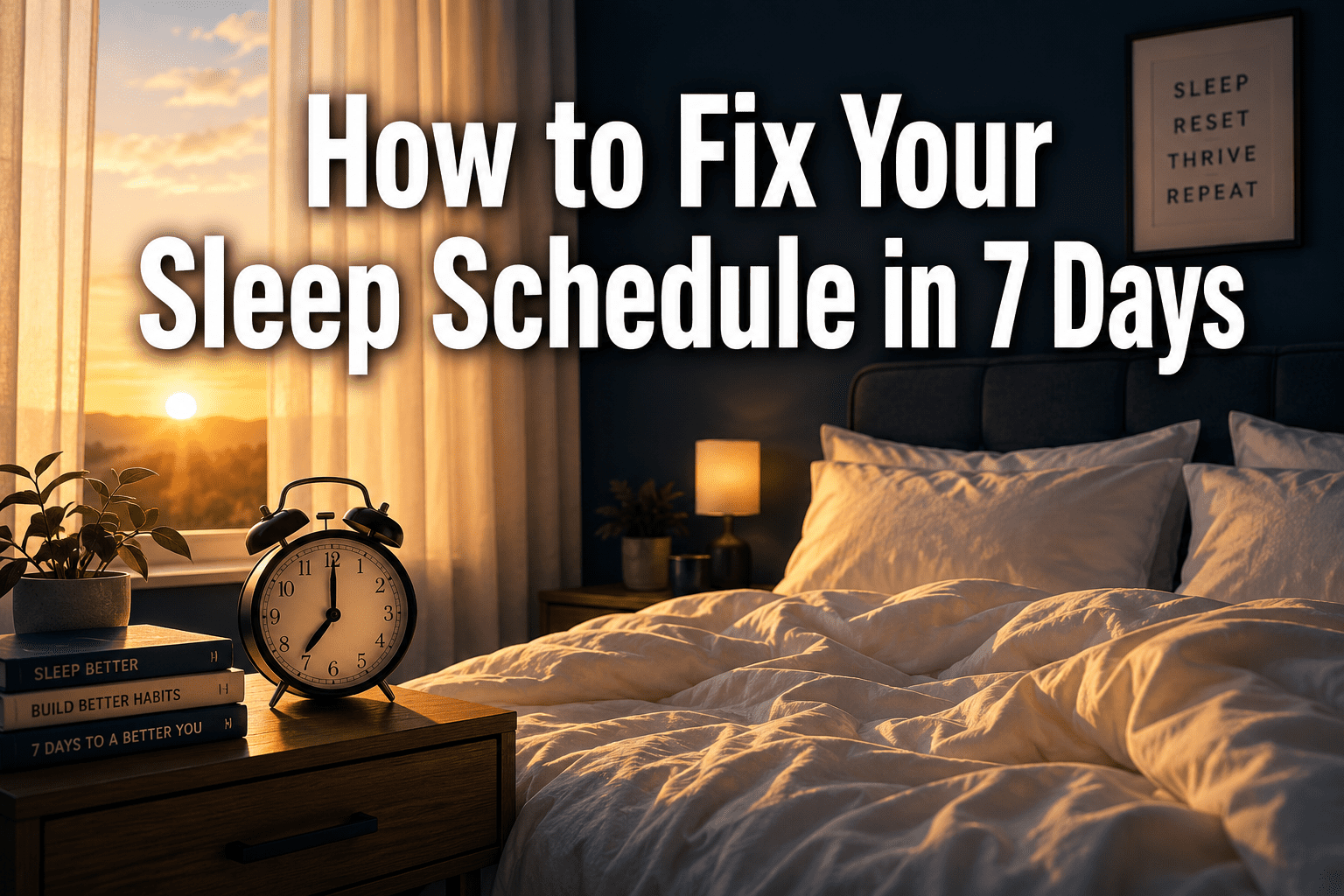
Quick Answer: To fix your sleep schedule, pick one consistent wake-up time and protect it every single day – including weekends. Then work backward to set a realistic bedtime, manage your light exposure, and reduce the habits that keep your brain wired at night. Most people see meaningful improvement within 5 to 7 days when they stick to the wake time above everything else.
Key Takeaways
- A fixed wake-up time is the single most important lever you have – more than your bedtime
- Light exposure in the morning and darkness at night are what actually set your internal clock
- Napping too long or too late will undo your progress faster than almost anything else
- Caffeine has a half-life of about 5-6 hours, which means your 3pm coffee is still active at 9pm
- Sleep restriction (staying up slightly later than you want) builds sleep pressure faster than going to bed early
- You don’t have to fall asleep – you just have to rest; removing the pressure to perform changes everything
- Most people who struggle with sleep have irregular schedules, not broken biology
- Weekends are where sleep schedules go to die – social jetlag is real and it matters
- If you’ve been dealing with this for a while, seven days won’t cure chronic insomnia – but it will give your body a reset point to build from

Why Your Sleep Schedule Is Broken in the First Place
Your body runs on a circadian rhythm – a roughly 24-hour internal clock that regulates when you feel sleepy and when you feel alert [10]. When that rhythm gets disrupted by inconsistent sleep times, late nights, shift work, or stress, your brain loses its anchor. It stops knowing when to release melatonin, when to drop your core temperature, and when to wind down.
The honest version is that most sleep schedule problems aren’t about willpower or laziness. They’re about a misaligned biological clock that keeps getting mixed signals.
Here’s what the research actually says: irregular sleep timing – going to bed and waking up at different times each day – is independently associated with worse sleep quality, even when total sleep hours look fine [8]. Your body isn’t just counting hours. It’s looking for consistency.
If you’ve been dealing with this for a while, you’ve probably noticed that some nights are better than others for no obvious reason. That randomness is often a sign your circadian rhythm is floating – not anchored to anything stable.
If you’re not sure whether what you’re experiencing is a schedule problem or something deeper, it’s worth reading about why you might be unable to sleep even when you’re doing everything right.
How to Fix Your Sleep Schedule: The One Rule That Overrides Everything
Before the 7-day plan, you need to understand one thing: your wake-up time is the anchor, not your bedtime.
Most people try to fix their sleep by going to bed earlier. That rarely works, because you can’t force sleep onset – your body will just lie there awake. But you can control when you get up. And a consistent wake time is what trains your circadian rhythm to consolidate sleep pressure at the right time [10].
Pick a wake time you can realistically hold every day for the next seven days. Not the time you wish you could wake up. The time you can actually commit to – including Saturday and Sunday.
Write it down. Set three alarms if you need to. Then get out of bed when it goes off, even if you slept badly. Especially if you slept badly.
In practice, this means you might feel rough for the first two or three days. That’s normal. Sleep pressure builds when you’re slightly sleep-deprived, and that pressure is what makes night four and five dramatically better.
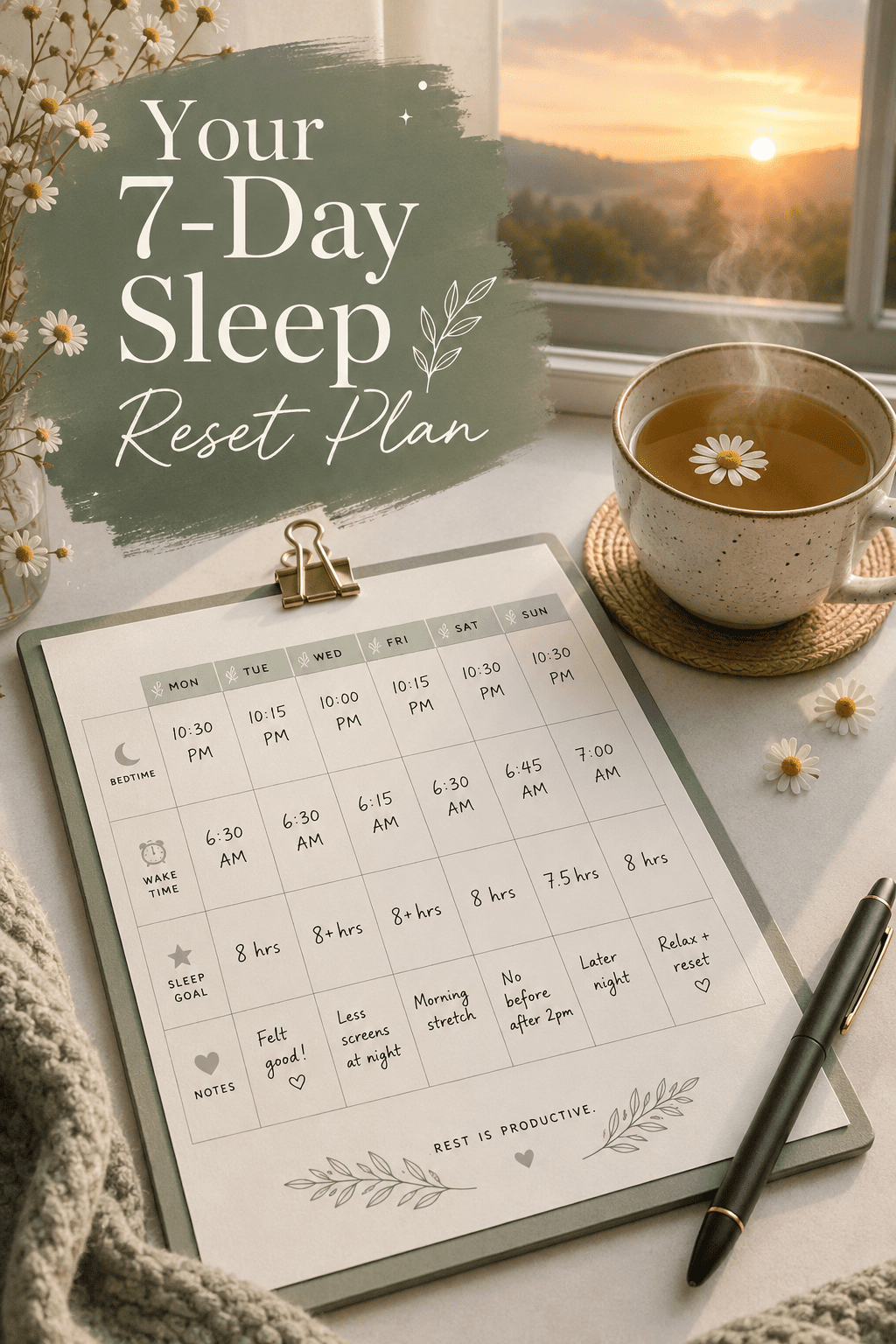
The 7-Day Step-by-Step Sleep Schedule Reset
This isn’t a rigid protocol. Think of it as a framework you adapt to your life. The core structure is consistent; the details flex.
Before Day 1 – Set your numbers:
Decide on your wake time and count back 7.5 to 8 hours to find your target bedtime. Don’t go to bed more than 30 minutes before that target, even if you’re tired. Going to bed too early when your sleep drive isn’t high enough is how you end up lying awake staring at the ceiling [3].
Day 1-2 – Light and timing:
Get outside within 30 minutes of waking. Natural light in the morning is the strongest signal your brain has for resetting its clock [10]. Even on a cloudy day, outdoor light is significantly brighter than indoor lighting. This single habit does more for circadian alignment than most supplements combined.
At night, dim your environment about 90 minutes before your target bedtime. This isn’t about avoiding screens entirely – it’s about reducing the brightness signal that tells your brain it’s still daytime.
Day 3-4 – Build sleep pressure deliberately:
Avoid naps longer than 20 minutes, and don’t nap after 3pm [8]. If you’re exhausted, a short rest is fine – but sleeping for two hours in the afternoon will blunt the sleep pressure you need to fall asleep at night.
Cut caffeine off by 1pm if you’re sensitive to it, or 2pm at the latest. This is one people consistently underestimate. Caffeine’s half-life means half of what you drank at 3pm is still circulating at 9pm [10].
Day 5-6 – Protect the wind-down window:
The hour before bed matters more than most people realize. Not because you need a perfect routine, but because your nervous system needs time to shift gears. If you’re going from high-stimulation activity straight to bed, you’re asking your brain to do something it’s not built to do quickly.
You don’t need an elaborate ritual. A consistent, low-stimulation sequence – whatever that looks like for you – signals to your brain that sleep is coming. For more on building that, the guide on how to build a sleep routine that calms your brain goes deeper on this.
Day 7 – Assess and adjust:
By day seven, most people notice they’re falling asleep faster or waking up feeling slightly more rested. If you’re not there yet, that’s okay. The goal of day seven isn’t perfection – it’s identifying what’s still getting in the way.
If you’re still struggling with racing thoughts at night, that’s a separate problem from schedule alignment. The guide on insomnia and overthinking covers that specifically.
Think you might have insomnia? If you’ve been struggling with sleep for more than two weeks and the tips above aren’t moving the needle, it’s worth taking a closer look at what’s actually going on. This free, anonymous insomnia test takes just a few minutes – evaluate how you’ve been feeling over the past two weeks and get a clearer picture of what you’re dealing with.

What to Do When You Can’t Fall Asleep at Your Target Bedtime
This is where most 7-day sleep plans fall apart. They tell you to go to bed at 10:30pm but don’t tell you what to do when you’re still awake at midnight.
First: don’t lie there for more than 20-25 minutes trying to force it. That’s how you train your brain to associate your bed with wakefulness [7].
Get up. Go to a dim room. Do something quiet and low-stimulation – reading a physical book, light stretching, listening to something calm. Then return to bed when you feel genuinely sleepy, not just tired.
This is called stimulus control, and it’s one of the most evidence-supported behavioral interventions for sleep problems [7]. It feels counterintuitive because you’re getting out of bed when you want to be sleeping. But the goal is to rebuild the mental association between your bed and sleep, not wakefulness.
You don’t have to fall asleep – you just have to rest. Removing the pressure to perform is often what allows sleep to actually happen.
This is what worked for me when my schedule was at its worst: I stopped treating bed as the place where I was supposed to fall asleep and started treating it as the place where I rested. The sleep came back gradually once I stopped fighting it.
For more techniques on falling asleep when your brain won’t cooperate, the 15 ways to fall asleep faster tonight article has practical options you can try the same night.
Common Mistakes That Derail a Sleep Schedule Reset
Most people don’t fail because the plan is wrong. They fail because of a few specific habits that quietly undermine everything else.
Sleeping in on weekends. Even one hour of extra sleep on Saturday shifts your circadian rhythm by the equivalent of a short flight across time zones. It’s called social jetlag, and it’s one of the most common reasons people feel exhausted on Monday mornings [8].
Going to bed too early when you can’t sleep. This feels logical but backfires. If you’re lying awake for 90 minutes every night, your body is learning that bed equals wakefulness. A slightly later bedtime with a consistent wake time builds sleep pressure faster and produces better quality sleep [3].
Checking the clock during the night. Every time you look at the time when you wake up at 3am, you’re calculating how much sleep you’ve lost. That mental math activates your stress response. Turn the clock away or put your phone face-down.
Expecting linear progress. Night three might be worse than night one. That doesn’t mean it’s not working. Sleep schedule resets are rarely smooth – they’re more like two steps forward, one step back.
How Light and Temperature Actually Fix Your Sleep Schedule
Light is the most powerful external signal your circadian system has. Morning light suppresses melatonin and advances your clock, making you sleepy earlier that night. Evening light delays your clock, pushing your sleepiness later [10].
This is why people who work night shifts or spend most of their day indoors often have chronically disrupted sleep – their light exposure is completely misaligned with when they’re trying to sleep.
The practical version: get bright light in the morning, reduce it in the evening. You don’t need a light therapy lamp (though they help in winter or for shift workers). Just going outside for 10-15 minutes after waking makes a real difference [5].
Temperature is the other underrated factor. Your core body temperature needs to drop slightly to initiate sleep. A cool bedroom – around 65-68°F (18-20°C) for most people – supports that drop [10]. A warm shower or bath about an hour before bed also helps, counterintuitively, because the subsequent cooling of your body as you dry off signals sleep onset.
For more on the specific habits that support deeper sleep, the guide on how to improve deep sleep covers the physiology in more detail.
Still not sure if what you’re experiencing is a sleep schedule issue or something more persistent? Insomnia looks different for different people. Take this free anonymous test to evaluate your symptoms over the past two weeks and get a clearer sense of what you’re dealing with. It’s not a diagnosis – but it’s a useful starting point.
When a 7-Day Reset Isn’t Enough
It’s not just you – some sleep problems don’t respond to schedule changes alone.
If you’ve run through a 7-day reset and you’re still waking at 3am every night, still lying awake for hours, still feeling unrefreshed no matter how many hours you get – there may be something else driving it. Anxiety, depression, sleep apnea, restless legs, or chronic insomnia disorder all require different approaches [2].
The 7-day plan works well for situational sleep disruption – jet lag recovery, a period of stress that threw your schedule off, new parenthood, a shift change. It’s a solid reset tool. But if you’ve been dealing with this for a while and the basics haven’t moved the needle, it’s worth looking at why you can’t sleep even when you go to bed on time or talking to a doctor about whether something like CBT-I (cognitive behavioral therapy for insomnia) might be a better fit.
CBT-I has the strongest evidence base of any treatment for chronic insomnia – stronger than medication – and it works by directly addressing the thought patterns and behaviors that perpetuate sleeplessness [2].
FAQ
How long does it actually take to fix a sleep schedule?
Most people notice improvement within 3-5 days of holding a consistent wake time. A full reset – where the new schedule feels natural – typically takes 1-2 weeks of consistency.
Should I go to bed earlier or wake up earlier to fix my schedule?
Wake up earlier. You can’t force an earlier bedtime, but a consistent wake time builds sleep pressure that naturally shifts your bedtime earlier over time.
Is it okay to nap during a sleep schedule reset?
Short naps (under 20 minutes) before 3pm are fine. Longer naps or late naps will reduce sleep pressure at night and slow your reset.
Does melatonin help reset a sleep schedule?
Low-dose melatonin (0.5-1mg) taken 1-2 hours before your target bedtime can help signal your clock to shift earlier. It’s more useful for circadian timing than for making you feel sleepy [10].
What if I have to work night shifts?
Shift work requires a different approach – your circadian rhythm needs to align with your work schedule, not a conventional day schedule. Strategic light exposure and napping before shifts are more relevant than a standard 7-day reset.
Can anxiety cause a disrupted sleep schedule?
Yes. Anxiety raises cortisol and keeps your nervous system activated, which delays sleep onset and fragments sleep. If anxiety is the primary driver, addressing that directly – not just the schedule – is necessary.
What’s the fastest way to reset a sleep schedule after jet lag?
Get morning light exposure at your destination’s local time immediately on arrival. Stay awake until local bedtime even if you’re exhausted. Avoid long naps. Most people adjust within 2-4 days.
Why do I wake up at the same time every night?
Waking at the same time repeatedly – often 3-4am – is common with anxiety, cortisol spikes, or sleep apnea. It’s worth tracking for a week and mentioning to a doctor if it persists. See also: why you can’t sleep at night even when you’re tired.
Is it bad to look at my phone before bed?
The light is less of a problem than the mental stimulation. Scrolling activates your brain in ways that delay sleep onset. A dim, low-stimulation alternative is better than white-knuckling a screen ban.
What if I’ve tried all of this and nothing works?
If you’ve been dealing with this for a while and behavioral changes aren’t helping, please talk to a doctor. Chronic insomnia is a real condition with effective treatments. It’s not a character flaw and it’s not permanent.
Conclusion
Fixing your sleep schedule isn’t complicated, but it does require consistency in the places most people give up – weekends, bad nights, the urge to sleep in when you’re exhausted.
The core of the 7-day reset is simple: pick a wake time, hold it, get morning light, reduce evening stimulation, and build sleep pressure by not going to bed until you’re actually sleepy. That’s it. Everything else – the wind-down routine, the temperature, the caffeine cutoff – supports those fundamentals.
If you want to go deeper on any part of this, the bedtime routine guide for adults who struggle to wind down and the sleep hygiene guide with 15 night habits that actually work are good next steps.
And if you’ve been dealing with this for a while and a 7-day reset feels too optimistic – that’s a fair reaction. Start with the wake time. Just that. Hold it for a week and see what shifts.
Not sure if what you’re experiencing crosses into insomnia? Take this free anonymous test to evaluate your symptoms from the past two weeks. It takes a few minutes and might give you a clearer picture of where to go from here.
References
[1] 7 Day Sleep Reset – https://sleepreset.fit/7-day-sleep-reset/
[2] A Seven Day Plan For Resetting Sleep – https://store.mayoclinic.com/education/a-seven-day-plan-for-resetting-sleep/
[3] How To Fix Your Sleep Schedule A Complete 7 Step Guide – https://sleepingzones.com/how-to-fix-your-sleep-schedule-a-complete-7-step-guide/
[5] How To Fix Sleep Schedule Issues A 7 Step Reset Plan – https://nsdr.co/post/how-to-fix-sleep-schedule-issues-a-7-step-reset-plan
[7] Fix Your Sleep Schedule – https://www.alphabetguides.com/blog/fix-your-sleep-schedule
[8] How To Reset Your Sleep Schedule In 7 Days – https://int.livhospital.com/how-to-reset-your-sleep-schedule-in-7-days/
[10] How To Fix Your Sleep Schedule – https://health.clevelandclinic.org/how-to-fix-your-sleep-schedule