Post Disclaimer
This post contains affiliate links. If you buy something through these links, I may earn a small commission at no extra cost to you. Full disclosure.
This article is for informational purposes only and does not constitute medical advice. Always consult a healthcare professional for personal health concerns. Full disclaimer.
Last updated: July 4, 2026
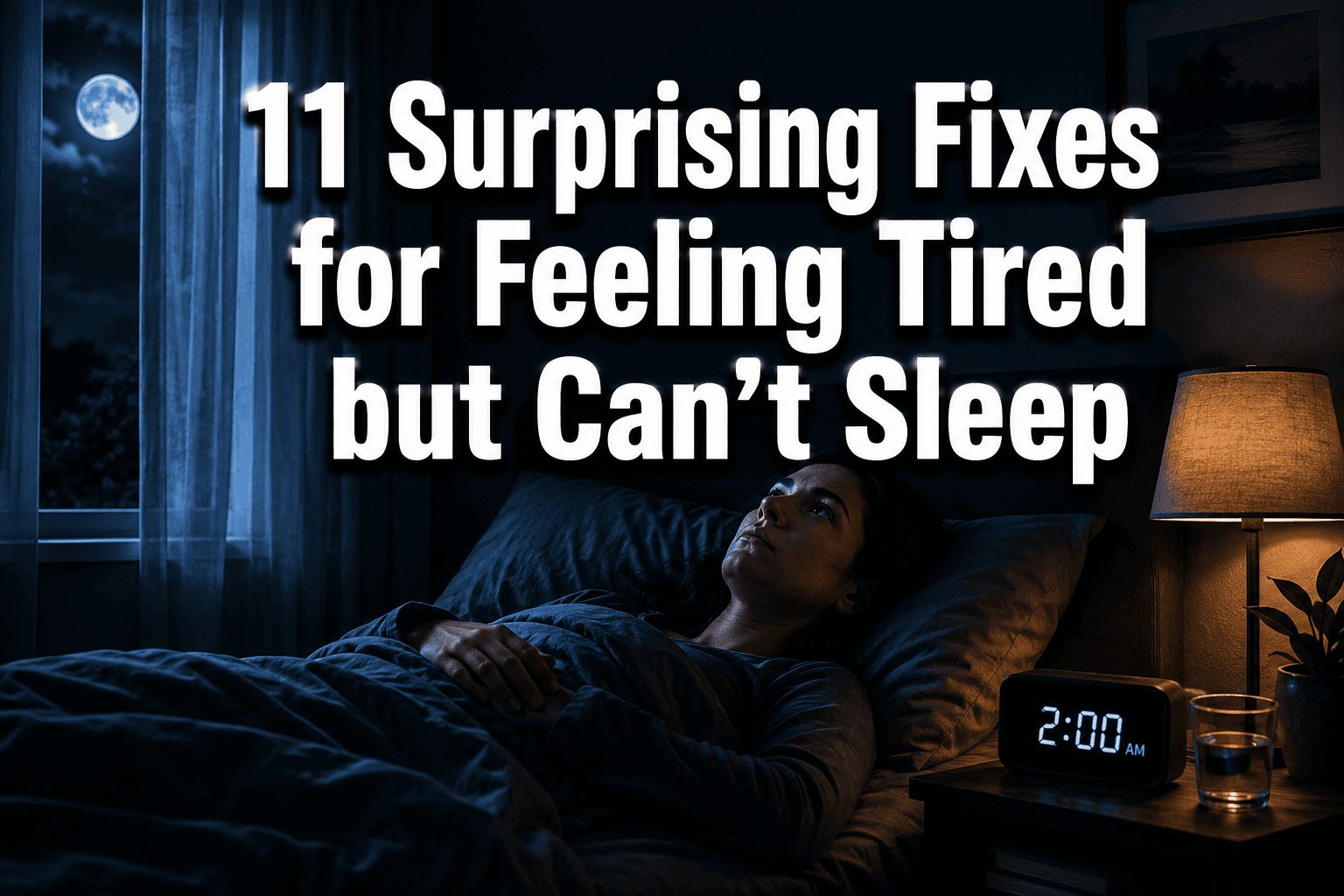
Quick Answer: Feeling tired but can’t sleep is usually caused by a mismatch between your body’s sleep drive and your nervous system’s arousal state – meaning your brain is stuck in alert mode even when your body is exhausted. The fixes that actually work target that arousal system directly, not just your bedtime habits. Most people skip straight to melatonin or screen-time rules, but the real levers are often elsewhere.
Key Takeaways
- The “tired but wired” feeling is a physiological state, not a character flaw or bad habit
- Cortisol dysregulation, anxiety, and circadian rhythm misalignment are the three most common causes
- Caffeine can stay active in your system for 8-10 hours, affecting sleep even when you don’t feel it
- Stimulus control – retraining your brain to associate bed with sleep – is one of the most evidence-backed fixes available
- If this has been happening for more than three weeks, it may meet the clinical criteria for insomnia
- Exercise timing matters more than most people realize
- You don’t have to fall asleep – you just have to rest. That shift in goal alone can reduce sleep-onset anxiety significantly
- Anxiety and medical conditions can both cause this pattern – they’re not mutually exclusive
- Chronic sleep deprivation changes how your brain processes tiredness, which is why you can feel exhausted and alert at the same time
- Seeing a doctor is warranted after two to three weeks of consistent difficulty, or sooner if it’s affecting daily function
Why Am I Tired but Can’t Fall Asleep – What’s Actually Happening
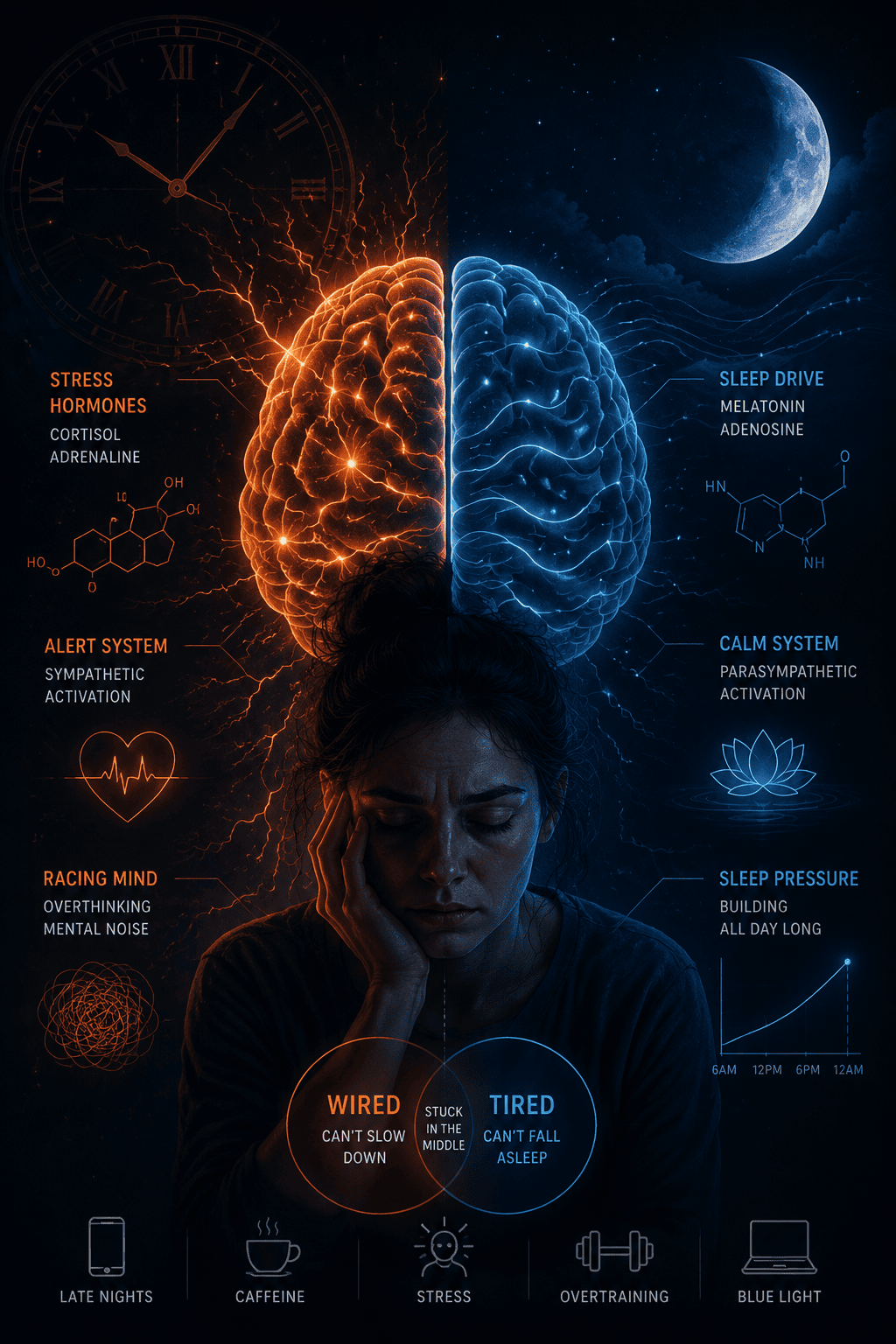
Your body has two separate systems driving sleep: sleep pressure (adenosine buildup from being awake) and circadian arousal (your brain’s alertness signal). When those two systems fall out of sync, you end up exhausted but unable to sleep.
This is sometimes called “hyperarousal” in the sleep research literature. Your nervous system is running in a low-grade fight-or-flight state – cortisol is elevated, your heart rate is slightly up, your mind is scanning for problems. Your body is tired. Your brain hasn’t gotten the memo.
It’s not just you. Research published in Sleep Medicine Reviews identifies hyperarousal as a core feature of chronic insomnia, present in both physiological measurements and self-reported experience. The honest version is that most people who struggle with sleep are dealing with a nervous system that never fully downshifts, not a willpower problem.
What Causes Being Exhausted but Unable to Sleep – The Real List
Several things can drive this pattern, and they often stack on top of each other.
The most common causes:
- Cortisol dysregulation – stress hormones that should drop at night staying elevated
- Anxiety – both general anxiety and sleep-specific anxiety (worrying about not sleeping)
- Circadian misalignment – your internal clock shifted later than your schedule allows
- Caffeine – still active in your system even 8-10 hours after your last cup (more on this below)
- Blue light and screen use – suppresses melatonin, but this is rarely the only factor
- Underlying medical conditions – thyroid issues, sleep apnea, restless legs syndrome, chronic pain
- Napping too late – reduces sleep pressure by the time you actually need it
Worth trying if you’ve ruled out the obvious: check whether you’ve had a significant schedule change recently. Shift work, travel, or even a few late nights can shift your circadian rhythm enough to cause this for weeks afterward.
For a deeper look at what might be driving your specific pattern, this breakdown of surprising insomnia causes covers several that most people never consider.
Is It Normal to Feel Tired but Can’t Sleep – And When Does It Become Insomnia
Occasional nights where you’re tired but can’t sleep are completely normal. Stress, travel, illness, and life disruptions all cause this. It becomes a clinical concern when it happens three or more nights per week for three or more weeks, and when it affects your daytime function.
That’s roughly the threshold used in the DSM-5 criteria for insomnia disorder. If you’re hitting that pattern, it’s worth taking it seriously – not because something is catastrophically wrong, but because the longer it goes on, the more your brain learns to associate bed with wakefulness, which makes it harder to fix.
If you’ve been dealing with this for a while, it’s worth checking where you actually land on a validated scale.
Free Insomnia Test: If you recognize the pattern described above – exhausted but awake, night after night – take this free, anonymous insomnia screening test. It evaluates how you’ve felt over the past two weeks and takes about two minutes. It won’t diagnose you, but it gives you a clearer picture of what you’re dealing with.
Tired but Wired at Night – What That Phrase Actually Means
“Tired but wired” describes a specific physiological state where sleep drive is high but nervous system arousal is also high. The two cancel each other out in terms of your ability to actually fall asleep.
I’ve experienced this firsthand. There are nights where I’m genuinely exhausted – heavy limbs, slow thinking, yawning every few minutes – and still lying awake at 1am with my mind running through tomorrow’s to-do list. It’s one of the most frustrating feelings I know.
The reason this matters is that treating it requires calming the arousal system, not just increasing sleep pressure. More exercise, more tiredness, more time in bed – none of that helps if your nervous system is still switched on. You need to address the “wired” part, not just the “tired” part.
Does Caffeine Make You Tired but Can’t Sleep – Yes, More Than You Think
Caffeine blocks adenosine receptors – the same receptors that build up sleep pressure throughout the day. When caffeine wears off, adenosine floods back in, which is why you feel a crash. But the caffeine itself can still be partially active in your system for much longer.
The half-life of caffeine is roughly 5-6 hours in most adults, meaning a 2pm coffee still has about half its caffeine load in your system at 8pm. For people who metabolize caffeine slowly (a genetic variation in the CYP1A2 gene), that window extends even further. The Sleep Foundation notes that caffeine sensitivity varies significantly between individuals.
In practice this means: if you’re tired but can’t sleep and you’re drinking coffee, tea, or energy drinks past noon, cut that off first. It’s not glamorous advice, but it’s one of the highest-leverage changes you can make.
Tired but Can’t Sleep – Anxiety or Medical Condition
Both. And often at the same time.
Anxiety is one of the most common drivers of the tired-but-can’t-sleep pattern. The mind races, the body stays tense, and even when you’re exhausted, sleep won’t come. But anxiety doesn’t rule out a medical cause – in fact, untreated sleep apnea, thyroid dysfunction, and restless legs syndrome all cause fragmented or unrefreshing sleep, which then creates anxiety about sleep, which makes everything worse.
Sleep anxiety is its own specific pattern worth understanding – it’s different from general anxiety, and it responds to different interventions.
If you’re unsure whether anxiety or something physical is driving your sleep problems, this guide on why you can’t sleep even when you’re tired breaks down the distinction in more detail.
Can Exercise Make You Tired but Can’t Sleep
Yes – if the timing is wrong. Exercise raises core body temperature and increases cortisol and adrenaline, all of which promote alertness. For most people, intense exercise within two to three hours of bedtime delays sleep onset.
Here’s what the research actually says: a 2019 meta-analysis in Sports Medicine found that vigorous exercise ending less than one hour before bed was associated with longer sleep onset times. But moderate exercise earlier in the day consistently improved sleep quality.
The fix isn’t to stop exercising – it’s to shift it earlier. Morning or early afternoon exercise is associated with better sleep in most studies. If evening is your only option, lower-intensity movement like walking or yoga is less likely to cause problems.
How to Fall Asleep When You’re Tired but Restless – 11 Fixes That Work
These aren’t the standard sleep hygiene tips you’ve already tried. They’re targeted at the hyperarousal state specifically.
1. Try stimulus control therapy
Get out of bed if you’ve been awake for more than 20 minutes. Go to another room, do something quiet, and return only when sleepy. This breaks the brain’s association between bed and wakefulness. It’s uncomfortable at first, but it’s one of the most evidence-backed tools in CBT-I (Cognitive Behavioral Therapy for Insomnia).
2. Shift your goal from sleeping to resting
You don’t have to fall asleep – you just have to rest. Seriously. When you stop fighting sleep and just allow yourself to lie still without the pressure to be unconscious, the arousal system often quiets on its own. This isn’t a trick – it’s a neurological reality.
3. Try a body scan instead of counting sheep
Slow, deliberate attention to physical sensations – starting at your feet and moving upward – activates the parasympathetic nervous system. It gives your mind something concrete to do instead of spiraling.
4. Lower your room temperature
Core body temperature needs to drop by about 1-2 degrees Fahrenheit to initiate sleep. A cooler room (around 65-68°F / 18-20°C) supports that drop. The NIH notes that thermoregulation plays a direct role in sleep onset.
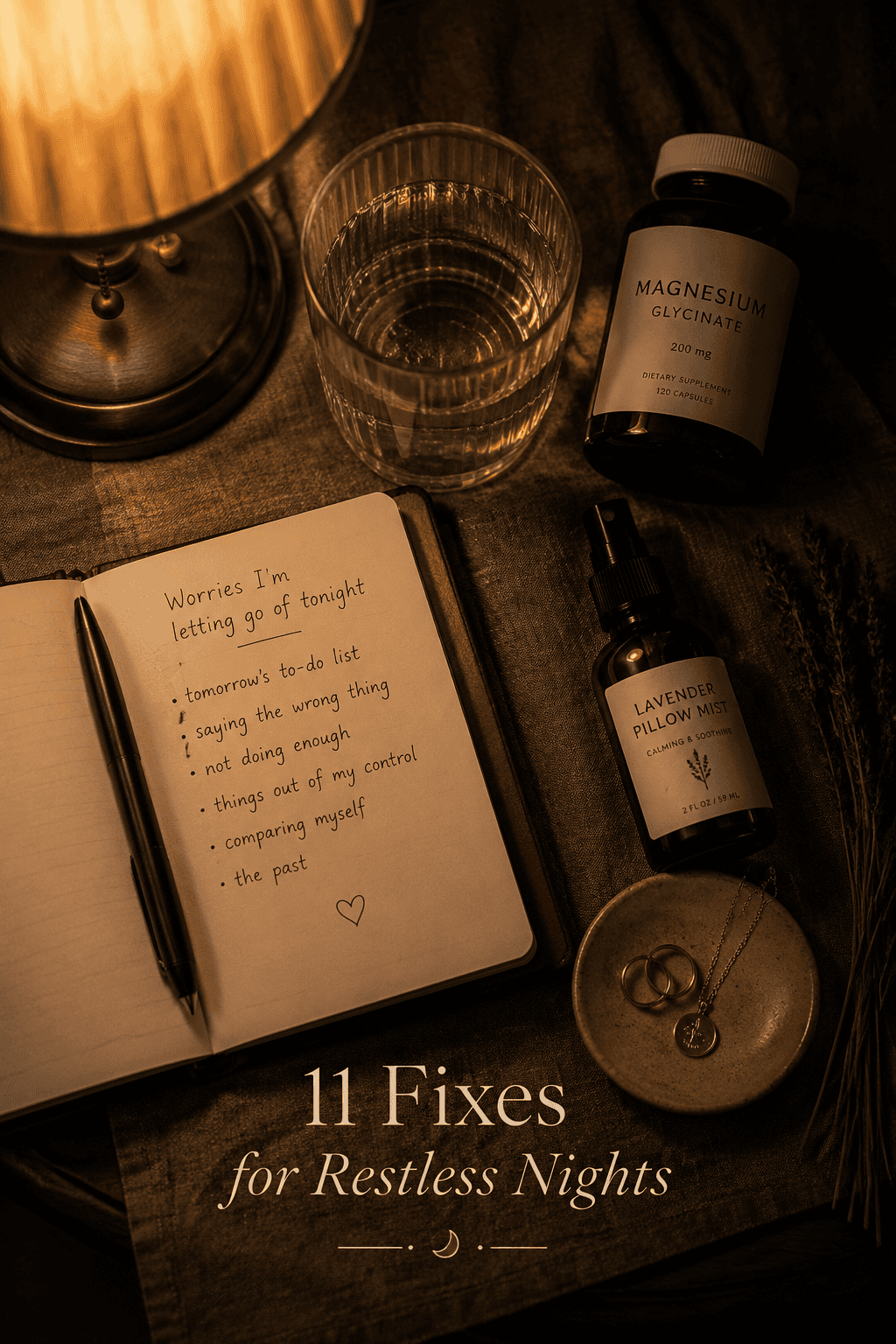
5. Use a “worry window” earlier in the evening
Set aside 15-20 minutes before 9pm to write down everything on your mind. This gives your brain permission to process concerns before bed rather than at 1am. Calming your mind for sleep covers this technique in more depth.
6. Try magnesium glycinate
Some evidence supports magnesium’s role in GABA regulation, which promotes nervous system calm. Glycinate form is better absorbed and less likely to cause digestive issues. Worth trying if you’re not getting much dietary magnesium.
7. Use the 4-7-8 breathing pattern
Inhale for 4 counts, hold for 7, exhale for 8. The extended exhale activates the vagus nerve and slows heart rate. It feels awkward at first. Do it anyway.
8. Write a “done list” not a to-do list
Instead of planning tomorrow, write down what you completed today. It shifts your brain from anticipatory mode to completion mode – a subtle but real difference in how your nervous system responds.
9. Avoid the clock
Turn your clock away from view. Watching the time increases performance anxiety around sleep, which increases arousal. This is a small change with a disproportionate effect.
10. Delay your bedtime temporarily
This is sleep restriction – a core component of CBT-I. By staying up slightly later and compressing your sleep window, you build stronger sleep pressure. It’s harder before it gets easier, but it works. Fixing your sleep schedule walks through this step by step.
11. Address the anxiety layer directly
If anxiety is driving the wakefulness, sleep fixes alone won’t be enough. Falling asleep when stressed covers techniques that work on the anxiety component specifically.
Still not sure what’s driving your sleep problems? Take this free anonymous insomnia test – it takes two minutes and helps you evaluate your symptoms over the past two weeks. No sign-up required.
Tired but Can’t Sleep vs Tired and Sleeping Too Much – How to Tell the Difference
These look like opposite problems but can share the same root cause.
Tired but can’t sleep usually points to hyperarousal, anxiety, circadian disruption, or insomnia. Tired and sleeping too much – but still unrefreshing – often points to sleep apnea, depression, hypothyroidism, or hypersomnia.
The key question: when you do sleep, do you wake up feeling rested? If you’re getting 8+ hours and still feel exhausted, the problem isn’t sleep quantity – it’s sleep quality. What causes too much sleep covers that pattern in detail.
Tired but Can’t Sleep – How Many Days Is Too Long and When to See a Doctor
Two to three weeks of consistent difficulty is the threshold most sleep specialists use. But you should see a doctor sooner if:
- You’re falling asleep at dangerous times (driving, at work)
- You have symptoms of sleep apnea (loud snoring, gasping, waking with headaches)
- Your mood has significantly changed alongside the sleep problems
- You’ve tried basic interventions for two weeks with no improvement
The honest version is that most people wait too long. They assume bad sleep is just who they are now. It’s not. But it also doesn’t fix itself without some deliberate intervention – and sometimes that intervention needs professional support.
Not sure if your symptoms are serious? This free insomnia screening test is anonymous, takes two minutes, and can help you decide whether to seek professional support. It evaluates how you’ve been feeling over the past two weeks.
FAQ
Why do I feel so tired but can’t sleep no matter what I try?
This usually means your nervous system’s arousal state is overriding your sleep drive. The fix isn’t more tiredness – it’s reducing the arousal. Stimulus control, breathing techniques, and addressing anxiety are more effective than trying to force sleep.
Is being tired but unable to sleep a sign of insomnia?
It can be. If it happens three or more nights per week for three or more weeks and affects your daytime function, it meets the general criteria for insomnia disorder. A doctor or sleep specialist can confirm.
Can anxiety cause you to be tired but not sleep?
Yes. Anxiety keeps the nervous system in a low-grade alert state, which directly interferes with sleep onset even when you’re physically exhausted. The two conditions reinforce each other.
What’s the fastest way to fall asleep when you’re tired but restless?
Stimulus control (leaving the bed if awake for 20+ minutes) and diaphragmatic breathing are the fastest-acting evidence-based tools. Shifting your goal from “fall asleep” to “rest” also reduces performance anxiety quickly.
Does melatonin help when you’re tired but can’t sleep?
Melatonin helps most with circadian timing issues – jet lag, shift work, delayed sleep phase. It’s less effective for hyperarousal-driven insomnia. It’s not a sedative; it’s a timing signal.
Can being overtired make it harder to sleep?
Yes. Severe sleep deprivation can paradoxically increase cortisol and alertness, making sleep onset harder. This is sometimes called “sleep debt rebound” and it’s a real physiological effect.
Should I stay in bed if I can’t sleep?
No. Staying in bed while awake trains your brain to associate bed with wakefulness. Get up after 20 minutes, do something calm in low light, and return only when sleepy.
Is there a medical test for why I can’t sleep?
A sleep study (polysomnography) can diagnose sleep apnea and other sleep disorders. Blood tests can rule out thyroid issues, iron deficiency, and other medical causes. Start with your primary care doctor.
Conclusion
Feeling tired but can’t sleep is one of the most frustrating experiences in the world – and it’s more common than most people realize. The good news is that it’s not random, and it’s not permanent. There’s almost always a specific mechanism driving it, and most of those mechanisms respond to targeted interventions.
Start with the basics you haven’t tried yet: stimulus control, temperature, caffeine cutoff time, and shifting your goal from sleeping to resting. If those don’t move the needle after two weeks, dig deeper – anxiety, circadian timing, and medical causes are all worth investigating.
If you’ve been dealing with this for a while and nothing has worked, please don’t assume this is just how you sleep now. Understanding why you can’t sleep is the first step. Getting proper support is the next one.
You don’t have to white-knuckle your way through every night. There are real fixes. Some of them are just not the ones anyone told you about first.
References
- Riemann, D., et al. (2010). “The hyperarousal model of insomnia.” Sleep Medicine Reviews. https://pubmed.ncbi.nlm.nih.gov/20006979/
- Stutz, J., et al. (2019). “Effects of evening exercise on sleep in healthy participants.” Sports Medicine. https://pubmed.ncbi.nlm.nih.gov/30374942/
- Sleep Foundation. (2023). “Caffeine and Sleep.” https://www.sleepfoundation.org/nutrition/caffeine-and-sleep
- National Institutes of Health. (2022). “Brain Basics: Understanding Sleep.” https://www.ninds.nih.gov/health-information/public-education/brain-basics/brain-basics-understanding-sleep
- American Psychiatric Association. (2013). Diagnostic and Statistical Manual of Mental Disorders, Fifth Edition (DSM-5). Arlington, VA.
- Morin, C.M., et al. (2006). “Psychological and behavioral treatment of insomnia.” Sleep. https://pubmed.ncbi.nlm.nih.gov/17168476/