Post Disclaimer
This post contains affiliate links. If you buy something through these links, I may earn a small commission at no extra cost to you. Full disclosure.
This article is for informational purposes only and does not constitute medical advice. Always consult a healthcare professional for personal health concerns. Full disclaimer.
Last updated: July 4, 2026
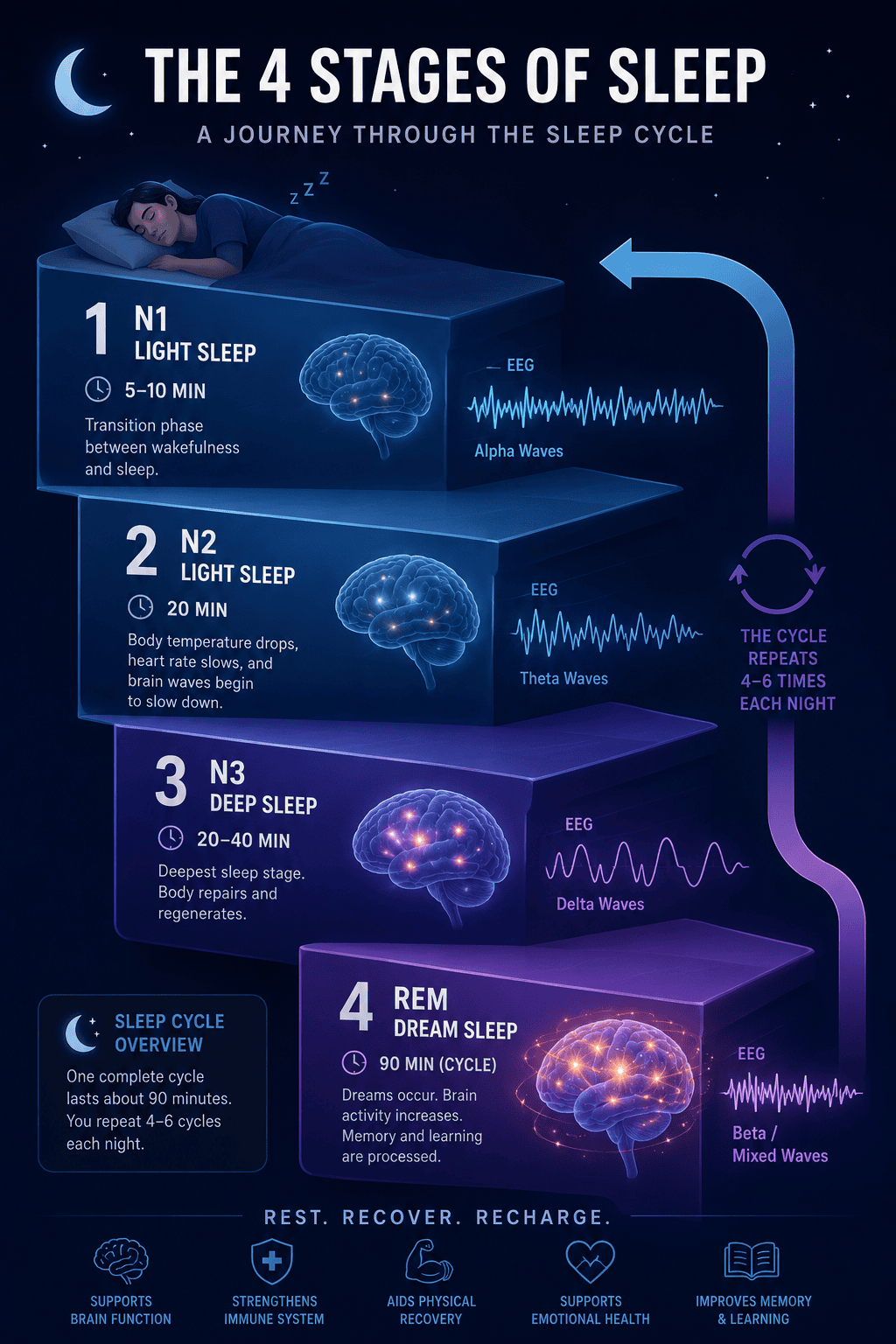
Quick Answer: The sleep cycle is a repeating sequence of four distinct stages your brain moves through during the night – roughly every 90 minutes. Two of those stages are light sleep, one is deep sleep, and one is REM (rapid eye movement) sleep. Most adults need 4-6 complete cycles per night to feel genuinely rested. If you’re sleeping 7-8 hours and still waking up exhausted, the problem is often cycle quality, not just total time in bed.
Key Takeaways
- A full sleep cycle lasts roughly 90 minutes and repeats 4-6 times per night [1]
- There are four stages: N1 (light), N2 (light), N3 (deep/slow-wave), and REM
- Deep sleep (N3) dominates early in the night; REM sleep gets longer toward morning [2]
- REM sleep is critical for memory consolidation and emotional regulation
- Missing deep sleep leaves you physically exhausted; missing REM affects mood and cognition
- Alcohol, inconsistent sleep timing, and stress are the top disruptors of healthy cycles
- Sleep trackers estimate stages using movement and heart rate – they’re useful but not precise
- Sleep cycles change significantly with age, and yes, pregnancy disrupts them too
- You can’t “skip” a stage intentionally, but your brain will prioritize what it missed
What Is the Sleep Cycle, Exactly?
The sleep cycle is the structured sequence your brain runs through repeatedly while you sleep – not a single block of unconsciousness, but a series of distinct biological phases, each doing different repair work. Most people think of sleep as an on/off switch. It isn’t. Your brain is actively cycling through states all night long [1].
A single cycle takes roughly 90 minutes on average, though this varies between 70 and 120 minutes depending on the person and the point in the night [2]. Over a full 7-8 hour night, you’ll complete about 4-5 of these cycles.
The reason this matters is that waking up at the wrong point in a cycle – say, during deep sleep – is why you can technically get 8 hours and still feel like you’ve been hit by a truck.
What Are the 4 Stages of Sleep and How Long Do They Last?
The four stages break down into two categories: non-REM (NREM) sleep, which has three stages, and REM sleep. Here’s what each one actually does [1][6]:
Stage N1 – Light Sleep (1-7 minutes)
This is the transition between wakefulness and sleep. Your muscles relax, your heart rate slows, and your brain produces theta waves. It’s easy to wake someone in N1 – they’ll often say they weren’t even asleep yet. This stage makes up about 5% of total sleep time [3].
Stage N2 – Deeper Light Sleep (10-25 minutes per cycle)
Your body temperature drops, eye movements stop, and your brain produces sleep spindles – bursts of neural activity thought to play a role in memory consolidation. N2 is where you spend the most time overall, roughly 45-55% of your night [1][5].
Stage N3 – Deep Sleep / Slow-Wave Sleep (20-40 minutes, mostly early in the night)
This is the physically restorative stage. Growth hormone is released, tissue repair happens, and your immune system gets a significant boost. Your brain produces slow delta waves. It’s genuinely hard to wake someone from N3, and if you do, they’ll be disoriented for several minutes [6].
REM Sleep (starts at about 10 minutes, extends to 60+ minutes in later cycles)
Your eyes move rapidly behind closed eyelids, your brain activity looks almost identical to wakefulness, and your body is essentially paralyzed from the neck down – a protective mechanism so you don’t act out your dreams. REM is where emotional processing and memory consolidation happen [2][8].
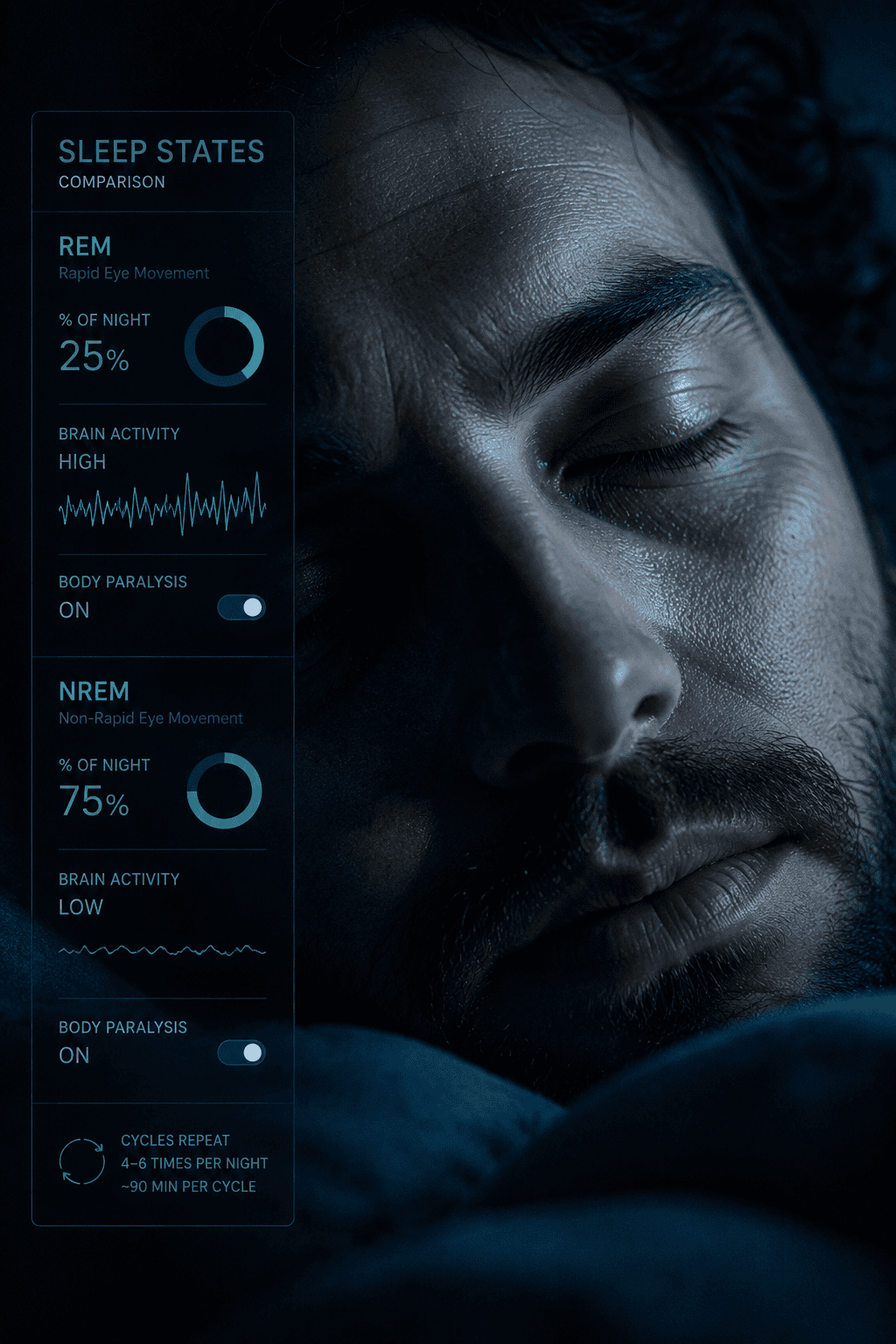
What Happens During REM Sleep vs Non-REM Sleep?
The honest version is that these two categories serve completely different biological functions, and you need both.
Non-REM sleep is primarily physical. Your body uses N3 deep sleep to repair muscle tissue, regulate hormones, and strengthen the immune system. Blood pressure drops, breathing slows, and your brain essentially goes into maintenance mode [6].
REM sleep is primarily mental. Your brain processes emotional experiences, consolidates declarative memory (facts and events), and clears out metabolic waste. Research suggests REM sleep also plays a role in creativity and problem-solving – the brain is making connections between information stored throughout the day [8].
In practice this means: if you’re waking up physically exhausted, you may be losing deep sleep. If you’re waking up emotionally raw, anxious, or mentally foggy, you’re likely cutting short your REM cycles – which happen mostly in the second half of the night.
Why Do We Cycle Through Sleep Stages Multiple Times a Night?
Your brain cycles because different stages serve different functions at different points in the night – it’s not random repetition.
Early cycles (the first 2-3 hours) are weighted heavily toward N3 deep sleep. Your body front-loads physical restoration. Later cycles shift toward longer REM periods, which is why your most vivid dreams happen close to morning [1][2].
This also explains why cutting sleep short by even 1-2 hours disproportionately wipes out REM sleep. You’re not losing a proportional slice of all stages – you’re cutting off the end of the night where REM dominates.
I’ve noticed this in my own sleep patterns. On nights when I only get 5-6 hours, I don’t just feel tired – I feel emotionally brittle and mentally slow in a way that feels different from physical fatigue. That’s REM deprivation, and it’s not just you.
What’s the Difference Between Light Sleep and Deep Sleep?
Light sleep (N1 and N2) keeps you in a recoverable state – your brain is still somewhat responsive to the environment, and waking up from it feels relatively natural. Deep sleep (N3) is where your brain actively resists waking. Your body is doing its most intensive repair work [3][5].
A useful way to think about it:
- Light sleep = the brain idling, processing, filing
- Deep sleep = the body in full repair mode, do not disturb
Most people who struggle with sleep are actually getting adequate light sleep but fragmenting their deep sleep – whether through noise, stress hormones, alcohol, or an irregular schedule.
How Long Should Each Sleep Stage Take for Good Health?
For a healthy adult sleeping 7-9 hours per night, rough targets look like this [1][6]:
| Stage | % of Total Sleep | Approx. Time (8-hr night) |
|---|---|---|
| N1 (Light) | 5% | ~25 minutes |
| N2 (Light) | 45-55% | ~220 minutes |
| N3 (Deep) | 13-23% | ~90 minutes |
| REM | 20-25% | ~100 minutes |
These are population averages, not personal targets you should stress about hitting. The numbers shift with age, health status, and what happened the previous night.
Can You Skip a Sleep Stage or Get Too Much Deep Sleep?
You can’t consciously skip a stage – your brain decides the sequence. But stages can be suppressed or shortened by external factors. Alcohol is a classic example: it suppresses REM sleep in the first half of the night, then causes a REM rebound in the second half that often wakes you up [5].
As for getting too much deep sleep – it’s rare in healthy adults. When it does happen, it’s usually the brain compensating for prior deep sleep deprivation (called slow-wave sleep rebound). If you’re consistently showing unusually high deep sleep on a tracker, it’s worth checking whether you’re actually sleep-deprived overall.
If you’re concerned about your sleep patterns, it might be worth checking out the silent signs of a sleep disorder – some of them are easy to miss.
What Happens If You Don’t Get Enough REM Sleep?
Short-term REM deprivation hits mood and cognition fast. After just a few nights of disrupted REM, most people experience increased anxiety, difficulty concentrating, and emotional reactivity that feels disproportionate to what’s actually happening [8].
Longer-term, here’s what the research actually says: chronic REM disruption has been linked to impaired memory consolidation, reduced emotional resilience, and – in some studies – associations with increased risk of mood disorders [2][8].
The frustrating part for people with insomnia is that anxiety itself disrupts REM sleep, which then increases anxiety, which then disrupts sleep again. It’s a loop that’s hard to break without addressing both sides. If you’re stuck in that cycle, sleep anxiety is worth reading about – it’s more common than most people realize.
If you’re experiencing ongoing sleep disruption and want to understand the severity, this free anonymous test can help you evaluate your symptoms over the past two weeks: Take the insomnia test here
Do Sleep Cycles Change With Age or Pregnancy?
Yes, significantly – and this is one of the most under-discussed parts of sleep science.
With age: Deep sleep (N3) decreases substantially as you get older. Adults over 60 may spend as little as 5-8% of their night in deep sleep, compared to 20%+ in young adults [10]. This is partly why older adults wake more easily and feel less restored by sleep – it’s not just perception.
With pregnancy: Sleep architecture shifts throughout all three trimesters. In early pregnancy, progesterone increases total sleep time but fragments it. By the third trimester, physical discomfort, frequent urination, and fetal movement significantly reduce deep sleep. REM sleep is also disrupted. If you’re pregnant and struggling, insomnia during pregnancy covers what’s actually going on and what helps.
For shift workers: Circadian misalignment – working nights and sleeping days – disrupts the natural timing of sleep stages. Your body’s internal clock still tries to push deep sleep at certain biological times, regardless of when you actually go to bed. This is why shift work sleep feels less restorative even when total hours are adequate.
How Do Sleep Trackers Measure Sleep Stages Accurately?
Most consumer sleep trackers (Fitbit, Oura, Apple Watch, Garmin) estimate sleep stages using a combination of movement (actigraphy) and heart rate variability. They do not measure brain activity directly – that requires a polysomnography (PSG) test in a sleep lab [4][7].
The honest version is: consumer trackers are reasonably accurate for distinguishing sleep from wakefulness and for identifying broad patterns over time. They’re less reliable for precise stage breakdowns on any given night [7].
That said, they’re genuinely useful for spotting trends – like consistently low deep sleep percentages or frequent nighttime awakenings – that give you something actionable to work with. Just don’t treat a single night’s data as diagnostic.
What Disrupts Sleep Cycles and How to Fix It
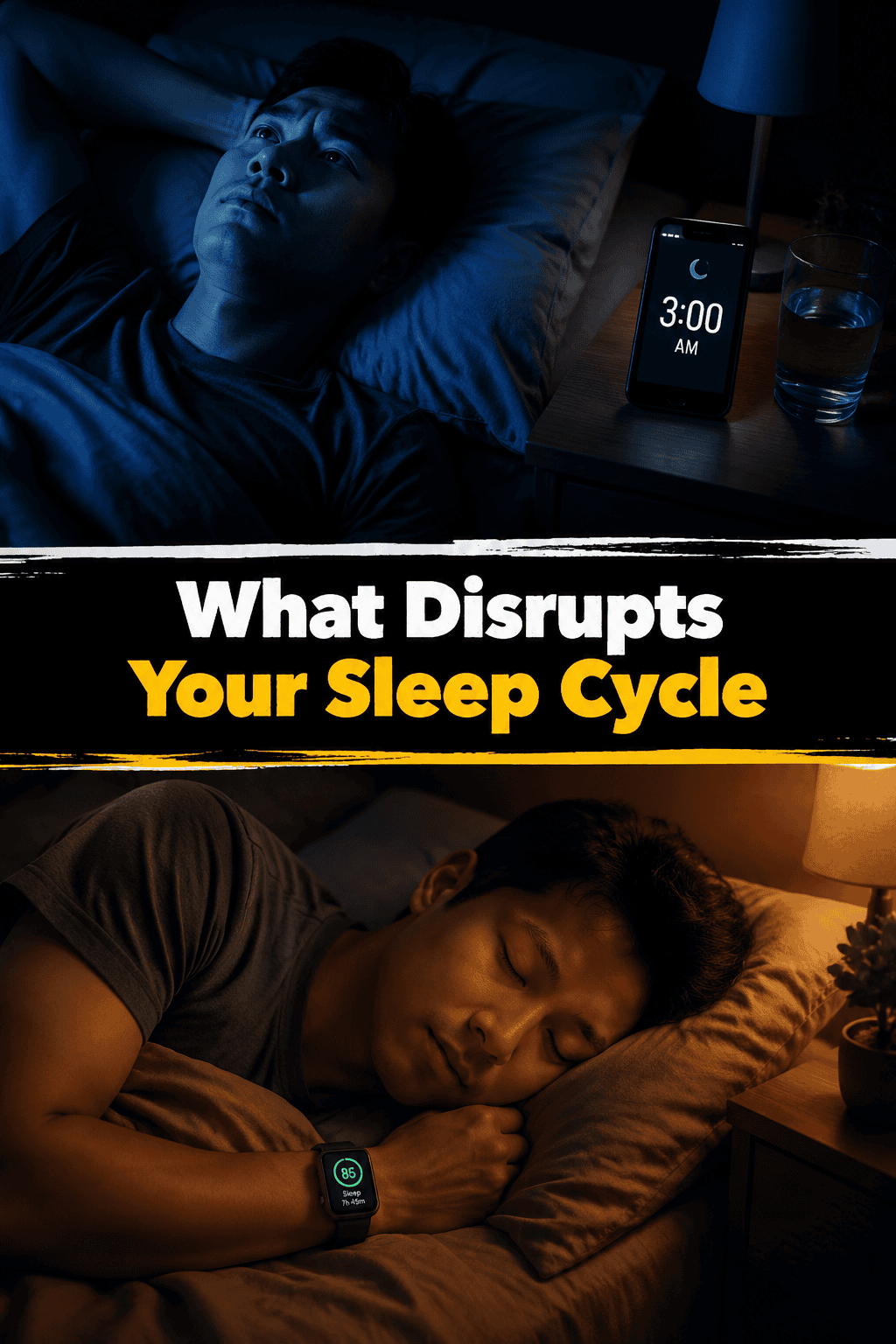
Several things reliably fragment sleep cycles, and most people dealing with chronic sleep problems are dealing with more than one at once [3][5]:
Common disruptors:
- Alcohol (suppresses REM, causes second-half fragmentation)
- Inconsistent sleep/wake times (disrupts circadian timing of stages)
- Stress and elevated cortisol (delays and fragments deep sleep)
- Blue light exposure close to bedtime (delays sleep onset, compresses early cycles)
- Sleep apnea (repeatedly pulls you out of deep and REM sleep)
- Caffeine after 2pm (extends N1, reduces N3 duration)
What actually helps:
- Consistent wake time – this is the single most effective anchor for cycle timing
- Keeping the bedroom cool (around 65-68°F / 18-20°C supports N3)
- Limiting alcohol within 3 hours of bed
- Addressing stress before it follows you into sleep – calming your mind before bed is worth the effort
If you’ve been dealing with this for a while and sleep hygiene advice hasn’t moved the needle, it may be worth looking at what’s actually causing your lack of sleep – sometimes the root cause isn’t what you’d expect.
Is It Bad to Wake Up During Different Sleep Stages?
Waking during N3 deep sleep causes “sleep inertia” – that heavy, disoriented grogginess that can last 20-30 minutes. Waking during REM sleep tends to feel more alert (you’re closer to wakefulness already) and is when you’re most likely to remember dreams [1][3].
Brief awakenings between cycles are normal – most people wake 10-30 seconds between cycles without remembering it. It only becomes a problem when you can’t get back to sleep.
If you’re waking up at a specific time – say, consistently at 3am – that’s often related to where you are in your cycle, cortisol rhythms, or blood sugar, not just random bad luck. Why you keep waking up at 3am has more on that.
How Can I Get More Deep Sleep Naturally?
Deep sleep responds well to a few specific inputs, and most of them aren’t complicated – they’re just inconsistently applied [5][6]:
- Exercise – moderate aerobic exercise increases slow-wave sleep, but timing matters. Morning or afternoon exercise helps; intense exercise within 2 hours of bed can delay sleep onset.
- Temperature – your core body temperature needs to drop to enter deep sleep. A cool room, a warm bath 1-2 hours before bed (which triggers the subsequent temperature drop), or cooling mattress pads all support this.
- Consistent schedule – your brain anticipates deep sleep at specific biological times. Irregular bedtimes fragment it.
- Reducing alcohol – even moderate drinking compresses N3 duration.
For a deeper look, how to improve deep sleep covers 11 specific strategies with the evidence behind each one.
Do Sleep Cycles Work the Same for Shift Workers?
Not exactly. Shift workers face a fundamental conflict between their work schedule and their circadian biology – the internal clock that regulates when each sleep stage occurs [9].
The circadian system is designed to deliver deep sleep in the early part of the biological night and REM sleep toward morning. When a night shift worker sleeps from 8am to 4pm, their circadian clock is still running on its original schedule – which means stage timing gets compressed or misaligned.
In practice this means shift workers often get less deep sleep and less REM sleep per sleep period, even if total hours look adequate. Strategic light exposure, consistent sleep timing on days off (rather than swinging back to a normal schedule), and keeping the sleep environment dark and cool all help – but there’s no perfect fix for circadian misalignment.
What Is the Sleep Cycle for People With Insomnia?
For people with chronic insomnia, the sleep cycle doesn’t disappear – but it gets fragmented, compressed, and shifted. The most common pattern is extended N1 (lying awake trying to fall asleep), reduced N3 deep sleep, and disrupted REM [2].
This is part of why insomnia feels so defeating. You’re not just losing sleep time – you’re losing the most restorative parts of the cycle. And because deep sleep and REM are the stages that regulate mood and stress response, insomnia feeds itself.
If you’re struggling with ongoing symptoms and want a clearer picture of what you’re dealing with, this free anonymous test evaluates how you’ve been feeling over the past two weeks: Take the insomnia assessment here
You don’t have to fall asleep – you just have to rest. But understanding what your brain is actually trying to do when you sleep makes it easier to stop fighting the process and start working with it.
Conclusion
Understanding what the sleep cycle is – and what each stage actually does – changes how you approach sleep problems. It shifts the question from “why can’t I sleep?” to “which part of the cycle am I losing, and why?”
If you’re waking up physically exhausted, deep sleep is the likely target. If you’re emotionally reactive, foggy, or anxious, look at your REM. If you’re getting adequate hours but still feel unrefreshed, fragmentation between cycles is probably the issue.
Actionable next steps:
- Fix your wake time first – it anchors every cycle that follows
- Keep your room cool – your body needs a temperature drop to enter deep sleep
- Cut alcohol within 3 hours of bed – it’s the most reliable REM suppressor most people don’t account for
- If you’re still struggling after addressing the basics, look at whether a sleep disorder might be involved – the silent signs are often overlooked
- If you want to understand the severity of your symptoms, take the free insomnia test – it takes a few minutes and gives you a clearer starting point
Sleep isn’t something you perform correctly. It’s something your brain does when the conditions are right. Your job is mostly to stop getting in the way.
Frequently Asked Questions
How many sleep cycles per night is normal?
Most adults complete 4-6 full sleep cycles per night. Each cycle lasts roughly 90 minutes, so a 7.5-hour night aligns well with 5 complete cycles [1].
What is the most important sleep stage?
All four stages serve distinct functions, so “most important” depends on what you’re recovering from. Deep sleep (N3) is most critical for physical restoration; REM is most critical for emotional and cognitive health [6].
Can you increase REM sleep?
Yes. Consistent sleep timing, avoiding alcohol, managing stress before bed, and simply sleeping long enough (REM is weighted toward the end of the night) all increase REM duration. See how to improve REM sleep for specifics.
Why do I feel groggy even after 8 hours of sleep?
Grogginess after adequate sleep usually points to poor sleep quality – specifically fragmented deep sleep or waking during N3. Sleep apnea, alcohol, and irregular schedules are common causes [3][5].
Does napping count toward sleep cycles?
A 90-minute nap can include a full cycle, including some deep sleep. Shorter naps (20-30 minutes) stay in N1/N2 and avoid sleep inertia. Napping late in the day can reduce deep sleep drive at night [7].
At what age does deep sleep start to decline?
Deep sleep begins declining in the mid-20s and continues gradually throughout adulthood. By age 60-70, many people spend significantly less time in N3 than they did in their 30s [10].
Is REM sleep the same as dreaming?
Most vivid dreaming occurs during REM sleep, but dreaming can also occur in NREM stages – particularly N2. REM dreams tend to be more narrative and emotionally intense [8].
Can stress permanently damage your sleep cycles?
Chronic stress disrupts sleep architecture, but the damage isn’t permanent. Addressing the stress response – through therapy, lifestyle changes, or both – typically allows sleep cycles to normalize over time [2].
Why does alcohol feel like it helps sleep but actually doesn’t?
Alcohol has sedative effects that speed up sleep onset, but it suppresses REM sleep and causes arousal in the second half of the night as it metabolizes. You fall asleep faster but cycle quality drops significantly [5].
How accurate are sleep stage readings on smartwatches?
Consumer trackers are moderately accurate for broad patterns (total sleep, rough stage proportions) but not reliable for precise nightly stage data. Use them to track trends, not as diagnostic tools [7].
References
[1] Stages Of Sleep – https://www.sleepfoundation.org/stages-of-sleep
[2] NBK526132 – https://www.ncbi.nlm.nih.gov/books/NBK526132/
[3] Sleep Basics – https://my.clevelandclinic.org/health/body/12148-sleep-basics
[4] Sleep Cycle Stages – https://www.medicalnewstoday.com/articles/sleep-cycle-stages
[5] Stages Of Sleep – https://www.healthline.com/health/healthy-sleep/stages-of-sleep
[6] Stages Of Sleep – https://www.nhlbi.nih.gov/health/sleep/stages-of-sleep
[7] Sleep Cycles: What You Need To Know – https://www.teladochealth.com/library/article/sleep-cycles-what-you-need-to-know
[8] NBK10996 – https://www.ncbi.nlm.nih.gov/books/NBK10996/
[9] Sleep Stages And Circadian Rhythms – https://www.khanacademy.org/science/health-and-medicine/executive-systems-of-the-brain/sleep-and-consciousness-lesson/v/sleep-stages-and-circadian-rhythms
[10] Sleep Cycles – https://www.ncoa.org/adviser/sleep/sleep-cycles/