Post Disclaimer
This post contains affiliate links. If you buy something through these links, I may earn a small commission at no extra cost to you. Full disclosure.
This article is for informational purposes only and does not constitute medical advice. Always consult a healthcare professional for personal health concerns. Full disclaimer.
Last updated: July 6, 2026
Quick Answer: A broken sleep cycle means your body is failing to move through the normal stages of sleep in the right order or duration – leaving you exhausted even after a full night in bed. The signs are often subtle: waking at odd hours, feeling foggy all morning, or never feeling truly rested. The good news is that most disrupted sleep cycles can be reset naturally, without medication, by targeting your circadian rhythm directly.
Key Takeaways
- A normal sleep cycle lasts roughly 90-96 minutes and repeats 4-6 times per night, cycling through light, deep, and REM sleep [2]
- Over 14% of American adults report difficulty falling asleep most days – so if this is you, it’s not just you [8]
- Feeling tired after 8 hours is one of the clearest signs something is wrong with your sleep architecture, not just your sleep duration
- Waking at the same time every night is usually a physiological pattern, not random
- Blue light, irregular schedules, and stress are the three most common cycle disruptors
- Resetting your circadian rhythm naturally takes most people 1-3 weeks of consistent effort
- Insomnia and a broken sleep cycle overlap but are not the same thing
- Morning light exposure is one of the most underused and most effective reset tools available
What Is a Normal Sleep Cycle?
A normal sleep cycle is a repeating sequence of sleep stages your brain moves through each night, typically lasting around 90-96 minutes per cycle [2]. Most adults complete 4-6 of these cycles per night. Each cycle includes light sleep, deep slow-wave sleep, and REM (rapid eye movement) sleep – each serving a different biological purpose.
For a deeper breakdown of how these stages work, the What Is the Sleep Cycle? The 4 Stages Explained guide covers this in detail.
Here is what a typical cycle looks like:
| Stage | Type | Duration (approx.) | Function |
|---|---|---|---|
| N1 | Light NREM | 1-7 minutes | Transition to sleep |
| N2 | Core NREM | 10-25 minutes | Heart rate drops, body cools |
| N3 | Deep NREM | 20-40 minutes | Physical repair, immune function |
| REM | REM sleep | 10-60 minutes | Memory, emotional processing |
REM sleep gets longer in later cycles – which is why cutting sleep short by even an hour can disproportionately reduce your REM time. That matters more than most people realize.
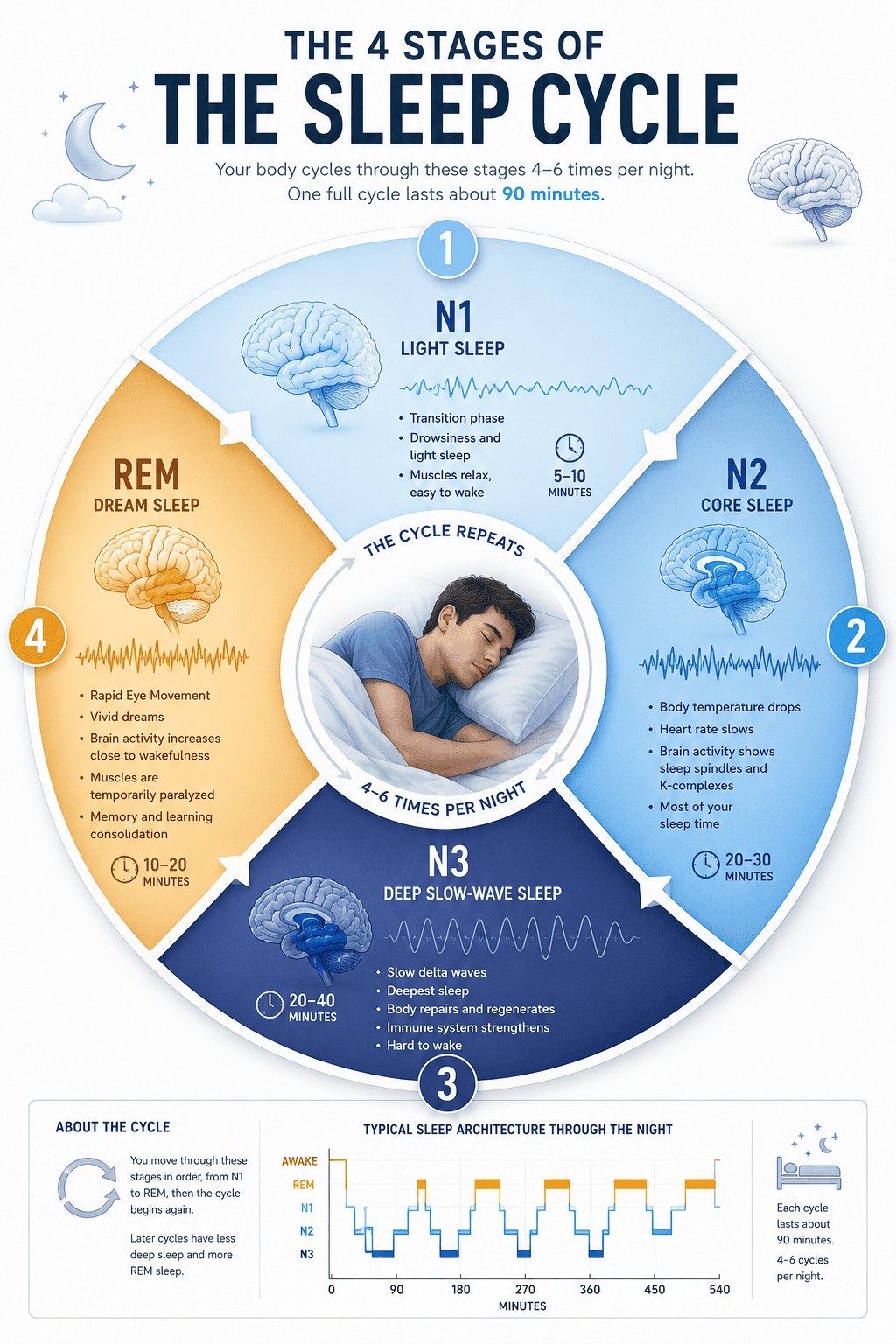
The 4 Stages of Sleep and How Long They Last
Each stage of sleep does something specific. N3 deep sleep handles physical recovery – tissue repair, immune function, growth hormone release [7]. REM sleep handles memory consolidation and emotional regulation. Neither stage is optional.
A study of 369 participants found that sleep cycle duration varies significantly between individuals, with a median cycle of 96 minutes. Age and sex influenced cycle length, but moderate environmental factors like light and noise had less impact than expected [2].
In practice this means your sleep architecture is partly biological – but it is also highly sensitive to behavioral and environmental inputs you can actually control.
How Many Hours of Sleep Do You Actually Need?
Most adults need 7-9 hours, but the honest version is that the number matters less than the quality of the cycles within those hours.
Research published in Nature found an inverted U-shaped relationship between sleep duration and biological aging – meaning both too little and too much sleep can accelerate aging processes [3]. Sleeping 6 hours consistently is not a personality trait. It is a deficit with measurable consequences.
That said, some people genuinely function on 7 hours. Others need 9. If you want a more detailed look at how to figure out your actual number, How Much Sleep Should I Get? It’s More Than Just Age is worth reading.
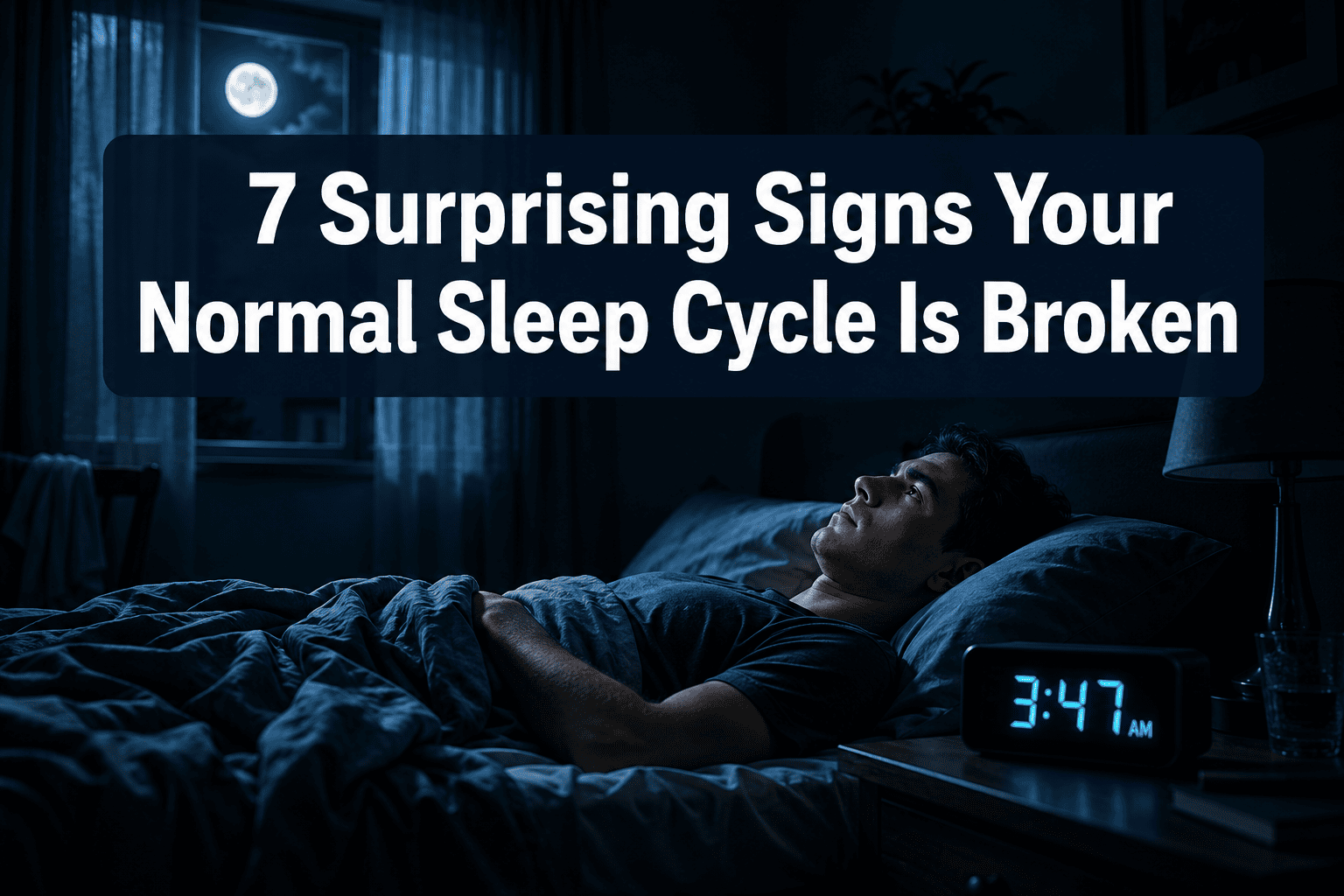
7 Surprising Signs Your Normal Sleep Cycle Is Broken
Most people assume broken sleep means not sleeping enough. But the signs are often more specific than that.
1. You wake up at the same time every night
This is rarely random. Waking consistently at 2am or 3am often reflects a shift in sleep stage timing – your body is surfacing from deep sleep into light sleep and not returning. Cortisol, alcohol metabolism, and blood sugar fluctuations are common triggers. See Why Do I Keep Waking Up at 3am? Real Reasons for specifics.
2. You feel exhausted after 8 hours of sleep
This is one of the most frustrating signs. If you are sleeping long enough but waking up feeling like you barely slept, your deep sleep or REM sleep is likely being compressed or fragmented. Duration is not the same as quality.
3. You cannot fall asleep until very late, no matter how tired you are
This points to a delayed circadian phase – your internal clock is shifted later than your lifestyle requires. It is not insomnia in the traditional sense. It is a timing problem.
4. You feel wide awake at bedtime but exhausted in the morning
Classic circadian misalignment. Your alertness peak is arriving at the wrong time for your schedule.
5. You need an alarm to wake up every day
A healthy sleep cycle ends naturally when your body has completed enough cycles. Relying on an alarm every single day – and feeling terrible when it goes off – suggests your sleep timing is off, not just your duration.
6. Your energy crashes hard in the early afternoon
A mild post-lunch dip is normal. A crash that makes it hard to function points to poor sleep architecture the night before, particularly insufficient deep sleep.
7. You feel mentally foggy for hours after waking
This is called sleep inertia, and while some grogginess is normal, extended fogginess lasting more than 30-45 minutes suggests you are waking during deep sleep – a sign your cycle timing is disrupted.
If you’ve been dealing with this for a while and recognize several of these signs, it’s worth taking a proper assessment. This free, anonymous insomnia test evaluates how you’ve felt over the past two weeks and can help clarify what you’re dealing with: Take the free insomnia test here. It takes a few minutes and gives you a clearer starting point.
Why Do You Feel Tired Even After 8 Hours of Sleep?
Feeling tired after a full night is almost always a sleep quality problem, not a sleep quantity problem. Your brain needs sufficient time in N3 deep sleep and REM sleep – and both can be disrupted without you knowing it.
Common reasons your sleep quality is poor even when duration looks fine:
- Alcohol before bed – it suppresses REM sleep in the second half of the night
- Sleep apnea – causes micro-arousals you may never consciously notice
- Anxiety – keeps the nervous system activated, preventing deep sleep entry
- Inconsistent sleep timing – disrupts the circadian signal that triggers deep sleep
If this is a persistent issue, How to Stop Waking Up Tired: 9 Hidden Habits Explained covers the specific habits that compress sleep quality.

What Causes a Disrupted Sleep Cycle?
Disrupted sleep cycles have both behavioral and physiological causes. The most common ones are:
Circadian rhythm disruption – Artificial light exposure, irregular schedules, and shift work all interfere with the body’s internal clock [4]. Your circadian rhythm controls when your brain releases melatonin and when cortisol rises – get those signals wrong and your sleep architecture collapses.
Stress and anxiety – A hyperactivated nervous system prevents the transition into deep sleep. The brain stays in a lighter, more vigilant state. If racing thoughts are part of your problem, How to Calm Your Mind for Sleep: 9 Techniques That Work is directly relevant.
Blue light exposure – Screens emit light in the wavelength range that suppresses melatonin production. Using a phone or laptop in the hour before bed delays your sleep onset signal. This is well-established in the research [4].
Irregular sleep timing – Going to bed at wildly different times on weekdays versus weekends – sometimes called social jetlag – confuses your circadian clock just as much as actual travel across time zones.
Underlying sleep disorders – If you have tried fixing your habits and nothing has shifted, it is worth checking whether something like sleep apnea or a circadian rhythm disorder is involved. Silent Signs of a Sleep Disorder You Might Be Ignoring covers what to look for.
What’s the Difference Between Insomnia and a Broken Sleep Cycle?
Insomnia is specifically the inability to fall or stay asleep despite adequate opportunity – and it causes daytime impairment. A broken sleep cycle is broader: it includes timing problems, quality problems, and architectural problems that may not fit the clinical definition of insomnia.
You can have a disrupted sleep cycle without insomnia – for example, if you sleep 8 hours but your REM sleep is severely compressed. You can also have insomnia without a fully broken cycle – if the problem is purely sleep onset difficulty but your cycles, once started, are normal.
The distinction matters because the fixes are different. Insomnia often responds well to CBT-I (cognitive behavioral therapy for insomnia). A circadian phase delay responds better to light therapy and schedule shifting.
How to Know If Your Sleep Cycle Is Messed Up
The clearest indicators are: waking unrefreshed despite adequate hours, consistent middle-of-the-night waking, extreme difficulty falling asleep at a normal time, and daytime impairment that does not improve with more time in bed.
If you recognize yourself in several of the 7 signs above, it is worth getting a clearer picture of what is happening. This free anonymous insomnia test asks about your experience over the past two weeks and helps identify patterns: Take the insomnia test here. No sign-up required.
Can You Fix a Broken Sleep Cycle Naturally?
Yes – for most people, a disrupted sleep cycle can be reset without medication. The key is targeting the circadian system directly, not just adding more sleep hygiene rules.
Here is what the research actually says works:
Consistent wake time – This is the single most powerful anchor for your circadian rhythm. Waking at the same time every day, including weekends, gives your internal clock a reliable signal to organize around [5]. Start here before anything else.
Morning light exposure – Getting outside within 30-60 minutes of waking – even on a cloudy day – suppresses residual melatonin and advances your circadian phase. This is free, takes no supplements, and has solid evidence behind it [6].
Reduce light at night – Dimming lights and avoiding screens in the 90 minutes before bed allows melatonin to rise naturally [4]. You don’t have to fall asleep – you just have to rest in a low-light environment and let the biology catch up.
Exercise timing – Physical activity during the day improves both sleep onset and sleep quality [6]. Late-night intense exercise can delay sleep for some people, so timing matters.
Cut alcohol before bed – Even moderate alcohol suppresses REM sleep in the second half of the night. This is one of the most underappreciated cycle disruptors.
For a structured approach, How to Fix Your Sleep Schedule in 7 Days (Step-by-Step) walks through this process day by day.
I have dealt with a delayed sleep phase for years. The honest version is that morning light exposure did more for my natural sleep timing than any supplement I tried. It took about two weeks of consistency before I noticed a real shift.
How Long Does It Take to Reset Your Sleep Schedule?
Most people see meaningful improvement in 1-3 weeks of consistent effort. Circadian rhythm shifts happen gradually – typically around 1-2 hours of phase advance per week with dedicated light management and schedule anchoring [5].
If you are trying to shift your sleep timing significantly – say, from 2am to 11pm – expect it to take longer. Rushing it by forcing an early bedtime without addressing the circadian signal usually just means lying awake frustrated.
How Does Blue Light Affect Sleep Cycles?
Blue light – the wavelength emitted by phones, laptops, and LED lighting – suppresses melatonin production by signaling to your brain that it is still daytime [4]. This delays sleep onset and shifts your circadian phase later.
The average healthy adult falls asleep in about 11.7 minutes under normal conditions [1]. Blue light exposure in the hour before bed can extend that significantly – and more importantly, it delays the onset of deep sleep even after you do fall asleep.
Practical fix: dim your environment after 9pm, use night mode on screens, or simply put the phone down earlier. Blue light glasses have mixed evidence – reducing overall screen brightness matters more.
Is It Normal to Have an Irregular Sleep Schedule?
Short-term irregularity – during travel, illness, or high-stress periods – is normal and recoverable. Chronic irregularity is not. Consistently variable sleep and wake times prevent your circadian rhythm from establishing a reliable pattern, which compounds sleep quality problems over time [4].
This is what worked for me: rather than trying to fix both bedtime and wake time simultaneously, I anchored my wake time first and let my natural sleep pressure pull my bedtime earlier over time. Trying to force both at once usually backfires.
How to Maintain a Consistent Sleep Cycle While Traveling
Travel across time zones disrupts your circadian rhythm by misaligning your internal clock with the local light-dark cycle. The faster you can expose yourself to local light patterns, the faster you adapt.
Practical steps:
- Switch to local meal and sleep times immediately on arrival
- Get outside in natural light during the local morning
- Avoid napping longer than 20 minutes on arrival day
- Keep your home wake time anchor as close as possible on short trips (1-2 days)
- For longer trips, melatonin at low doses (0.5-1mg) taken at local bedtime can help shift your phase – but timing matters more than dose
Still not sure what’s driving your sleep problems? If you’ve been struggling for more than a few weeks, this free anonymous insomnia test is a good starting point. It evaluates your experience over the past two weeks and helps clarify whether what you’re dealing with looks more like insomnia, a circadian issue, or something else worth addressing.
Best Ways to Reset Your Circadian Rhythm Without Medication
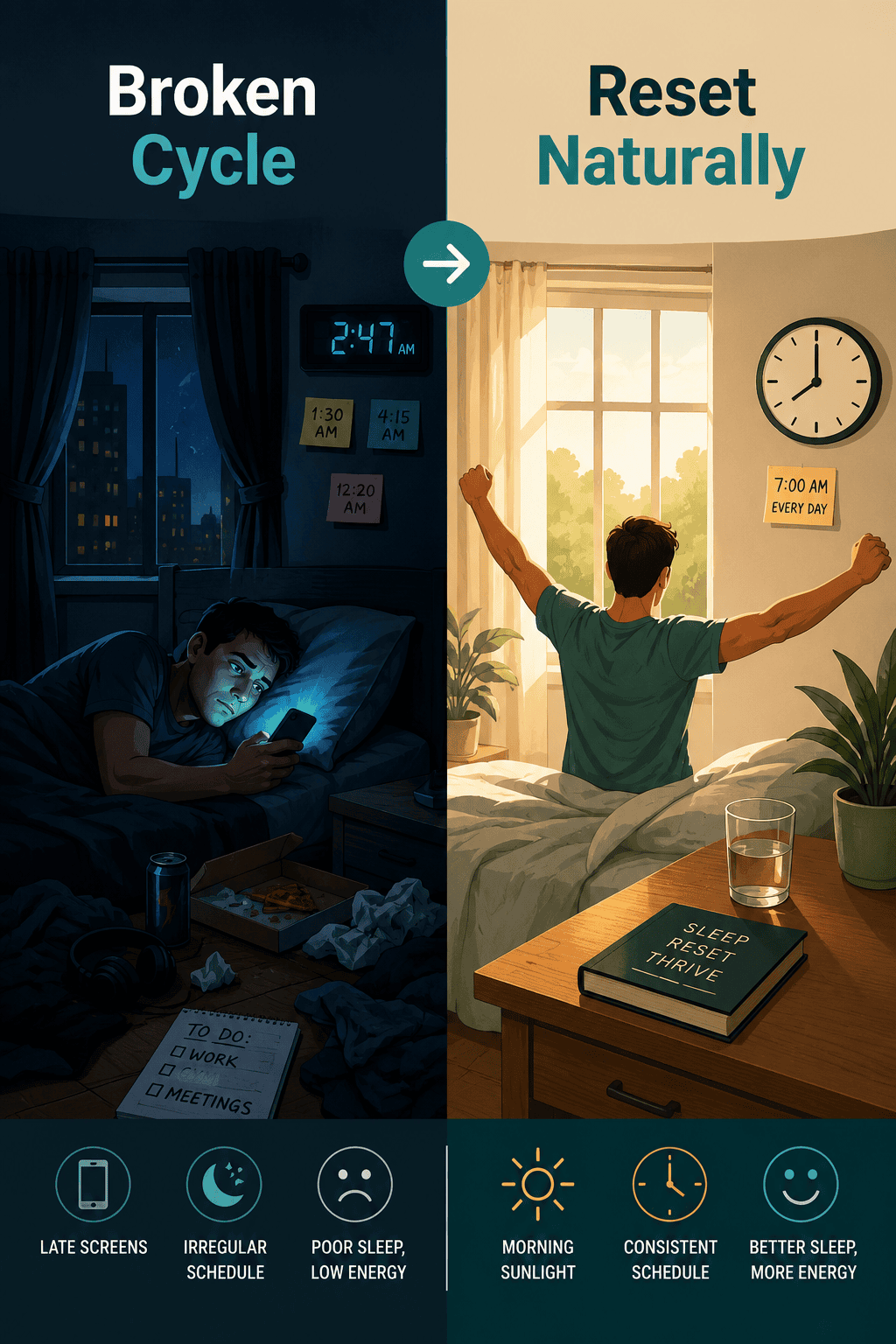
To reset your circadian rhythm naturally, the most evidence-backed approach combines a fixed wake time, morning light exposure, and evening light reduction – applied consistently for at least two weeks [5][6].
Ranked by evidence strength:
- Fixed wake time – Non-negotiable anchor for circadian stability
- Morning sunlight – 20-30 minutes outside within an hour of waking
- Evening light reduction – Dim lights and screens after 9pm
- Consistent meal timing – Eating at regular times reinforces circadian signals
- Daily exercise – Preferably in the morning or early afternoon
- Caffeine cutoff – No caffeine after 2pm (caffeine has a 5-6 hour half-life)
Conclusion
A broken normal sleep cycle is not a character flaw and it is not permanent. But it does require more than the standard advice about screens and chamomile tea – especially if you have been struggling for a while.
Start with the two things that have the strongest evidence: a fixed wake time and morning light exposure. Do those consistently for two weeks before adding anything else. Most people who struggle with sleep try to fix everything at once and end up changing nothing long enough to see results.
If you recognize several of the 7 signs in this article, take the free insomnia test to get a clearer picture of what you are dealing with. And if you want to go deeper on specific pieces of this, these are worth your time:
- How to Improve REM Sleep: 11 Natural Habits That Work
- How to Fall Asleep Naturally Without Pills or Supplements
- Why Can’t I Sleep? 12 Surprising Reasons Explained
- How to Build a Sleep Routine That Calms Your Brain
You don’t have to have perfect sleep. You just have to give your biology the right signals consistently enough for it to do its job.
FAQ
Q: How do I know if my sleep cycle is broken or if I just need more sleep?
If you feel unrefreshed after 7-9 hours, wake at consistent times during the night, or feel mentally foggy for hours after waking, the issue is likely cycle quality, not duration. More time in bed without fixing the underlying pattern rarely helps.
Q: Can stress permanently break your sleep cycle?
Chronic stress can cause lasting disruption to sleep architecture, but it is not permanent. Addressing the stress response – through CBT, relaxation techniques, or lifestyle changes – typically restores normal sleep patterns over weeks to months.
Q: How many sleep cycles per night is normal?
Most adults complete 4-6 full cycles per night, each lasting roughly 90-96 minutes [2]. Fewer than 4 cycles typically means either insufficient sleep duration or frequent cycle interruptions.
Q: Does alcohol help or hurt sleep cycles?
Alcohol may help you fall asleep faster, but it suppresses REM sleep and causes fragmented sleep in the second half of the night. The net effect on sleep quality is negative.
Q: What is the fastest natural way to reset a sleep cycle?
The fastest approach is a combination of a fixed early wake time and immediate morning light exposure, applied every day. Most people notice a shift within 5-7 days, with fuller improvement in 2-3 weeks [5].
Q: Is waking up at 3am a sign of a broken sleep cycle?
Consistent waking at the same time – especially 2-4am – is a recognized pattern associated with sleep cycle disruption, cortisol shifts, blood sugar fluctuations, or sleep apnea. It is worth tracking and, if persistent, discussing with a doctor.
Q: Can a broken sleep cycle cause anxiety?
Yes. Poor REM sleep in particular is strongly associated with increased emotional reactivity and anxiety the following day. The relationship runs both ways – anxiety disrupts sleep, and disrupted sleep worsens anxiety.
Q: Do sleep tracking apps accurately reflect sleep cycles?
Consumer wearables estimate sleep stages using movement and heart rate data. They are not as accurate as clinical polysomnography, but they can identify broad patterns – like consistently short deep sleep or frequent nighttime waking – that are useful for tracking changes over time.
References
[1] Longer Sleep Latency Time Observed Recent Definition Sleep Onset Meta Analysis – https://www.neurologylive.com/view/longer-sleep-latency-time-observed-recent-definition-sleep-onset-meta-analysis?utm_source=openai
[2] Fulltext – https://www.sleephealthjournal.org/article/S2352-7218%2823%2900204-8/fulltext?utm_source=openai
[3] S41598 024 56316 7 – https://www.nature.com/articles/s41598-024-56316-7?utm_source=openai
[4] Circadian Rhythm – https://www.sleep.com/sleep-health/circadian-rhythm?utm_source=openai
[5] How To Reset Your Sleep Routine – https://www.sleepfoundation.org/sleep-hygiene/how-to-reset-your-sleep-routine?utm_source=openai
[6] How To Fix Sleep Schedule – https://www.healthline.com/health/healthy-sleep/how-to-fix-sleep-schedule?utm_source=openai
[7] Sleep 101 – https://www.webmd.com/sleep-disorders/sleep-101?utm_source=openai
[8] What Happens During Sleep And How To Improve It – https://www.health.harvard.edu/sleep/what-happens-during-sleep-and-how-to-improve-it?utm_source=openai