Post Disclaimer
This post contains affiliate links. If you buy something through these links, I may earn a small commission at no extra cost to you. Full disclosure.
This article is for informational purposes only and does not constitute medical advice. Always consult a healthcare professional for personal health concerns. Full disclaimer.
Last updated: July 9, 2026
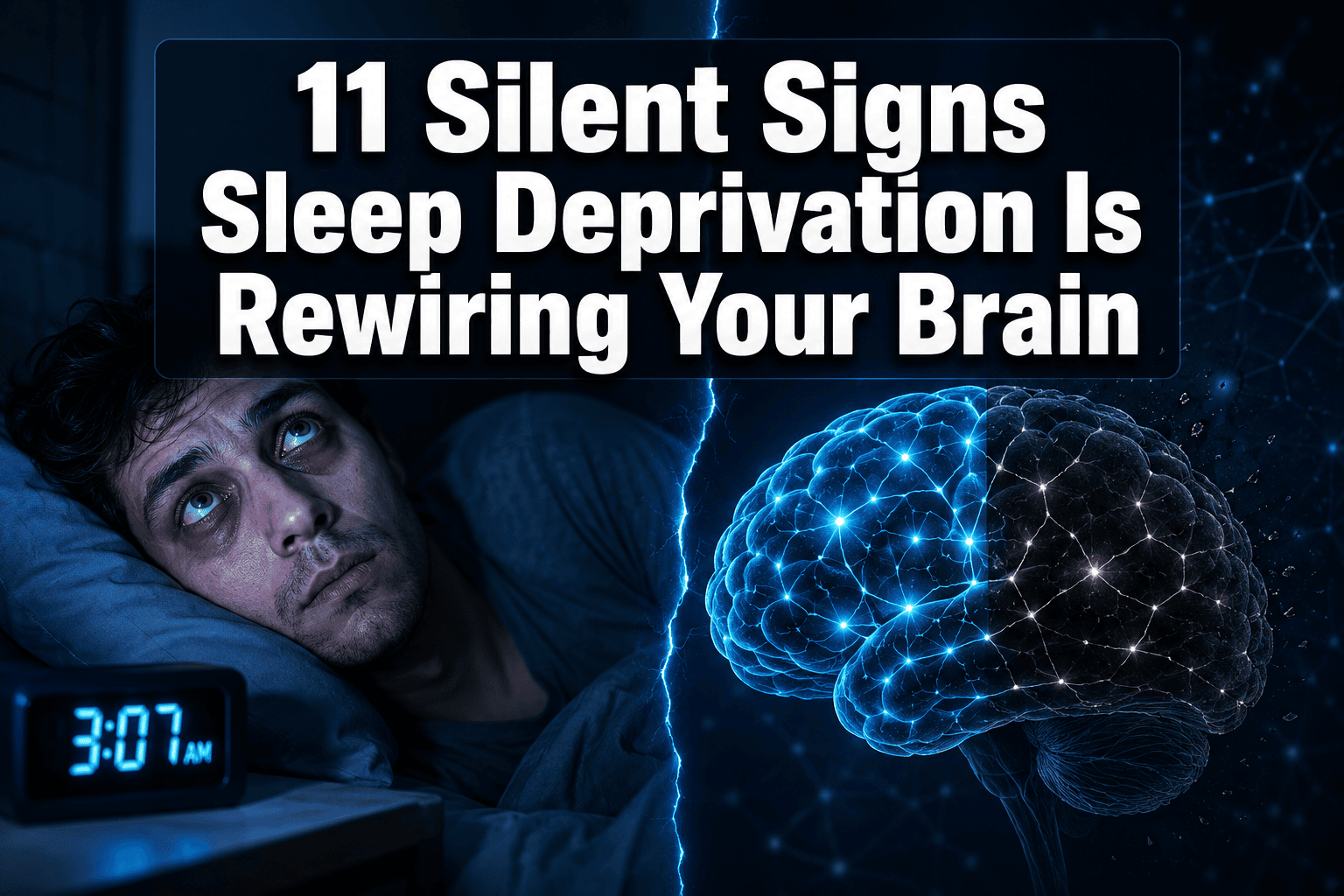
Quick Answer: Sleep deprivation does more than make you tired – it physically changes how your brain functions, affecting memory, emotional regulation, and long-term cognitive health. The damage can begin after just one or two poor nights, but the good news is that most of it is reversible with consistent, quality sleep. The key is recognizing the signs early, before short-term sleep loss becomes a chronic problem.
Key Takeaways
- Chronic sleep deprivation is linked to a 33% increased risk of dementia and can age the brain by 3 to 5 years [1]
- Your brain’s waste-clearance system (the glymphatic system) only fully activates during deep sleep – skip it, and toxic proteins accumulate [2]
- Sleep loss can reduce your memory formation capacity by up to 40% [2]
- There’s a real difference between being tired and being clinically sleep deprived – and most people can’t tell which one they are
- One good night of sleep does NOT fully reverse chronic sleep debt
- Sleep deprivation and insomnia are related but not the same thing
- Most adults need 7 to 9 hours per night – not 6, not “whatever I can get”
- Emotional overreaction, poor decisions, and brain fog are neurological symptoms, not personality flaws
- Recovery is possible, but it takes more than a single weekend of sleeping in
- If symptoms have lasted more than three weeks, it’s worth talking to a doctor
What Does Sleep Deprivation Do to Your Brain?
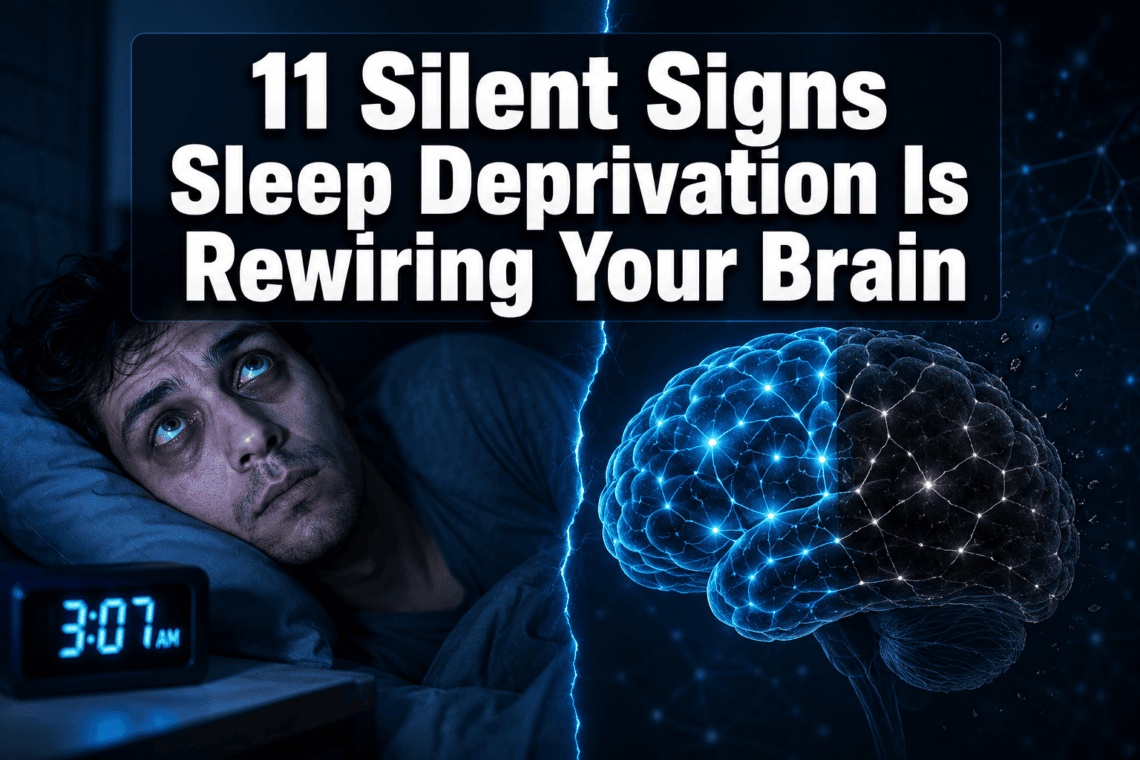
Sleep deprivation disrupts nearly every major brain system – from memory consolidation and emotional regulation to waste clearance and decision-making. It’s not just fatigue. It’s a measurable change in how your brain operates.
Here’s what the research actually says: during sleep, your brain runs a biological cleaning cycle called the glymphatic system. Cerebrospinal fluid flushes through brain tissue and clears out metabolic waste, including the amyloid-beta proteins associated with Alzheimer’s disease. When you don’t sleep enough, that system underperforms – and the waste builds up [2].
At the same time, the connection between your prefrontal cortex (the rational, decision-making part of your brain) and your amygdala (the emotional alarm system) weakens. The result is that you react more intensely to stress, feel more anxious for no clear reason, and struggle to think through problems calmly [2].
Prolonged sleep loss also disrupts long-range temporal correlations in the brain – basically, the brain’s ability to coordinate complex tasks like working memory and decision-making starts to fall apart [3].
The honest version is: this isn’t about willpower or being “bad at sleep.” It’s biology.
How Long Does It Take Sleep Deprivation to Damage Your Brain?
Measurable cognitive impairment can appear after just 17 to 19 hours of continuous wakefulness – roughly the equivalent of pulling a late night. After 24 hours without sleep, performance on cognitive tests drops to a level comparable to a blood alcohol concentration of 0.10% [4].
For chronic sleep deprivation, the timeline is more gradual but the effects compound. Research suggests that consistently sleeping less than 6 hours per night over several weeks leads to the same level of cognitive impairment as going without sleep entirely for two days – but because the decline is slow, most people don’t notice it happening [4].
The more alarming finding is the long-term picture. Lack of sleep has been linked to brain aging of 3 to 5 years and a 33% increased risk of developing dementia [1]. That’s not a dramatic one-night consequence – it’s the result of years of accumulated sleep debt.
If you’ve been dealing with this for a while, the damage isn’t sudden. But it is real.
What Are the 11 Silent Signs You’re Not Getting Enough Sleep?
Most people expect sleep deprivation to feel obvious. It often doesn’t. These are the signs that tend to go unnoticed – or get blamed on something else entirely.
- You make small decisions slowly – choosing what to eat, what to reply to a text. Decision fatigue that hits before noon.
- You’re more irritable than usual, for no clear reason – not angry, just reactive. Short fuse, low threshold.
- You forget words mid-sentence – tip-of-the-tongue moments that happen multiple times a day.
- You feel emotionally flat – not sad exactly, just disconnected. Less engaged in things you normally care about.
- Your appetite feels off – either hungrier than usual or not hungry at all. Sleep loss disrupts ghrelin and leptin, the hormones that regulate hunger [5].
- You need caffeine to function, not just to feel good – there’s a difference between enjoying coffee and depending on it to reach baseline.
- You fall asleep within minutes of sitting still – on the couch, in a car, during a meeting. This is a sign of significant sleep debt, not just tiredness.
- Your coordination is slightly off – bumping into things, misjudging distances, dropping objects.
- You feel mentally slow in the afternoon, even after a good lunch – the post-lunch dip is normal; a complete cognitive shutdown isn’t.
- You’re getting sick more often – sleep deprivation reduces the production of infection-fighting cytokines [5].
- You feel like your personality has changed – less patient, less curious, less yourself. This one is easy to dismiss, but it matters.
If several of these sound familiar, it’s not just you. And it’s not just stress. It may be worth taking this free, anonymous insomnia test to get a clearer picture of what you’re dealing with. It takes about two minutes and asks how you’ve felt over the past two weeks.
What’s the Difference Between Being Tired and Sleep Deprived?
Tiredness is temporary – it resolves after rest. Sleep deprivation is a physiological state where your brain and body have accumulated a deficit that a single nap won’t fix.
The practical difference: if you sleep a full night and still feel foggy, unrefreshed, or emotionally flat the next day, you’re likely dealing with sleep deprivation rather than ordinary tiredness. Tiredness responds to rest. Sleep deprivation doesn’t fully respond until the debt is paid back over multiple nights.
Another marker: people who are simply tired can usually fall asleep and stay asleep when they get the chance. People who are sleep deprived often find that their sleep quality is also disrupted – they wake frequently, sleep lightly, or feel unrested no matter how long they’re in bed. If that sounds like you, the silent signs of a sleep disorder article covers this in more depth.
Sleep Deprivation vs Insomnia: What’s the Difference?
Sleep deprivation means you’re not getting enough sleep – usually because of circumstances (work, a newborn, shift work, scrolling until 2am). Insomnia means you can’t sleep even when you have the time and opportunity to do so.
This distinction matters because the solutions are different. Sleep deprivation is primarily a scheduling and prioritization problem. Insomnia is a neurological and psychological one – often involving hyperarousal, conditioned wakefulness, or anxiety about sleep itself.
You can have both at the same time, which is where things get complicated. Many people start with situational sleep deprivation, develop anxiety around sleep, and end up with insomnia as a secondary condition. If you’re not sure which one you’re dealing with, this breakdown of what causes lack of sleep can help you identify your specific pattern.
Why Does Sleep Deprivation Affect Memory and Focus?
Sleep is when your brain consolidates memories – moving information from short-term storage into long-term memory. Without enough sleep, that transfer process is interrupted. Research shows that sleep deprivation can reduce memory formation capacity by up to 40% [2].
Focus is affected for a different reason. The prefrontal cortex – the part of your brain responsible for sustained attention, filtering distractions, and working memory – is one of the regions most sensitive to sleep loss. When it’s underperforming, you can’t hold information in your head long enough to use it, and every small distraction feels like it breaks your train of thought completely.
I’ve experienced this personally. During a stretch of bad sleep last year, I’d re-read the same paragraph four times and still not retain it. It wasn’t laziness. My brain literally wasn’t encoding the information. That’s what sleep deprivation does – it doesn’t just slow you down, it changes what your brain is capable of.
How Much Sleep Do You Actually Need Per Night?
Most adults need between 7 and 9 hours of sleep per night, according to the Sleep Foundation [4]. Not 6. Not “whatever I can get on weekdays and catch up on weekends.”
The honest version is that sleep need is partially individual – some people genuinely function well on 7 hours, others need closer to 9. But the number of people who truly function optimally on less than 6 hours is very small – estimated at around 1-3% of the population, and it’s a genetic trait, not a habit you can train yourself into.
For more on how to figure out your personal sleep need, the how much sleep should I get guide goes deeper on this. Age, activity level, and health status all play a role.
What Happens to Your Brain After Pulling an All-Nighter?
After a full night without sleep, your brain enters a state of significant impairment. Reaction time slows, working memory degrades, and emotional regulation breaks down – you become more reactive, more impulsive, and less able to assess risk accurately [4].
The glymphatic system, which normally clears waste during sleep, has gone a full cycle without running. Toxic proteins accumulate. The amygdala becomes hyperactive – studies show it responds up to 60% more intensely to negative stimuli after sleep deprivation [2].
In practice, this means that after an all-nighter, you’re not just tired – you’re operating with a brain that is functionally compromised in ways you probably can’t fully perceive. That’s the dangerous part. Sleep-deprived people consistently overestimate their own performance.
How Does Sleep Deprivation Affect Mental Health?
Sleep deprivation and mental health exist in a two-way relationship – each makes the other worse. Poor sleep increases the risk of anxiety and depression, and anxiety and depression make it harder to sleep [2].
The mechanism is the disconnection between the prefrontal cortex and the amygdala. When that regulatory link weakens, emotional responses become disproportionate. Small frustrations feel overwhelming. Neutral events get interpreted as threatening. Over time, this pattern can develop into a diagnosable anxiety disorder or depressive episode.
Chronic sleep deprivation is also linked to a 48% increased risk of heart disease and nearly three times the risk of developing type 2 diabetes [1]. The mental health effects don’t exist in isolation – they’re part of a broader physiological stress response that affects the whole body.
If you’re noticing that sleep problems and low mood are feeding each other, this free insomnia test is a good starting point. It’s anonymous, takes two minutes, and asks specifically about how you’ve been feeling over the past two weeks – which is exactly the window that matters clinically.
Can You Reverse Brain Damage from Lack of Sleep?
For most people, yes – the cognitive effects of sleep deprivation are largely reversible with consistent, quality sleep over time. The brain shows real recovery in memory performance, emotional regulation, and reaction time after several nights of adequate sleep [2].
The caveat is “consistent.” One good night doesn’t undo weeks of sleep debt. Research suggests that full cognitive recovery from chronic sleep deprivation can take several days to weeks of proper sleep – not a single weekend.
The more serious long-term risks – like the increased dementia risk associated with years of poor sleep – are harder to reverse simply because some of the structural changes (amyloid protein accumulation, for example) may be cumulative. This is why catching and addressing sleep deprivation early matters.
How to Recover from Chronic Sleep Deprivation
Recovery from chronic sleep deprivation requires more than just going to bed earlier. Here’s what actually works:
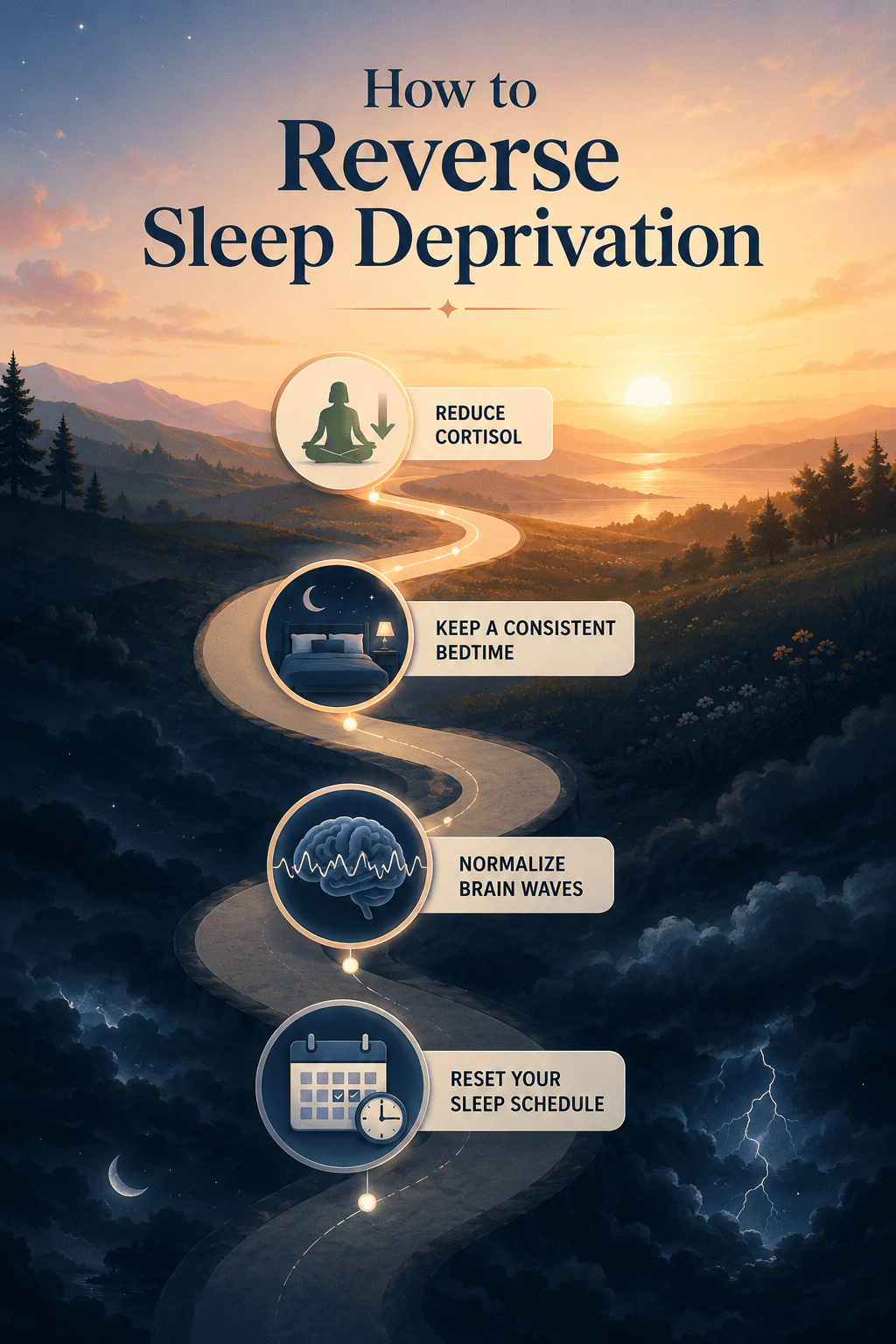
Prioritize consistency over duration first. A regular wake time – even on weekends – is the single most effective way to stabilize your circadian rhythm. Your body clock responds to consistency more than to total hours.
Reduce sleep pressure gradually. If you’ve been running on 5 hours and suddenly try to sleep 9, your brain may resist. Shift your bedtime earlier by 15-30 minutes every few days rather than making a dramatic change overnight.
Address what’s keeping you awake. If anxiety or a racing mind is the root cause, fixing your schedule won’t be enough. The how to calm your mind for sleep guide covers specific techniques that work for this – not generic breathing exercises, but approaches backed by sleep research.
Protect deep sleep. Deep sleep is where most of the brain restoration happens. Alcohol, late-night eating, and inconsistent sleep timing all suppress it. For more on this, how to improve deep sleep has 11 specific approaches worth trying.
Don’t rely on sleep debt recovery alone. Sleeping in on weekends helps, but it doesn’t fully compensate for weekday deficits. The goal is to eliminate the deficit, not just manage it.
Worth trying if you’re also dealing with a racing mind at bedtime: Cognitive Behavioral Therapy for Insomnia (CBT-I) is currently the most evidence-backed treatment for sleep problems – more effective than sleep medication for long-term outcomes.
Can One Good Night of Sleep Fix Sleep Deprivation?
No. One good night helps, but it doesn’t reverse chronic sleep debt. Studies show that after extended sleep deprivation, full cognitive recovery requires multiple nights of adequate sleep – and some functions, like sustained attention, recover more slowly than others [4].
This is why you can sleep 9 hours on a Saturday and still feel foggy on Sunday. You’ve made a dent in the debt, but you haven’t cleared it.
The good news is that recovery does happen. The brain is more adaptable than most people give it credit for. But it requires patience and consistency – not a single heroic night of sleep.
Best Ways to Reset Your Sleep Schedule
Resetting your sleep schedule works best when you anchor it to your wake time rather than your bedtime.
A practical approach:
- Pick a wake time and stick to it every day – including weekends
- Get bright light exposure within 30 minutes of waking (outdoors is best)
- Avoid naps longer than 20 minutes, especially after 3pm
- Push your bedtime earlier by 15 minutes every 2-3 days until you reach your target
- Keep your bedroom cool and dark – your body temperature needs to drop to initiate sleep
For a full step-by-step plan, the how to fix your sleep schedule in 7 days guide walks through this in detail.
You don’t have to fall asleep – you just have to rest. That reframe alone takes a lot of pressure off the process.
When Should You See a Doctor About Sleep Problems?
See a doctor if your sleep problems have lasted more than three weeks, are significantly affecting your daily functioning, or if you’re experiencing symptoms like gasping during sleep, extreme daytime sleepiness despite adequate time in bed, or mood changes that feel out of proportion.
You should also seek help if you’ve tried consistent sleep hygiene changes for several weeks and nothing has improved. At that point, you may be dealing with a sleep disorder – sleep apnea, restless leg syndrome, circadian rhythm disorder, or clinical insomnia – that requires professional assessment.
A GP can refer you for a sleep study if needed, or to a therapist trained in CBT-I. Don’t wait until you’re in crisis. If you’re unsure whether your symptoms warrant attention, this free insomnia test is a good first step – it evaluates how you’ve been feeling over the past two weeks and gives you a clearer sense of whether what you’re experiencing is within normal range or worth investigating further.
Conclusion
Sleep deprivation doesn’t announce itself loudly. It shows up as a shorter fuse, a word you can’t find, a decision you keep putting off. It rewires your brain gradually – and that’s exactly what makes it easy to miss.
The research is clear: chronic poor sleep affects memory, emotional regulation, immune function, and long-term brain health in measurable ways [1][2]. But most of these effects are reversible if you catch them early and address them consistently.
Your next steps:
- Identify which of the 11 signs apply to you right now
- Check your actual sleep duration – not what you aim for, but what you’re getting
- Start with one change: a consistent wake time, every day
- If anxiety or a racing mind is the barrier, address that directly – not just the schedule
- If symptoms have lasted more than three weeks, talk to a doctor
If you want to go deeper on any of this, the how to build a sleep routine that calms your brain guide is a good next read. And if you’re not sure whether what you’re experiencing is insomnia or something else, why can’t I sleep at night even when I’m tired covers the most common underlying patterns.
You’ve probably already tried the basics. This is where you go after the basics haven’t worked.
FAQ
Q: How do I know if I’m sleep deprived or just tired?
A: If you feel unrested after a full night’s sleep, struggle to focus during the day, or feel emotionally reactive without a clear cause, you’re likely sleep deprived rather than simply tired. Tiredness resolves with rest; sleep deprivation persists until the deficit is repaid over multiple nights.
Q: Can sleep deprivation cause permanent brain damage?
A: For most people, the cognitive effects of sleep deprivation are reversible with consistent quality sleep. However, chronic long-term sleep deprivation is associated with a 33% higher risk of dementia and structural brain changes that may be harder to reverse [1]. Early intervention matters.
Q: How long does it take to recover from sleep deprivation?
A: Recovery from short-term sleep loss can take a few nights. Recovery from chronic sleep deprivation – weeks or months of insufficient sleep – can take several weeks of consistent adequate sleep before cognitive function fully normalizes [4].
Q: Is 6 hours of sleep enough?
A: For the vast majority of adults, no. The Sleep Foundation recommends 7 to 9 hours per night for adults. Only a very small percentage of people (estimated 1-3%) can genuinely function optimally on 6 hours or less due to a rare genetic trait [4].
Q: Does napping help with sleep deprivation?
A: Short naps (10-20 minutes) can temporarily improve alertness and performance. They don’t repay sleep debt, but they reduce its immediate cognitive impact. Naps longer than 30 minutes can cause sleep inertia and may disrupt nighttime sleep.
Q: What’s the fastest way to recover from an all-nighter?
A: Get a full night of sleep the following night – not a long nap during the day, which can disrupt your circadian rhythm. Prioritize your normal wake time the day after recovery to avoid shifting your sleep schedule further.
Q: Can sleep deprivation cause anxiety?
A: Yes. Sleep loss disrupts the connection between the prefrontal cortex and the amygdala, increasing emotional reactivity and the risk of anxiety and depression [2]. The relationship is bidirectional – anxiety also makes sleep harder, creating a cycle that often requires targeted intervention to break.
Q: What is the glymphatic system and why does it matter for sleep?
A: The glymphatic system is the brain’s waste-clearance network. It flushes out toxic proteins – including those linked to Alzheimer’s disease – primarily during deep sleep. Insufficient sleep impairs this process, allowing harmful proteins to accumulate over time [2].
Q: Is sleep deprivation the same as insomnia?
A: No. Sleep deprivation means not getting enough sleep, usually due to circumstances. Insomnia means being unable to sleep even when you have the opportunity. You can have both simultaneously, but they require different approaches to treat.
Q: When does sleep deprivation become a medical emergency?
A: Extreme sleep deprivation (beyond 72 hours) can cause hallucinations and cognitive collapse. More commonly, you should seek medical attention if sleep problems have persisted for more than three weeks, are significantly impairing your daily function, or are accompanied by symptoms like gasping during sleep or extreme daytime sleepiness.
References
[1] The Effects Of Sleep Deprivation – https://www.hopkinsmedicine.org/health/wellness-and-prevention/the-effects-of-sleep-deprivation
[2] Sleep Deprivation Effects Brain – https://www.simplypsychology.com/articles/sleep-deprivation-effects-brain
[3] arxiv – https://arxiv.org/abs/1706.03835
[4] Effects Of Sleep Deprivation – https://www.sleepfoundation.org/sleep-deprivation/effects-of-sleep-deprivation
[5] Effects On Body – https://www.healthline.com/health/sleep-deprivation/effects-on-body