
Post Disclaimer
This post contains affiliate links. If you buy something through these links, I may earn a small commission at no extra cost to you. Full disclosure.
This article is for informational purposes only and does not constitute medical advice. Always consult a healthcare professional for personal health concerns. Full disclaimer.

Last updated: June 15, 2026
Quick Answer: Deep sleep – the slow-wave stage where your brain and body actually repair themselves – can be increased through specific, evidence-based changes to your light exposure, temperature, timing, and habits. Most people focus on falling asleep faster when the real problem is staying in the deepest sleep stages long enough. The 11 fixes below target that specific problem.
Key Takeaways
- Deep sleep (N3 stage) is when your body releases growth hormone, consolidates memory, and clears metabolic waste from the brain
- Adults need roughly 1.5 to 2 hours of deep sleep per night, which is about 20-25% of total sleep
- A consistent sleep-wake schedule – even on weekends – is one of the highest-impact changes you can make
- Room temperature around 65-68°F (18-20°C) significantly supports the body’s core temperature drop needed for deep sleep
- Morning sunlight within 60 minutes of waking strengthens the circadian signals that drive deep sleep at night
- Magnesium glycinate and low-dose melatonin have the most evidence behind them for improving sleep depth
- Alcohol, late meals, and irregular schedules are the three most common deep sleep killers
- Sleep trackers can give you useful trends, but their stage accuracy is limited – use them as a guide, not a diagnosis
- Medical conditions like sleep apnea and restless leg syndrome can block deep sleep entirely and need proper evaluation
- You don’t have to fall asleep – you just have to rest. Reducing sleep anxiety itself often improves sleep depth
What Exactly Is Deep Sleep and Why Does It Matter
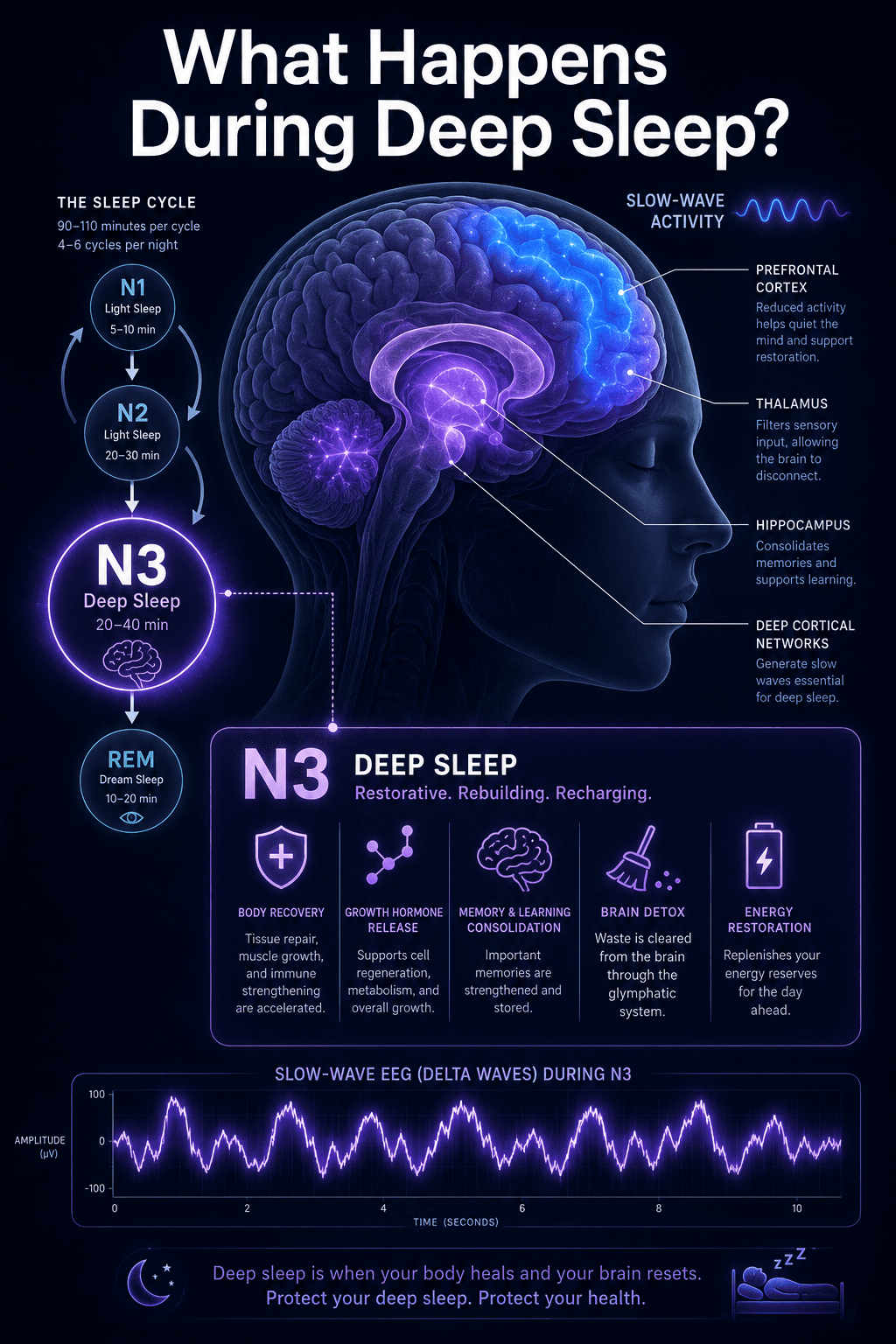
Deep sleep – also called slow-wave sleep or N3 – is the third stage of non-REM sleep. It’s the stage where your brain produces slow, high-amplitude delta waves, your heart rate drops, your muscles relax fully, and your body does most of its physical repair work [9].
This is also when your brain runs its glymphatic system – essentially a waste-clearance process that flushes out metabolic byproducts, including proteins linked to neurodegenerative conditions. Miss enough deep sleep over time and you’re not just tired. You’re running on a brain that hasn’t been properly cleaned overnight.
The reason this matters is that many people who feel unrefreshed after a full night’s sleep aren’t getting enough of this specific stage – not because they slept too few hours total, but because their deep sleep is fragmented or suppressed.
How Many Hours of Deep Sleep Do Adults Actually Need
Most adults need roughly 1.5 to 2 hours of deep sleep per night, which works out to about 20-25% of total sleep time [9]. If you’re sleeping 7 hours but only hitting 45 minutes of deep sleep, that’s where the problem lives.
Deep sleep is front-loaded. You get the most of it in the first half of the night, which is why going to bed significantly later than usual – even once – can cut your deep sleep substantially. It also naturally decreases with age, which we’ll cover below.
If you’ve been dealing with this for a while and consistently wake up feeling like you didn’t sleep at all, tracking your sleep stages (even roughly) can help you understand whether deep sleep is actually the issue. More on that later.
How Age Affects Deep Sleep Cycles
Here’s something most people aren’t told: deep sleep declines significantly with age, and it starts earlier than you’d expect. Research shows that slow-wave sleep decreases progressively from young adulthood onward, with some estimates suggesting a 2% reduction per decade [9].
By your 60s and 70s, deep sleep may account for less than 5% of total sleep time. This is a normal physiological shift – but it also means that if you’re in your 30s or 40s and already struggling with unrefreshing sleep, it’s worth addressing now rather than assuming it’ll sort itself out.
For younger adults, poor deep sleep is more often behavioral or environmental. For older adults, it’s more often structural – meaning the brain’s capacity for slow-wave activity has genuinely changed, and the strategies need to adapt accordingly.
Common Mistakes That Reduce Deep Sleep
Most people who struggle with sleep are accidentally suppressing their own deep sleep without realizing it. These are the biggest culprits:
- Alcohol before bed. It might help you fall asleep, but it fragments the second half of your night and significantly reduces slow-wave sleep [5]
- Eating late. A large meal within 2-3 hours of bed raises core body temperature and keeps your digestive system active – both of which interfere with the body’s shift into deep sleep
- Inconsistent sleep timing. Varying your bedtime and wake time by more than an hour – especially across weekdays and weekends – disrupts the circadian signals that regulate deep sleep architecture [6]
- A warm bedroom. Rooms above 72°F (22°C) are consistently associated with more awakenings and less time in slow-wave sleep [8]
- Chronic sleep anxiety. Lying in bed dreading poor sleep activates your nervous system in ways that actively prevent the brain from downshifting into deep stages
If you’re not sure what’s driving your sleep problems, this breakdown of what causes lack of sleep covers the most common culprits in detail.
How to Improve Deep Sleep With Light and Temperature
These two levers are the most underused – and the most effective.
Light exposure directly regulates your circadian rhythm, which controls when and how deeply you sleep. Here’s what the research actually says: getting 10-15 minutes of direct morning sunlight within 30-60 minutes of waking (or 20-30 minutes on overcast days) strengthens the circadian signal that drives deep sleep later that night [1][6]. In the evening, dimming your lights and switching to warm, low-color-temperature bulbs (around 2700K or lower) 2-3 hours before bed helps your brain prepare for sleep depth, not just sleep onset.
Temperature is equally important. Your core body temperature needs to drop by about 1-2°C to initiate and maintain deep sleep. A bedroom kept around 65-68°F (18-20°C) supports that drop [6][8]. The counterintuitive trick: warm your hands and feet before bed – through socks or a warm bath – which promotes peripheral vasodilation and actually accelerates heat loss from your core. It sounds backward, but the mechanism is solid.
I’ve personally found the temperature piece more impactful than almost anything else I’ve tried. Sleeping in a room that was even slightly too warm left me waking up at 3am with no obvious reason. Dropping the thermostat a few degrees fixed that almost immediately.
How to Improve Deep Sleep Through Diet and Supplements
Food timing matters more than most people realize. Finishing your last meal 2-3 hours before bed gives your digestive system time to settle and allows your core temperature to drop naturally. Late eating – especially high-carb or high-fat meals – delays that process [4].
For supplements, here’s what actually has evidence behind it:
- Magnesium glycinate (200-400mg before bed): supports GABA activity, which is the neurotransmitter associated with slow-wave sleep. It’s one of the few supplements with consistent data behind it [5][9]
- Low-dose melatonin (0.5-1mg, not the 5-10mg doses most products sell): helps with sleep timing, particularly useful if your circadian rhythm is shifted. Higher doses don’t work better and may cause grogginess [9]
- Tart cherry juice: contains natural melatonin precursors and has shown modest improvements in sleep quality in small studies [4]
- L-theanine: may reduce sleep latency and improve sleep quality by promoting relaxation without sedation
Worth trying if you’re already doing the basics and still struggling: magnesium glycinate is low-risk, inexpensive, and frequently makes a noticeable difference within a week or two.
Note: Always check with a healthcare provider before starting supplements, especially if you take other medications.
How Blue Light and Electronics Impact Deep Sleep Quality
Blue light from screens suppresses melatonin production – that part is well-established. But the deeper issue isn’t just the light. It’s the mental activation that comes with scrolling, responding to messages, or watching stimulating content in the hour before bed [2].
Your brain needs a gradual wind-down to shift into the slow-wave stages. Anything that keeps your prefrontal cortex engaged – email, social media, news – delays that transition.
The honest version is: it’s not just about wearing blue-light glasses or enabling night mode. It’s about giving your brain actual downtime before sleep. A 30-minute screen-free window before bed consistently outperforms any filtering technology in the research [2][7].
If a racing mind is your main problem at night, this guide on insomnia and overthinking goes deeper on what actually helps.
What Medical Conditions Prevent Deep Sleep
This is the section most sleep articles skip, and it’s important.
Several medical conditions can systematically block deep sleep regardless of what behavioral changes you make:
- Obstructive sleep apnea (OSA): repeated breathing interruptions pull you out of deep sleep dozens of times per night, often without you knowing. Loud snoring, waking with headaches, and daytime fatigue are the main signs [9]
- Restless leg syndrome (RLS): uncomfortable sensations that worsen at rest and disrupt sleep onset and maintenance
- Periodic limb movement disorder (PLMD): involuntary leg movements during sleep that fragment slow-wave stages
- Chronic pain conditions: pain activates the nervous system in ways that prevent the brain from reaching deep sleep
- Anxiety and depression: both are strongly associated with reduced slow-wave sleep and altered sleep architecture [5]
If you’ve tried everything on this list and still wake up exhausted, it’s worth asking your doctor about a sleep study. Sleep apnea in particular is massively underdiagnosed.
If you’re experiencing persistent sleep problems and want to understand what you’re dealing with, consider taking this free, anonymous insomnia test – it evaluates how you’ve been feeling over the past two weeks and can help clarify what’s going on: Take the free insomnia test here
Differences Between REM and Deep Sleep Stages
People often confuse REM and deep sleep – they’re both important, but they do very different things.
| Deep Sleep (N3) | REM Sleep | |
|---|---|---|
| Brain waves | Slow delta waves | Fast, similar to waking |
| When it peaks | First half of night | Second half of night |
| Main function | Physical repair, immune function, memory consolidation | Emotional processing, creativity, procedural memory |
| Dreams | Rare, non-vivid | Vivid, narrative dreams |
| Disrupted by | Alcohol, warm rooms, irregular timing | Stress, REM-suppressing medications |
Both stages matter. If you’re waking up between 3-5am and can’t get back to sleep, you may be losing REM more than deep sleep. For more on that, this guide on improving REM sleep covers the distinction in detail.
Cheapest Ways to Improve Deep Sleep Without Buying Expensive Gear
You don’t need a $400 mattress pad or a fancy sleep tracker to improve your deep sleep. The highest-impact changes cost nothing:
- Fix your wake time first. Pick a consistent time and stick to it every day, including weekends. This is the single most effective free intervention [6]
- Get outside in the morning. Even 10 minutes of natural light within an hour of waking makes a measurable difference [1]
- Drop your bedroom temperature. If you have a thermostat, set it to 65-68°F at night
- Stop eating 2-3 hours before bed. Free, and consistently effective
- Cut alcohol, especially within 3 hours of sleep. Even one drink affects slow-wave sleep architecture
- Do something genuinely boring before bed. Reading a physical book, light stretching, or quiet conversation – not screens
If you want a full framework for building better pre-sleep habits, the sleep hygiene guide for adults covers 15 specific habits that are easy to start tonight.
What Sleep Tracking Devices Actually Work for Measuring Deep Sleep
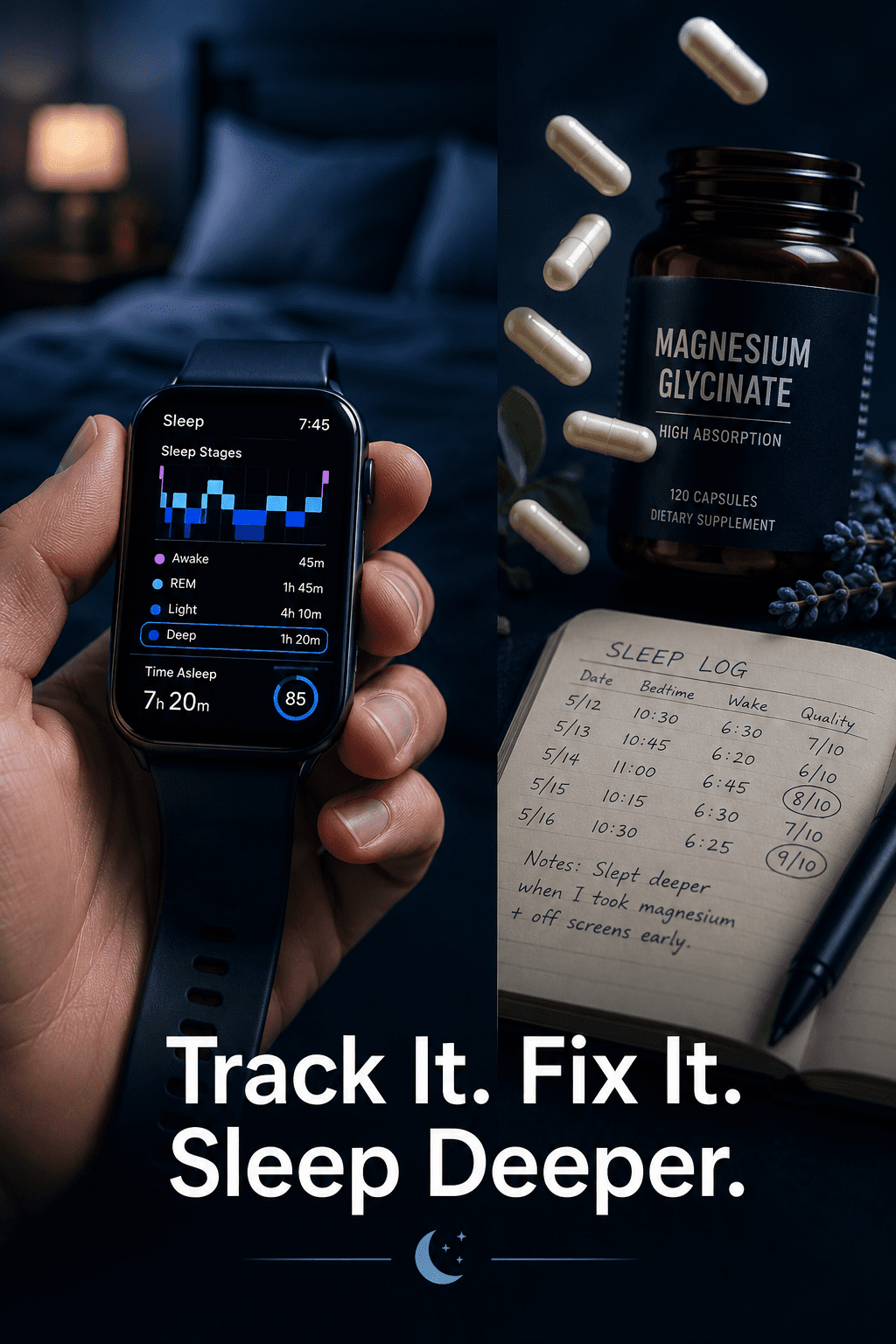
Consumer sleep trackers – Oura Ring, Fitbit, Apple Watch, Garmin – can give you useful trend data, but their accuracy for specific sleep stages is limited. They use movement and heart rate variability to estimate stages, which is a reasonable proxy but not the same as polysomnography (the clinical gold standard) [9].
Here’s what trackers are actually good for: spotting patterns. If your deep sleep percentage drops every time you drink alcohol, eat late, or go to bed an hour later than usual, that’s genuinely useful information. Use the data directionally, not diagnostically.
If you suspect a real sleep disorder, a home sleep test or in-lab study ordered by a doctor is the only way to get accurate data.
Worth noting: if your tracker consistently shows very low deep sleep (under 10%) despite good habits, that’s a signal worth discussing with a doctor – not just a reason to buy a better tracker.
Is Deep Sleep More Important for Athletes or Office Workers
Both groups need it, but for different reasons – and the consequences of missing it differ.
For athletes, deep sleep is when growth hormone is released and muscle tissue repairs. Cutting deep sleep short reduces recovery, increases injury risk, and impairs reaction time [9]. Studies on elite athletes consistently show that sleep extension – deliberately increasing total sleep time – improves performance metrics significantly.
For office workers and knowledge workers, deep sleep is critical for memory consolidation, decision-making, and emotional regulation. Chronic deep sleep deficiency is associated with reduced cognitive performance that people often don’t notice because it happens gradually [5].
The honest version is: it’s not a competition. If you’re a parent running on 5 hours, a shift worker with a disrupted schedule, or someone managing anxiety alongside a desk job, your deep sleep matters just as much. It’s not just you – this affects more people than the wellness industry tends to acknowledge.
If you’re struggling to understand why sleep keeps escaping you despite doing everything right, this article on why you can’t sleep even when you’re tired might answer some questions.
11 Science-Backed Fixes to Improve Deep Sleep – Full List
Here’s the complete list, pulled from everything above:
- Set a fixed wake time and protect it every day of the week
- Get morning sunlight within 60 minutes of waking – 10-15 minutes minimum
- Dim lights 2-3 hours before bed and switch to warm-toned bulbs
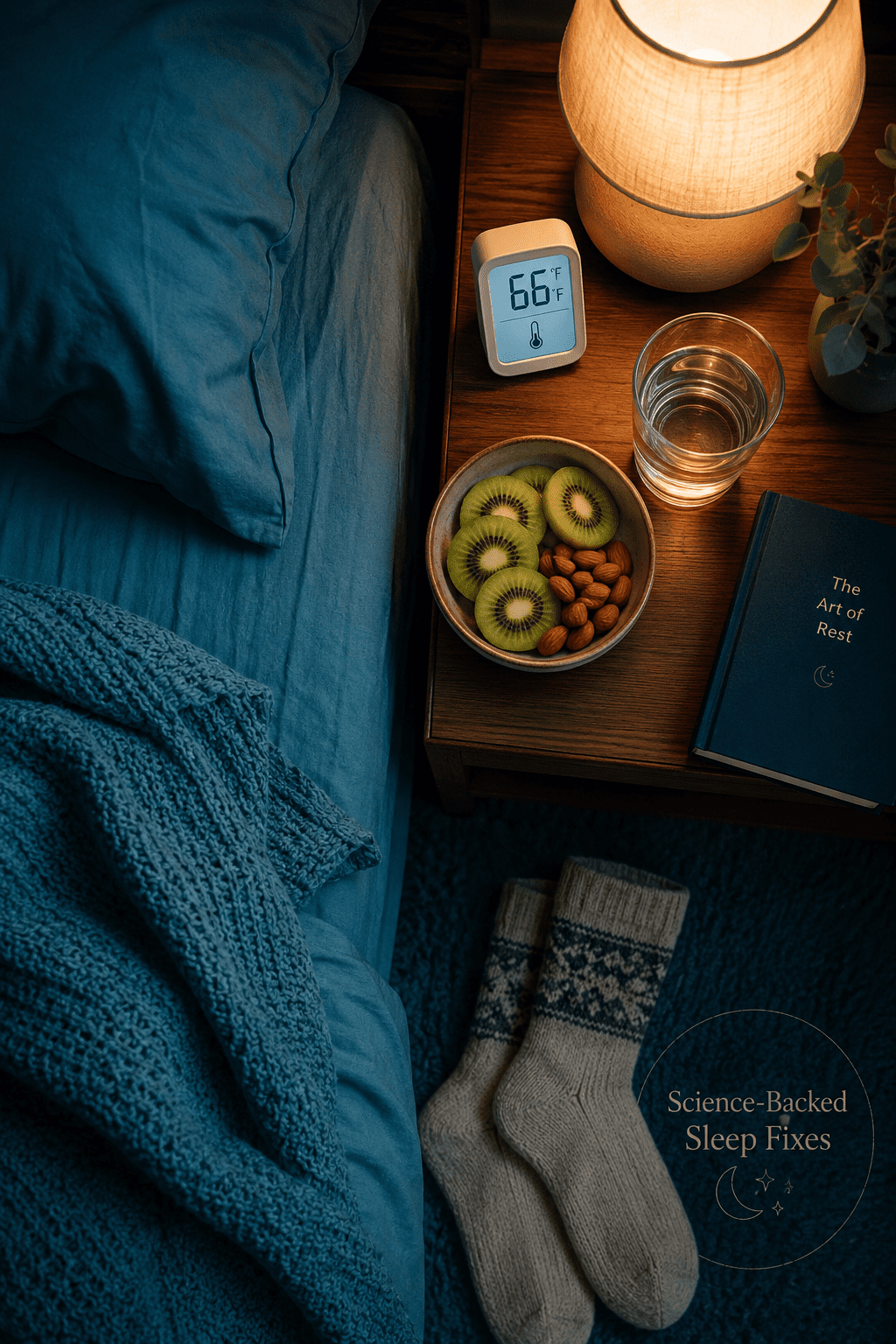
- Cool your bedroom to 65-68°F (18-20°C)
- Warm your feet before bed with socks or a warm bath to accelerate core heat loss
- Stop eating 2-3 hours before sleep to allow digestion and temperature drop
- Cut alcohol – even moderate amounts suppress slow-wave sleep
- Try magnesium glycinate (200-400mg before bed) – low risk, reasonable evidence
- Create a 30-minute screen-free wind-down before bed
- Rule out sleep apnea if you snore, wake with headaches, or feel unrefreshed despite enough hours
- Reduce sleep performance anxiety – you don’t have to fall asleep, you just have to rest
If you’ve been dealing with this for a while and want to check whether what you’re experiencing fits the pattern of clinical insomnia, this free and anonymous test takes about 5 minutes: Take the insomnia test here
FAQ
Can you make up for lost deep sleep?
Partially. Your brain does show some rebound slow-wave sleep after deprivation, but chronic deficits don’t fully recover. Consistency matters more than occasional catch-up sleep.
Does exercise increase deep sleep?
Yes – moderate aerobic exercise is consistently associated with increased slow-wave sleep. Timing matters though: intense exercise within 2-3 hours of bed can delay sleep onset for some people [4].
Why do I wake up at 3am every night?
This often happens at the transition between sleep cycles, when deep sleep has mostly completed and you’re in lighter REM. Stress, alcohol, and temperature fluctuations are common triggers. See tips for sleeping through the night for specific strategies.
Does melatonin increase deep sleep?
Melatonin primarily affects sleep timing, not sleep depth. It signals to your brain that it’s nighttime, but it doesn’t directly increase slow-wave activity. Low doses (0.5-1mg) are more effective than high doses for most people [9].
Is deep sleep the same as dreamless sleep?
Mostly yes. Deep sleep (N3) is largely dreamless or produces only vague, non-narrative mental content. Vivid dreams happen during REM sleep.
How long does it take to see improvement in deep sleep?
Behavioral changes like fixing your wake time and adjusting temperature can show results within a week. Supplement effects (magnesium) typically take 1-2 weeks. Addressing underlying conditions like sleep apnea takes longer but often produces dramatic improvement.
Can stress permanently damage deep sleep?
Chronic stress suppresses slow-wave sleep through elevated cortisol, but this is reversible. Treating the stress – through therapy, lifestyle changes, or medication if appropriate – typically restores sleep architecture over time.
What’s the best sleeping position for deep sleep?
Side sleeping is generally associated with better airway patency and may reduce sleep apnea events, which supports deeper sleep. Back sleeping can worsen airway obstruction in some people.
Conclusion
If you’ve read this far, you probably already know that “just sleep more” isn’t the answer. The real problem is sleep quality – specifically, whether you’re spending enough time in the slow-wave stages that actually restore your brain and body.
The good news is that deep sleep responds to specific, targeted changes. Not a complete lifestyle overhaul – just a few well-placed adjustments to your light exposure, temperature, timing, and habits.
Start with the free stuff: fix your wake time, get morning light, cool your room, stop eating close to bed. If those don’t move the needle after two weeks, look at supplements (magnesium glycinate is a reasonable first step) and consider whether a medical condition might be involved.
And if you’re not sure whether what you’re experiencing is situational or something more persistent, understanding why you might have insomnia is a useful starting point – as is this free insomnia assessment that takes about 5 minutes and can help clarify what you’re dealing with.
It’s not just you. Sleep problems are common, they’re real, and they’re fixable – even when it doesn’t feel that way.
References
[1] D41586 025 03148 8 – https://www.nature.com/articles/d41586-025-03148-8
[2] Better Sleep Experts Advice – https://www.sciencefocus.com/the-human-body/better-sleep-experts-advice
[4] 15 Science Backed Ways To Improve Sleep Quality – https://www.sciencenewstoday.org/15-science-backed-ways-to-improve-sleep-quality
[5] How To Increase Deep Sleep – https://www.healthcentral.com/sleep/how-to-increase-deep-sleep
[6] Sleep Optimization Science Backed Guide 2026 – https://www.copilotly.com/blog/sleep-optimization-science-backed-guide-2026
[7] Secrets More Restful Nights Sleep – https://www.sciencefocus.com/the-human-body/secrets-more-restful-nights-sleep
[8] Sleep Optimization 2026 – https://www.oqua.com/articles/sleep-optimization-2026
[9] How To Get More Deep Sleep – https://health.clevelandclinic.org/how-to-get-more-deep-sleep

![The Perfect Bedtime Routine for Adults Who Struggle to Wind Down Last updated: June 15, 2026 Quick Answer: A good bedtime routine for adults who struggle to sleep starts 30-60 minutes before bed and uses the same sequence of calming activities every night. The goal is not to force sleep - it is to signal to your nervous system that the threat is over and it is safe to rest. Consistency matters more than perfection. Key Takeaways A 30-60 minute wind-down window is the core structure recommended by sleep physicians and behavioral sleep specialists [4] Consistency in timing - same bedtime, same sequence - is more powerful than any single sleep hack Screens are not just a blue light problem; the content you consume (news, social media, work email) is equally disruptive to sleep onset People with anxiety need a slightly different approach - one that addresses racing thoughts directly, not just physical relaxation Supplements like low-dose melatonin and magnesium glycinate have some evidence behind them, but they work best alongside behavioral changes Night shift workers and people with irregular schedules can still build effective routines - they just need to anchor them to their sleep time, not the clock Most common mistake: lying in bed awake trying to fall asleep, which trains your brain to associate bed with wakefulness You don't have to fall asleep - you just have to rest. That reframe alone reduces sleep anxiety significantly What Is a Good Bedtime Routine That Actually Helps Adults Fall Asleep Faster A good bedtime routine for adults is a repeatable sequence of low-stimulation activities done in the 30-60 minutes before sleep, at roughly the same time each night. The Sleep Foundation describes it as a set of predictable actions that cue your brain sleep is coming [4]. It works because your nervous system responds to patterns - not commands. Here's what the research actually says: you cannot force sleep. What you can do is lower your physiological arousal enough that sleep becomes likely. That is the whole job of a wind-down routine. A simple structure that works for most people: 10 minutes - light tidying or preparing for tomorrow (reduces mental load) 10 minutes - bathroom hygiene, skincare, whatever signals "day is done" 10-20 minutes - gentle stretching or body scan 15-20 minutes - reading a physical book or listening to calm audio Sleep coaches and clinicians have been popularizing both 30-minute and 60-minute versions of this structure in 2025-2026, specifically because anxious sleepers do better with concrete timing rather than vague advice to "relax before bed" [1]. The honest version is: the specific activities matter less than the consistency. If you do the same things in the same order every night, your body starts anticipating sleep before you even get into bed. How Long Should a Bedtime Routine Actually Take For most adults, 30-60 minutes is the target. Sleep physicians interviewed by NPR in early 2026 specifically recommended a protected wind-down window of this length, devoted only to calming, predictable activities [4]. If you are severely overstimulated at night - high-stress job, anxiety, or a history of insomnia - 60 minutes is more realistic than 30. If your schedule is tight, even 20 minutes of consistent, low-stimulation activity beats nothing. The key word is protected. That window is not for checking one last email, scrolling for five minutes, or finishing a work task. Those things restart your stress response right when you need it to be winding down. Best Ways to Relax Before Bed Without Screens The most effective screen-free wind-down activities are reading physical books, gentle yoga or stretching, journaling, listening to calm audio (podcasts, audiobooks, ambient sound), and taking a warm bath or shower. A warm bath or shower about 90 minutes before bed has decent research behind it. The drop in body temperature that follows mimics the natural temperature drop your body uses to initiate sleep. It is one of the more underrated tools in a bedtime routine for adults. Other options worth trying: Progressive muscle relaxation - tensing and releasing muscle groups from feet to face Light journaling - not processing your whole day, just writing a short "done list" and a brief plan for tomorrow to offload mental loops Stretching - even 10 minutes of slow, floor-based stretching significantly reduces physical tension Herbal tea - chamomile, passionflower, and lemon balm have mild calming effects; the ritual itself is part of the benefit I keep a paperback on my nightstand specifically for this. Not because reading is magic, but because it gives my brain something absorbing that is not a screen and not my own anxious thoughts. That is the actual mechanism - displacement, not sedation. What Should You Avoid Doing Right Before Sleep Several common evening habits actively delay sleep onset, and most people who struggle with sleep are doing at least two or three of them without realizing it. Avoid these in the 60-90 minutes before bed: Checking work email or anything requiring a decision Watching stimulating content (thrillers, news, anything emotionally activating) Eating a large meal or anything high in sugar Alcohol - it may help you fall asleep faster but it fragments sleep in the second half of the night [6] Intense exercise (more on this below) Bright overhead lighting - switch to lamps or warm-toned bulbs after 9pm Cleveland Clinic specifically recommends keeping phones, tablets, and laptops out of the bedroom entirely and using the bed only for sleep and sex [9]. The reasoning is behavioral: if you use your bed for work, scrolling, or watching TV, your brain stops associating it with sleep. That association is harder to rebuild than most people expect. Sleepstation, a UK-based digital CBT-I provider, advises stopping all electronic devices at least two hours before bed for people who genuinely struggle to wind down [5]. That feels extreme until you try it for two weeks and notice the difference. Is It Bad to Exercise Right Before Bed For most people, vigorous exercise within 60-90 minutes of bedtime raises core body temperature and cortisol, both of which delay sleep onset. That said, light movement - walking, stretching, gentle yoga - is fine and often helpful. If your only available exercise window is evening, do not give it up entirely. The long-term sleep benefits of regular exercise outweigh the short-term disruption of late workouts for most people. Just try to finish anything intense at least 90 minutes before your target sleep time, and build a proper cool-down into your bedtime routine for adults. Worth trying if you are a late exerciser: a 10-minute cool-down walk followed by a warm shower. It accelerates the body temperature drop that signals sleep readiness. Bedtime Routine Differences for People With Anxiety If anxiety is driving your sleep problems, a standard wind-down routine is not quite enough on its own. The issue is not just stimulation - it is an overactive threat-detection system that does not switch off when the lights go out. For anxious sleepers, the routine needs to include something that directly addresses racing thoughts, not just physical relaxation. Insomnia and overthinking are closely linked, and ignoring the cognitive side of the problem is why most basic sleep hygiene advice fails this group. What works better for anxiety-driven insomnia: Scheduled worry time - 15 minutes earlier in the evening to write down worries and possible next steps, then close the notebook. The goal is to contain the worry, not eliminate it. Cognitive shuffle - a technique where you imagine random, unconnected images in sequence to interrupt the narrative thinking that keeps you awake Body scan meditation - shifting attention to physical sensations rather than thoughts (more on this below) Stimulus control - if you are lying awake for more than 20 minutes, get up and do something calm in dim light until you feel sleepy If you've been dealing with this for a while, it is worth evaluating whether what you are experiencing goes beyond normal sleep difficulty. If you recognize yourself in any of this - the racing thoughts, the dread of bedtime, the exhaustion that does not lead to sleep - consider taking this free anonymous insomnia test. It takes a few minutes and evaluates how you have been feeling over the past two weeks. It is not a diagnosis, but it can help clarify whether what you are dealing with needs more targeted support. Meditation Techniques to Calm Your Mind Before Bed Simple meditation works for sleep because it interrupts the rumination cycle - the loop of thoughts that keeps your nervous system activated. You do not need an app or experience. You need a technique you will actually use. Three that have the most practical evidence for sleep: 4-7-8 breathing - inhale for 4 counts, hold for 7, exhale for 8. The extended exhale activates the parasympathetic nervous system. Do 4 cycles. Body scan - starting at your feet, slowly move attention up through your body, noticing sensation without trying to change anything. It is boring by design. That is the point. Cognitive shuffle - developed by sleep researcher Luc Beaulieu-Prévost, this involves imagining a random word and then picturing unrelated images for each letter. It interrupts linear thinking, which is what keeps anxious minds awake. This is what worked for me: body scan, but only after I had done a short journaling session. Without offloading the day's mental residue first, I would just lie there narrating my worries instead of scanning my body. Sequence matters. What Supplements Actually Help With Sleep Quality Low-dose melatonin (0.5-3mg) and magnesium glycinate are the two supplements with the most consistent evidence for sleep, and both are relatively low-risk. Everything else requires more scrutiny. Melatonin - most useful for shifting sleep timing (jet lag, shift work, delayed sleep phase) rather than treating insomnia itself. The common mistake is taking too much - doses above 5mg are rarely more effective and can cause next-day grogginess [6]. Magnesium glycinate - some evidence for reducing sleep onset time and improving sleep quality, particularly in people who are deficient (which is more common than most people realize). The glycinate form is gentler on digestion than magnesium oxide. Ashwagandha - has some emerging evidence for reducing cortisol and improving sleep quality in stressed adults, but the research is less consistent. L-theanine - an amino acid found in green tea; may reduce anxiety and improve sleep quality at doses of 200-400mg. Generally well-tolerated. Medical disclaimer: Supplements can interact with medications and are not regulated the same way as pharmaceuticals. Talk to your doctor before starting anything new, especially if you take prescription medications. Worth trying if you want a starting point: magnesium glycinate (200-400mg) about an hour before bed. It is inexpensive, widely available, and has a reasonable evidence base. Why Do You Keep Waking Up in the Middle of the Night Waking up in the middle of the night is different from struggling to fall asleep, and the causes are often different too. Common drivers include: alcohol consumption in the evening, sleep apnea, blood sugar fluctuations, room temperature being too warm, and - especially in people with anxiety - conditioned arousal where the brain has learned to partially wake at certain times. If this is a persistent problem for you, these tips for sleeping through the night go deeper into the specific causes and fixes. The short version: alcohol is the most underestimated culprit, and keeping your bedroom cooler (around 65-68°F / 18-20°C) helps more than most people expect. The other thing worth knowing: waking briefly during the night is biologically normal. You have multiple sleep cycles per night, and light waking between them is common. The problem is when you cannot get back to sleep - which is usually a sign that your arousal threshold is too high, not that something is medically wrong. How to Build a Bedtime Routine If You Have an Irregular Work Schedule Night shift workers and people with variable schedules can still build an effective bedtime routine - they just need to anchor it to their sleep time, not the clock on the wall. The principle is the same: a consistent pre-sleep sequence that signals your brain sleep is coming. The difference is that "bedtime" might be 7am on some days and 11pm on others. That is genuinely harder, and it is not just you - shift work is one of the most disruptive things you can do to your circadian rhythm. Practical adjustments: Use blackout curtains and a sleep mask if sleeping during daylight hours Keep your pre-sleep routine identical regardless of what time it is Avoid bright light exposure in the 90 minutes before your target sleep time If possible, try to keep your sleep window consistent even on days off - large swings in sleep timing (social jet lag) undo a lot of the progress from a good routine [4] For people with truly erratic schedules, understanding why you can't sleep even when you're tired can help identify whether the issue is circadian disruption, sleep pressure, or something else. Common Mistakes That Ruin Your Sleep Routine Most people who struggle with sleep are not failing because they lack willpower. They are failing because they are making a few specific structural errors that undermine everything else. The biggest mistakes: Trying too hard to fall asleep - the effort itself raises arousal. Sleep is not something you do; it is something that happens when you stop interfering. Inconsistent wake times - sleeping in on weekends feels restorative but it shifts your circadian rhythm and makes Monday night harder [4] Using the bed for wakefulness - working, scrolling, or watching TV in bed trains your brain to be alert there [9] Giving up on a routine after one bad night - it takes 2-3 weeks of consistency before a new routine starts to produce reliable results Over-relying on supplements or alcohol - both can mask the underlying issue while making it worse over time If you have been doing everything "right" and still not sleeping, the problem might not be your routine - it might be an underlying issue driving the insomnia. Understanding why you have insomnia is sometimes the missing step. Cheap vs Expensive Sleep Aids: What Actually Works The honest version is that most expensive sleep aids do not outperform cheap ones. The most evidence-backed interventions for sleep are also free or nearly free: consistent sleep timing, a dark cool room, and a simple wind-down routine. Tool Cost Evidence Level Notes Consistent sleep/wake times Free Strong Most impactful single change Blackout curtains $20-60 Good Especially useful for shift workers White noise machine $30-80 Moderate Helpful if noise is a trigger Magnesium glycinate $15-25/month Moderate Worth trying for 4 weeks Melatonin (low dose) $10-15/month Moderate for timing Less useful for maintenance insomnia Sleep tracking devices $200-400 Variable Can increase sleep anxiety in some people CBT-I (online programs) $50-200 Very strong Best evidence-based treatment for insomnia CBT-I (Cognitive Behavioral Therapy for Insomnia) consistently outperforms sleep medication in long-term studies and is now recommended as the first-line treatment by most sleep medicine organizations. If you have not tried it, it is worth serious consideration - especially if you have been dealing with insomnia for more than a few months. Building Your Bedtime Routine for Adults: A Practical Starting Point You do not need a perfect routine. You need a consistent one. Start with 30 minutes, pick three or four activities that feel manageable, and do them in the same order at the same time for two weeks before judging whether it works. A simple starting template: 30-minute version: 10 min: dim lights, make herbal tea, light tidy 10 min: bathroom routine + change into sleep clothes 10 min: read a physical book in bed (or body scan) 60-minute version: 15 min: journal + write tomorrow's short task list 10 min: gentle stretching 10 min: bathroom routine 25 min: read or listen to calm audio in low light For more specific techniques on falling asleep faster once you are in bed, these methods for falling asleep fast cover what actually works beyond the routine itself. It's not just you if this feels harder than it should. Building a sleep routine as an adult - especially when you have been sleeping badly for months or years - is not a simple habit change. It is retraining a nervous system that has learned to be vigilant at night. That takes time and patience, not just a better checklist. If you are still unsure whether what you are experiencing is standard sleep difficulty or something that needs more support, take this free anonymous insomnia test. It evaluates how you have been feeling over the past two weeks and can help you understand what you are dealing with. FAQ How long does it take for a new bedtime routine to work?Most people see some improvement within 1-2 weeks of consistent practice, but meaningful change in sleep quality typically takes 3-4 weeks. Consistency matters more than perfection - one off night does not reset your progress. Can I use my phone if I use night mode or blue light glasses?Blue light filtering helps, but the bigger issue is the content - news, social media, and work email activate your stress response regardless of the screen's color temperature. Night mode is not a substitute for putting the phone down. What if I do my routine but still cannot fall asleep?If you have been lying awake for more than 20 minutes, get up. Go to a dim room and do something calm until you feel genuinely sleepy, then return to bed. Lying awake in bed trains your brain to associate bed with wakefulness, which makes the problem worse over time. Is it okay to nap if I had a bad night?A short nap (20 minutes) before 3pm is generally fine and will not significantly disrupt nighttime sleep. Longer naps or naps taken late in the afternoon reduce sleep pressure and can make it harder to fall asleep at night. Does alcohol help with sleep?Alcohol may reduce the time it takes to fall asleep, but it fragments sleep in the second half of the night by suppressing REM sleep and increasing awakenings. Regular evening drinking is one of the most common unrecognized causes of poor sleep quality. What is the best temperature for sleep?Most sleep research points to 65-68°F (18-20°C) as the range that supports sleep onset and maintenance for most adults. Your body needs to drop its core temperature slightly to initiate sleep, and a cool room supports that process. Do I need a different routine on weekends?Ideally, no. Sleeping in significantly on weekends - even by 90 minutes - shifts your circadian rhythm and creates what sleep researchers call social jet lag. A consistent wake time, even on days off, is one of the most impactful things you can do for sleep quality. What if my partner has a different sleep schedule?This is genuinely difficult. Practical options include separate alarm setups, using a sleep mask and earplugs, and negotiating a "quiet hour" before your target sleep time. It is worth the conversation - sleep deprivation affects mood, health, and the relationship itself. Conclusion A bedtime routine for adults is not a wellness trend. It is a practical tool for retraining a nervous system that has learned to stay alert when it should be winding down. Start small. Pick a consistent time. Do the same three or four things in the same order every night. Give it three weeks before you decide it is not working. And remember: you don't have to fall asleep - you just have to rest. That shift in expectation removes the performance pressure that keeps so many people awake. If you want to go deeper on the behavioral side of sleep, this sleep hygiene guide for adults covers the small nightly habits that support everything a routine is trying to do. And if you suspect your sleep problems go beyond what a routine can fix, understanding what is actually causing your insomnia is the right next step. If you are not sure where you fall on the spectrum of sleep difficulty, this free anonymous insomnia test takes a few minutes and evaluates your experience over the past two weeks. It is a useful starting point for understanding what you are actually dealing with. Sleep is not a personality trait. It is a skill - and most skills can be rebuilt with the right approach. References [1] Bedtime Routine For Adults - https://maevemag.com/sleep/bedtime-routine-for-adults/[2] Bedtime Routines For Adults Rcna117635 - https://www.today.com/health/sleep/bedtime-routines-for-adults-rcna117635[4] Bedtime Routine For Adults - https://www.sleepfoundation.org/sleep-hygiene/bedtime-routine-for-adults[5] Wind Down Routine - https://www.sleepstation.org.uk/articles/sleep-tips/wind-down-routine/[6] Nighttime Routine - https://www.healthline.com/health/nighttime-routine[9] Sleep Hygiene - https://health.clevelandclinic.org/sleep-hygiene Meta Title: Bedtime Routine for Adults Who Struggle to Wind DownMeta Description: A research-backed bedtime routine for adults who can't wind down at night. Covers timing, anxiety, supplements, shift work, and what actually works. Tags: bedtime routine adults, insomnia, sleep hygiene, wind down routine, sleep anxiety, sleep supplements, night shift sleep, meditation for sleep, falling asleep faster, sleep problems, CBT-I, adult sleep tips](https://napsology.com/wp-content/uploads/2026/06/slot-0-1781547799259-75x75.png)


![7 Best Sleep Positions That Finally End Morning Back & Neck Pain Last updated: July 12, 2026 Quick Answer: The best sleep positions for back and neck pain are side sleeping with a pillow between your knees and back sleeping with a pillow under your knees. Both keep your spine in a neutral alignment, which reduces pressure on muscles and joints overnight. Stomach sleeping is the one position most consistently linked to worsening pain, and it's worth avoiding if you can. Key Takeaways Side sleeping with knee support is the most widely recommended position for lower back pain [1] Back sleeping with a pillow under the knees maintains the spine's natural curve [1] Stomach sleeping strains the neck and lumbar spine - it's the position to avoid [1] Your pillow height matters as much as your position - wrong pillow height causes neck pain regardless of how you sleep [2] Left-side sleeping is the best position during pregnancy and also helps with acid reflux Snoring and sleep apnea improve significantly with side sleeping compared to back sleeping It takes most people 2-4 weeks to adjust to a new sleep position consistently Mattress firmness should match your sleep position - side sleepers need softer, back sleepers need medium-firm Waking up with neck pain is almost always a pillow problem, not just a position problem [3] You can train yourself to stay in a new position using body pillows or rolled towels as physical barriers What Are the Best Sleep Positions for Back Pain? Side sleeping with a pillow between your knees is the single most recommended position for back pain, followed closely by back sleeping with a pillow under your knees. Both positions reduce spinal compression and help your muscles actually relax overnight instead of working to compensate for poor alignment. Here's what the research actually says: according to the Mayo Clinic, sleeping on your side with your legs slightly drawn toward your chest and a pillow between your knees helps align the spine, pelvis, and hips, taking pressure off the lower back [1]. Back sleeping with a pillow under the knees maintains the natural lumbar curve and lets the back muscles decompress [1]. The honest version is that there's no single "perfect" position for everyone. Back pain has different causes - disc issues, muscle tightness, SI joint problems - and what helps one person may not help another. But these two positions are the safest starting point for most people. The 7 positions, ranked from most to least back-friendly: Side sleeping with pillow between knees - best for most lower back pain Back sleeping with pillow under knees - best for maintaining lumbar curve Fetal position (side sleeping, knees drawn up) - good for disc herniation Side sleeping with full body pillow - reduces hip and shoulder pressure Back sleeping flat - neutral but less effective than with knee support Reclined back sleeping (adjustable base or wedge) - helpful for spinal stenosis Stomach sleeping with hip pillow - last resort if you can't change positions [1] Side Sleeping vs Back Sleeping - Which Is Actually Better? For most people, side sleeping wins - but back sleeping is better for specific conditions like sleep apnea or facial pressure issues. Side sleeping is the most common position worldwide, and it has real advantages: it reduces snoring, is the safest option during pregnancy, and keeps the airway more open. The downside is that it can create shoulder and hip pressure if your mattress is too firm, and it can cause neck pain if your pillow isn't the right height. Back sleeping is better for keeping your face and neck in neutral alignment, which is why some physical therapists prefer it for neck pain specifically [3]. The problem is that it worsens snoring and is actively dangerous for people with untreated sleep apnea. In practice this means: if you snore, have acid reflux, or are pregnant, side sleeping is the better choice. If you have chronic neck pain and don't snore, back sleeping with proper pillow support may serve you better. How Do I Know If My Sleep Position Is Causing Neck Pain? If your neck pain is worse in the morning and improves within an hour of getting up, your sleep position - or your pillow - is almost certainly the cause. The pattern matters here. Pain that's worst right after waking and fades during the day points directly to something happening during sleep. Pain that builds throughout the day is more likely posture or tension-related. Signs your position is the problem: Stiffness on one side only (usually the side you sleep on) Pain that's worse after longer sleep, not less Headaches at the base of the skull in the morning Numbness or tingling in your arm or hand when you wake up Harvard Health notes that the wrong pillow is one of the most overlooked causes of chronic neck pain - specifically, a pillow that's too high or too low forces your neck into a bent position for hours [2]. Even a good sleep position won't help if your pillow is working against you. If you've been dealing with this for a while and nothing seems to fix it, the pillow is usually where I'd look first. I spent months adjusting my sleep position before realizing my pillow was the actual problem. What's the Best Pillow for Side Sleepers? Side sleepers need a firmer, higher pillow that fills the gap between the shoulder and the head - typically 4 to 6 inches, depending on shoulder width. The reason this matters is that when you lie on your side, your shoulder pushes your head upward. A pillow that's too flat lets your head drop, straining the neck muscles on the upper side. A pillow that's too thick pushes your head up and strains the opposite side. What to look for: Height: Should keep your head level with your spine - not tilted up or down Firmness: Medium-firm to firm so it doesn't compress flat under your head's weight Material: Memory foam or latex holds its shape better than down or polyester fill Width: Wide enough that shifting slightly doesn't take you off the pillow The Sleep Foundation recommends that side sleepers also consider a body pillow between the knees to prevent the hips from rotating and pulling the spine out of alignment [3]. This is one of those small changes that makes a noticeable difference faster than you'd expect. Can Sleeping on Your Stomach Cause Problems? Yes - stomach sleeping is the most problematic position for both neck and back health. It forces your neck to rotate to one side for hours, compresses the lumbar spine, and puts your back muscles in a shortened, strained position all night [1]. Most people who struggle with morning stiffness and can't figure out why are stomach sleepers. It's not just you - this position is genuinely hard on the body. If you can't break the habit, the Mayo Clinic suggests placing a pillow under your hips and lower abdomen - not under your head - to reduce the arch in your lower back [1]. Skip the head pillow entirely if you're a stomach sleeper, or use a very thin one, to reduce how far your neck has to rotate. Worth trying if you're a committed stomach sleeper: a body pillow placed along your side can give you the pressure sensation you're used to while gradually shifting you toward a side-sleeping position. What Sleep Position Is Best for Snoring? Side sleeping is the most effective position for reducing snoring. Back sleeping causes the tongue and soft palate to fall backward into the airway, which is what creates the snoring sound. The difference can be significant. For people with mild to moderate snoring, switching to side sleeping alone sometimes eliminates it entirely. For people with obstructive sleep apnea, it reduces severity but isn't a substitute for a CPAP or other treatment. If you keep rolling onto your back at night: Sew a tennis ball into the back of a sleep shirt (old trick, but it works) Use a body pillow behind your back as a barrier Try a wedge pillow that elevates your upper body slightly Consider a positional sleep device designed specifically for this If snoring is affecting your sleep quality or your partner's, it's worth checking out the silent signs of a sleep disorder - snoring is sometimes the first visible sign of something that needs medical attention. Best Sleep Position for Pregnancy Left-side sleeping is the recommended position during pregnancy, particularly in the second and third trimesters. It improves circulation to the fetus, reduces pressure on the liver, and helps with kidney function. The reason left side specifically matters is that the inferior vena cava - the large vein that returns blood to the heart - runs along the right side of the spine. Lying on the left side keeps the uterus from compressing it as pregnancy progresses. A full-length body pillow or a pregnancy pillow that supports both the belly and the back makes left-side sleeping significantly more comfortable. If you're struggling with sleep during pregnancy more broadly, the insomnia during pregnancy guide covers what actually helps beyond just position. Sleep Positions to Avoid If You Have Arthritis For arthritis, the position to avoid depends on which joints are affected - but stomach sleeping is almost universally problematic, and sleeping with joints in a bent, compressed position worsens morning stiffness. General rules by joint: Hip arthritis: Avoid side sleeping on the affected hip - use a pillow between knees to reduce joint compression Knee arthritis: Avoid sleeping with knees fully bent - a small pillow under the knees in back sleeping helps Shoulder arthritis: Avoid sleeping on the affected shoulder - back sleeping or opposite-side sleeping is better Spinal arthritis (spondylitis): Back sleeping with minimal pillow height keeps the spine in the most neutral position The goal with arthritis is to keep affected joints in a mid-range, unloaded position overnight. Joints that are compressed or held at end-range for hours will be stiffer and more painful in the morning. What Sleep Position Helps With Acid Reflux? Left-side sleeping is the best position for acid reflux. It keeps the stomach below the esophagus, which makes it physically harder for stomach acid to travel upward. Back sleeping with the head elevated (using a wedge pillow, not just stacking pillows) is the second-best option. Elevating the upper body by 6 to 8 inches reduces reflux episodes significantly for most people. Right-side sleeping is the worst position for reflux - it relaxes the lower esophageal sphincter and makes reflux more likely. If you're waking up with a burning sensation in your chest or throat, your sleep position is worth examining before anything else. How Long Does It Take to Adjust to a New Sleep Position? Most people need 2 to 4 weeks to feel comfortable in a new sleep position, and up to 8 weeks before it becomes their default. The first few nights are usually the hardest - you'll wake up having rolled back to your old position, which is normal. The adjustment is partly physical (your body adapting to different pressure points) and partly habitual. Using a body pillow or a rolled towel as a physical barrier speeds up the process by making it uncomfortable to roll back. If you're also struggling to fall asleep during the transition, it's worth reading through these science-backed fixes for feeling tired but unable to sleep - position changes sometimes temporarily disrupt sleep onset before things improve. How to Train Yourself to Sleep on Your Back Back sleeping is one of the harder positions to adopt if you're a natural side or stomach sleeper, but it's trainable with the right setup. Step-by-step approach: Place a pillow under your knees before you get in bed - this makes back sleeping immediately more comfortable Use two body pillows, one on each side, to prevent rolling Keep your arms at your sides or on your chest - not above your head, which strains the shoulders [3] Start by trying to fall asleep on your back, even if you end up moving during the night Gradually, your body will spend more time in the position as it becomes familiar It's not just about willpower. The physical setup matters more than the intention. Best Mattress Firmness for Different Sleep Positions Your mattress firmness should match your primary sleep position. Using the wrong firmness is one of the most common reasons people wake up with pain even when their position is technically correct. Sleep Position Recommended Firmness Why Side sleeper Soft to medium (3-5/10) Allows shoulder and hip to sink in, keeping spine level Back sleeper Medium to medium-firm (5-7/10) Supports lumbar curve without excessive sinking Stomach sleeper Firm (7-8/10) Prevents hips from sinking and arching the spine Combination sleeper Medium (5/10) Balances needs across positions The reason this matters is simple: a side sleeper on a very firm mattress has their spine bowing upward because the shoulder and hip can't sink in. A back sleeper on a very soft mattress has their hips sinking too deep, which exaggerates the lumbar curve. Is It Bad to Sleep in the Same Position Every Night? Sleeping in the same position every night isn't inherently bad - as long as it's a good position. The problems arise when that position is stomach sleeping, or when you're sleeping on a surface that creates consistent pressure on the same joints. If you're a committed side sleeper, alternating sides periodically helps prevent shoulder and hip imbalances. Some people develop one-sided neck or shoulder tightness from always sleeping on the same side. For people who wake up stiff and sore, the issue is usually not the position itself but the combination of position, pillow, and mattress firmness. Fixing one without the others often doesn't solve the problem. 🔎 If you're waking up exhausted regardless of how you sleep, it may be worth looking deeper. Take this free, anonymous insomnia test to evaluate your symptoms over the past two weeks - it only takes a few minutes and can help you understand what's actually going on. Why Do I Wake Up With Neck Pain? Morning neck pain is almost always caused by one of three things: a pillow that's the wrong height, sleeping on your stomach, or sleeping with your arm under your head. The pillow height issue is the most common and the most overlooked. Harvard Health specifically notes that a pillow that doesn't support the natural curve of the neck - whether too high or too flat - puts the neck in a strained position for the entire night [2]. For back sleepers, a rounded, contoured pillow under the neck with a flatter section for the head works better than a standard flat pillow [2]. For side sleepers, the pillow needs to be thick enough to keep the head level with the spine. Most standard pillows are too thin for side sleeping, which is why so many side sleepers end up with one-sided neck pain. The Sleep Foundation also points out that back sleepers should keep their hands at their sides or on their chest - not raised above the head, which rotates and strains the neck and upper back [3]. If you've sorted out your pillow and position and still wake up with neck pain, applying heat or cold to the neck for 10 to 15 minutes before bed can help reduce existing tension before it compounds overnight [3]. Conclusion Morning back and neck pain isn't something you just have to accept. Most of the time, it comes down to a few specific, fixable things: your sleep position, your pillow height, and your mattress firmness. The most practical starting points: Switch to side sleeping with a pillow between your knees, or back sleeping with a pillow under your knees Check your pillow height - it should keep your head level with your spine, not tilted in either direction If you're a stomach sleeper, place a pillow under your hips and work gradually toward side sleeping Give any new position at least 3 to 4 weeks before deciding it doesn't work This is what worked for me: fixing the pillow height made more difference than any position change I tried. I'd been adjusting everything else for months before I realized the pillow I'd been using for years was too flat for side sleeping. If you're dealing with pain that doesn't improve with position changes, it's worth looking at the bigger picture. Poor sleep quality overall - not just position - affects how much pain you feel. You might find it useful to look at how to improve deep sleep or work through a proper bedtime routine for adults that helps your nervous system actually wind down before bed. And if you're not sure whether what you're experiencing goes beyond position-related discomfort, these 15 insomnia tips cover the situations where sleep problems run deeper than any single fix. You don't have to fall asleep perfectly every night. You just have to rest - and making your sleep position work for your body instead of against it is one of the more reliable ways to get there. 🔎 Still waking up exhausted no matter what you try? Take this free anonymous insomnia test - it evaluates your symptoms over the past two weeks and takes only a few minutes. It's a useful first step in understanding what's actually driving your sleep problems. Medical disclaimer: The information in this article is for educational purposes only and does not constitute medical advice. If you have chronic pain, a diagnosed sleep disorder, or symptoms that aren't improving, please consult a qualified healthcare provider. FAQ Q: What is the single best sleep position for lower back pain?Side sleeping with a pillow between the knees is the most consistently recommended position for lower back pain. It aligns the spine, hips, and pelvis and reduces pressure on the lumbar region [1]. Q: Is it okay to sleep on your back every night?Yes, back sleeping is one of the healthiest positions for spinal alignment. The key is using a pillow under the knees to maintain the natural lumbar curve. It's not recommended for people with untreated sleep apnea or heavy snorers [1]. Q: Why does my neck hurt more on the side I sleep on?This usually means your pillow is too thin. When side sleeping, the pillow needs to fill the space between your shoulder and your head. If it's too flat, your head drops toward the mattress, straining the neck muscles on the upper side [2]. Q: Can the wrong mattress cause back pain even with a good sleep position?Yes. A mattress that's too soft allows the hips to sink too far, misaligning the spine regardless of position. A mattress that's too firm creates pressure points on the hips and shoulders. Matching firmness to your sleep position matters [3]. Q: What's the best sleep position for people with acid reflux?Left-side sleeping is best for acid reflux. It keeps the stomach positioned below the esophagus, making it harder for acid to travel upward. Right-side sleeping is the worst position for reflux. Q: How do I stop rolling onto my back when I'm trying to side sleep?Use a body pillow behind your back as a physical barrier. You can also try the tennis ball method - sewing a tennis ball into the back of a sleep shirt makes rolling uncomfortable enough to disrupt the habit within a few weeks. Q: Is stomach sleeping always bad?It's the most problematic position for most people, particularly for neck and lower back health. If you can't change the habit, placing a pillow under the hips and lower abdomen reduces the strain significantly [1]. Q: What pillow is best for back sleepers with neck pain?A contoured or cervical pillow that supports the neck's natural curve while keeping the head relatively flat. Harvard Health recommends a rounded pillow under the neck with a flatter section for the head, rather than a single thick pillow that pushes the head forward [2]. Q: Does sleep position affect snoring?Yes, significantly. Back sleeping causes the tongue and soft palate to fall backward into the airway. Side sleeping keeps the airway more open and reduces snoring for most people. Q: How long before a new sleep position stops feeling uncomfortable?Most people adjust within 2 to 4 weeks. The first few nights are the hardest. Using pillows as physical barriers and being consistent about starting in the new position speeds up the process. References [1] Sleeping Positions for Back Pain - https://www.mayoclinic.org/diseases-conditions/back-pain/in-depth/sleeping-positions/art-20546852 [2] Say Good Night to Neck Pain - https://www.health.harvard.edu/pain/say-good-night-to-neck-pain [3] Best Sleeping Position for Neck Pain - https://www.sleepfoundation.org/sleeping-positions/best-sleeping-position-for-neck-pain 🔎 Not sure if your sleep issues go beyond position? Take this free, anonymous insomnia test - evaluate how you've felt over the past two weeks and get a clearer picture of what might be keeping you from real rest. Meta Title: 7 Best Sleep Positions to End Back & Neck Pain (2026) Meta Description: Waking up stiff and sore? These 7 best sleep positions are backed by research and fix the real causes of morning back and neck pain. Find out which works for you. Tags: best sleep positions, sleep positions for back pain, neck pain sleep position, side sleeping benefits, back sleeping tips, sleep posture, pillow for side sleepers, acid reflux sleep position, pregnancy sleep position, snoring sleep position, mattress firmness, insomnia tips](https://napsology.com/wp-content/uploads/2026/07/slot-0-1783848052926-500x330.png)