Post Disclaimer
This post contains affiliate links. If you buy something through these links, I may earn a small commission at no extra cost to you. Full disclosure.
This article is for informational purposes only and does not constitute medical advice. Always consult a healthcare professional for personal health concerns. Full disclaimer.
Last updated: June 12, 2026
Quick Answer: Going to bed on time is only one piece of the puzzle. If you’re still not sleeping well, the cause is usually one of several things — an inconsistent sleep schedule, undiagnosed anxiety or a sleep disorder, a sleep environment that’s quietly disrupting you, or a body that simply hasn’t built up enough sleep pressure during the day. The fix depends on which of those is actually driving your problem.
Key Takeaways
- Going to bed at the right time doesn’t guarantee good sleep — your circadian rhythm, sleep pressure, and stress levels all matter just as much
- Most adults need at least 7 hours of sleep per night; consistently getting less has measurable health consequences [9]
- Stress and anxiety are among the most common drivers of poor sleep quality, even when total sleep time looks adequate
- Sleep disorders like sleep apnea and restless legs syndrome are frequently undiagnosed and can wreck sleep quality without you knowing it [5]
- Inconsistent wake times — not just inconsistent bedtimes — are a major reason people wake at 3 a.m. and can’t fall back asleep [3]
- Caffeine, alcohol, and heavy meals in the evening all interfere with sleep architecture in ways most people underestimate
- If your sleep problems have lasted more than three months, that’s clinical insomnia territory — and worth professional attention
- You don’t have to fall asleep — you just have to rest. Reducing the pressure to perform sleep is itself a meaningful intervention
What Are the Most Common Reasons for Not Getting Sleep?
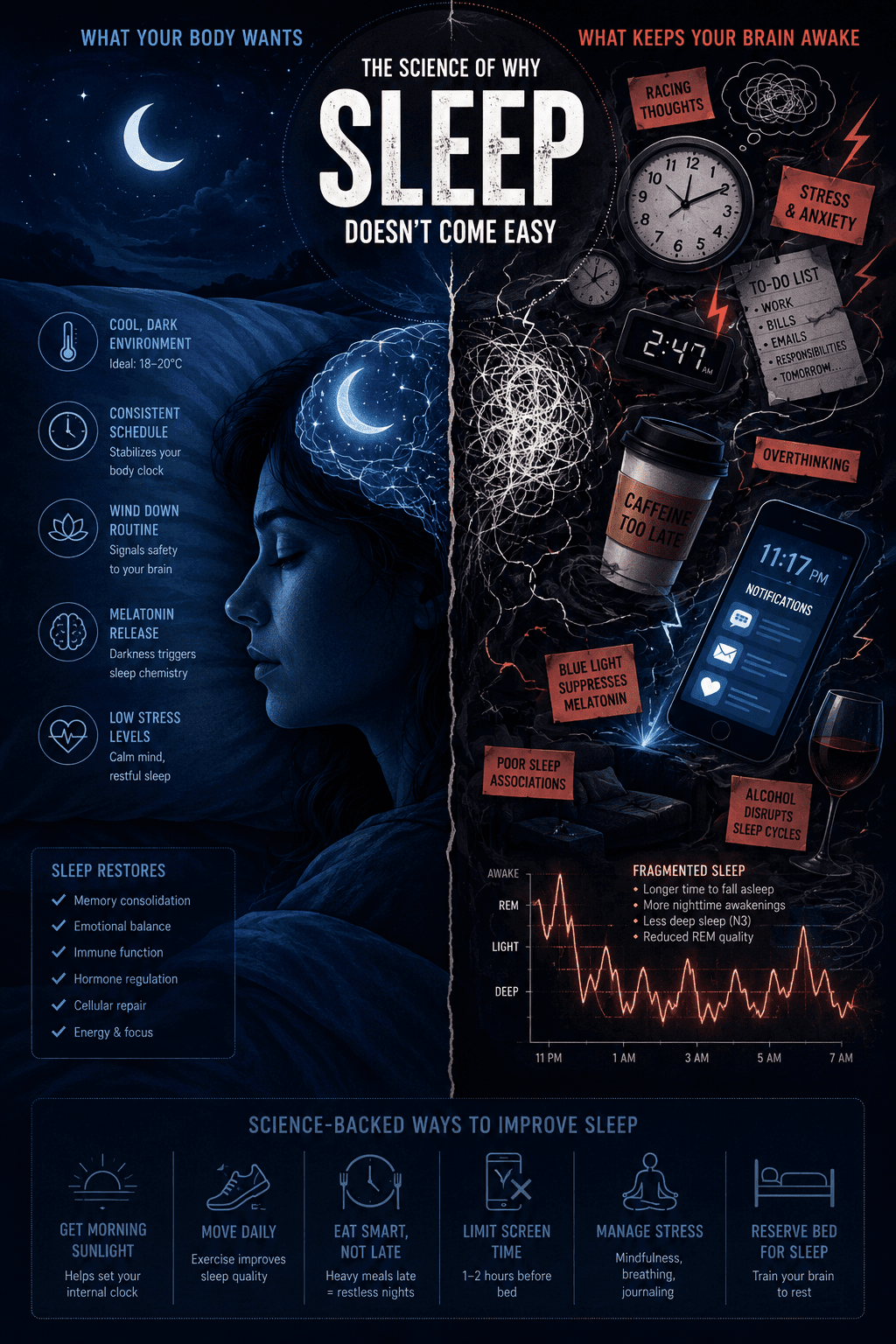
The most common reasons you’re not sleeping well — even when you go to bed on time — are a misaligned circadian rhythm, low sleep pressure from an inactive day, stress and anxiety, poor sleep environment, and undiagnosed sleep disorders. Most people who struggle with sleep are dealing with at least two of these at once.
Here’s what the research actually says: going to bed earlier doesn’t automatically mean you’ll sleep better. If you try to “catch up” by hitting the pillow an hour or two earlier than usual, you’re often fighting your own body clock — and that mismatch leads to fragmented sleep and those frustrating 3 a.m. wake-ups [1].
The other underrated factor is sleep pressure — the biological drive to sleep that builds the longer you’re awake. If you’ve had a sedentary day with little physical or mental activity, your sleep pressure is low by bedtime, and your brain simply isn’t ready to commit to deep sleep [2].
Common culprits worth checking:
- Irregular wake times — your body clock anchors to when you wake up, not when you go to bed
- Low daytime activity — physical and mental effort during the day builds the sleep drive you need at night
- Caffeine after noon — caffeine has a half-life of around 5–6 hours, meaning an afternoon coffee is still partially active at midnight
- Alcohol — it helps you fall asleep but fragments the second half of your night
- A warm or bright bedroom — even minor light and temperature issues cause micro-awakenings you won’t remember [5]
For a deeper look at what’s driving your specific situation, this breakdown of what causes lack of sleep covers 10 of the most common culprits in detail.
How Much Sleep Do Adults Actually Need?
Most adults need between 7 and 9 hours of sleep per night. The lower end of that range — 7 hours — is the minimum associated with healthy cognitive function, immune response, and metabolic regulation [9].
The honest version is: some people genuinely function on 6 hours. But they’re rarer than they think. Research consistently shows that people who sleep 6 hours or less tend to believe they’ve adapted, while objective performance tests show otherwise. If you’re relying on caffeine to feel human before noon, you probably haven’t adapted — you’ve just normalized the deficit.
Worth remembering: The question isn’t just how many hours you’re in bed. It’s how many hours of restorative sleep you’re actually getting. Eight hours of fragmented, light sleep can leave you more exhausted than six hours of solid, uninterrupted sleep [5].
Can Stress and Anxiety Cause Sleep Problems?
Yes — and they’re probably the most underestimated cause of why people aren’t getting sleep despite doing everything “right.” Stress activates your sympathetic nervous system, raises cortisol, and keeps your brain in a scanning-for-threats mode that is biologically incompatible with deep sleep.
Nighttime is when anxious thoughts tend to surface because there’s nothing else competing for your attention. Your brain isn’t broken — it’s doing exactly what it evolved to do. It’s just doing it at the worst possible time.
One approach that’s shown real results: keeping your bedtime and wake time within the same one-hour window at least five nights a week. This consistency helps regulate both your circadian rhythm and your sleep pressure, which together reduce the window where anxiety can take hold [4].
If you’ve been dealing with this for a while and suspect anxiety is the main driver, it’s worth taking a proper assessment. This free, anonymous insomnia and sleep test asks you to evaluate how you’ve felt over the past two weeks — it takes a few minutes and can help clarify whether what you’re experiencing goes beyond ordinary stress.
What’s the Difference Between Insomnia and Just Bad Sleep Habits?
Bad sleep habits are behavioral — inconsistent schedules, too much screen time before bed, caffeine too late. Fix the habits, fix the sleep. Insomnia is a clinical condition defined by difficulty falling or staying asleep at least three nights per week for three months or more, despite having adequate opportunity to sleep — and it causes real daytime impairment.
The distinction matters because the solutions are different. Sleep hygiene advice — the kind you’ve probably already tried — works well for habit-based sleep problems. It does almost nothing for clinical insomnia, which typically requires Cognitive Behavioral Therapy for Insomnia (CBT-I), the evidence-based first-line treatment.
If you’re reading this and thinking I’ve tried all the basics and nothing works — that’s a signal you may be past the “bad habits” stage. Understanding why you have insomnia and finding your trigger is a useful next step.
How Do I Know If I Have a Sleep Disorder?
Sleep disorders are more common than most people realize, and many go undiagnosed for years. The key signs that something beyond lifestyle is at play [5]:
- You wake up tired after 7–8 hours of sleep, consistently
- Your partner notices you snore loudly, stop breathing, or gasp during sleep (possible sleep apnea)
- You have an uncomfortable urge to move your legs at night (possible restless legs syndrome)
- You feel like you never actually slept, even when you did — this is called paradoxical insomnia [7]
- You fall asleep suddenly during the day in inappropriate situations
Paradoxical insomnia deserves a mention here because it’s genuinely distressing. Some people are convinced they haven’t slept when objective sleep studies show they have. It’s not imagined — it’s a real perceptual disconnect, and it requires professional evaluation rather than more sleep hygiene tips [7].
I’ve had nights where I was certain I lay awake for hours, only to realize from a sleep tracker that I’d actually had several sleep cycles. That gap between perception and reality is exhausting in its own way.
Are There Medical Conditions That Prevent Good Sleep?
Several medical conditions directly interfere with sleep quality, independent of your habits or stress levels. These include:
| Condition | How It Disrupts Sleep |
|---|---|
| Sleep apnea | Repeated breathing interruptions fragment sleep architecture |
| Restless legs syndrome | Uncomfortable leg sensations prevent sleep onset and maintenance |
| Chronic pain | Pain signals activate the nervous system throughout the night |
| Thyroid disorders | Both hypo- and hyperthyroidism affect sleep regulation |
| GERD (acid reflux) | Lying down worsens symptoms, causing arousals |
| Depression | Alters REM sleep and causes early morning awakening |
| Menopause | Hot flashes and hormonal shifts disrupt sleep continuity |
If you’re experiencing daytime fatigue that doesn’t improve with more sleep, mood swings you can’t explain, or microsleep episodes during the day, those are red flags that something medical may be involved [8]. These symptoms warrant a conversation with a doctor — not just another adjustment to your bedtime routine.
How Do Age and Hormones Impact Sleep?
Sleep architecture changes significantly with age, and hormonal shifts accelerate those changes. This is one of the most overlooked reasons why people who slept fine in their 20s find themselves struggling in their 30s and 40s.
As you get older, you spend less time in slow-wave (deep) sleep and more time in lighter sleep stages. That means you’re more easily disturbed by noise, temperature, or a full bladder — and those disturbances feel more disruptive because you’re already sleeping lighter.
For women, perimenopause and menopause bring estrogen and progesterone fluctuations that directly affect sleep regulation. Hot flashes aside, the hormonal shift itself reduces sleep quality. For men, declining testosterone in middle age is associated with increased sleep fragmentation and more frequent nighttime awakenings.
In practice this means: if your sleep started deteriorating in your late 30s or 40s without an obvious lifestyle reason, hormones are worth discussing with your doctor.
What Foods or Drinks Might Be Disrupting My Sleep?
Several common dietary habits interfere with sleep in ways that aren’t always obvious:
- Caffeine — the half-life is 5–6 hours, so a 3 p.m. coffee still has significant activity at 9 p.m. Sensitive individuals feel it even longer
- Alcohol — it sedates initially but suppresses REM sleep and causes rebound arousal in the second half of the night
- Heavy meals within 2–3 hours of bed — digestion raises core body temperature, which works against sleep onset
- High-sugar foods in the evening — blood sugar spikes and crashes can cause nighttime awakenings
- Spicy food — can worsen acid reflux when lying down
The reason this matters is that these aren’t minor inconveniences. Alcohol, in particular, is frequently mistaken for a sleep aid. It helps you fall asleep faster while quietly destroying the quality of what follows.
What Sleep Supplements Actually Work?
The honest answer: most supplements have modest evidence at best. A few are genuinely worth trying.
Magnesium glycinate — probably the most evidence-supported option for people with sleep difficulties. It supports GABA activity and muscle relaxation. Worth trying if you’re also dealing with nighttime restlessness or anxiety.
Melatonin — useful for circadian rhythm issues (jet lag, shift work, delayed sleep phase) but not a strong sedative. Low doses (0.5–1mg) are often more effective than the 5–10mg doses sold in stores.
L-theanine — an amino acid found in green tea that promotes relaxation without sedation. Some people find it helpful for quieting a racing mind at bedtime.
Valerian root — mixed evidence. Some people respond well; many don’t notice anything.
Disclaimer: Supplements can interact with medications. Check with a healthcare provider before starting anything new, especially if you’re managing a health condition.
For people who want to avoid supplements entirely, falling asleep naturally without pills is a practical starting point.
Can Technology and Screen Time Affect My Sleep?
Yes, but probably not just because of blue light — that’s only part of the story. The bigger issue is cognitive and emotional stimulation. Scrolling social media, reading news, or watching something intense keeps your brain in an alert, reactive state that takes time to wind down from.
Blue light does suppress melatonin production, but the effect is relatively modest compared to the stimulation problem. The real issue is that your phone is a machine designed to keep you engaged, and engagement is the opposite of what you need before sleep.
In practice this means: a blue light filter helps a little, but putting the phone in another room helps a lot more.
Best Ways to Improve Sleep Quality Naturally
If you’ve already tried the basics and they haven’t worked, here’s what the research actually points to as meaningful interventions [2][3]:
- Fix your wake time first — pick a consistent time and hold it, even on weekends. Your body clock anchors to wake time more than bedtime
- Build sleep pressure during the day — physical activity, mental engagement, and morning sunlight all help
- Keep your sleep window realistic — going to bed too early when you’re not sleepy creates more frustration, not more sleep [1]
- Cool your bedroom — the ideal sleep temperature is around 65–68°F (18–20°C)
- Use your bed only for sleep — if you’re lying awake for more than 20 minutes, get up and do something calm until you feel sleepy
- Try the 7:1 rule — at least 7 hours of sleep, with bedtime within a 1-hour window, at least 5 nights per week [3]
If you want a broader toolkit, 15 ways to fall asleep faster tonight covers practical changes you can start immediately.
When Should I See a Doctor About My Sleep Issues?
See a doctor if your sleep problems have lasted more than three months, if you have symptoms of sleep apnea (snoring, gasping, excessive daytime sleepiness), or if poor sleep is affecting your work, relationships, or mental health [6].
It’s not just you — chronic sleep deprivation is associated with increased risk of cardiovascular disease, weakened immune function, impaired memory, and mood disorders [6]. These aren’t distant risks. They accumulate quietly.
If you’re not sure whether what you’re experiencing crosses a clinical threshold, this free insomnia test is a good starting point. It’s anonymous, takes a few minutes, and asks you to reflect on the past two weeks — it can help you decide whether professional support makes sense.
For a broader self-assessment, understanding what your body is telling you when you can’t sleep is worth reading before your appointment.
FAQ
Q: Why am I not getting sleep even though I feel tired?
Feeling tired and being ready to sleep aren’t the same thing. If your circadian rhythm is misaligned, your sleep pressure is low, or your nervous system is in an alert state from stress, your brain can resist sleep even when your body feels exhausted.
Q: Is it normal to wake up at 3 a.m. every night?
Occasional nighttime waking is normal. Waking at the same time every night and struggling to return to sleep is not — it’s often a sign of anxiety, inconsistent sleep scheduling, or a sleep disorder worth investigating [1].
Q: Can I catch up on sleep on weekends?
Partially. You can recover some cognitive function, but you can’t fully reverse the biological effects of chronic sleep debt. More importantly, sleeping in on weekends shifts your circadian rhythm and makes Monday night harder [3].
Q: How do I know if I have sleep apnea?
Common signs include loud snoring, waking with a dry mouth or headache, feeling unrefreshed after a full night’s sleep, and excessive daytime sleepiness. A partner noticing pauses in your breathing is a strong indicator. A sleep study (polysomnography) is the only way to confirm it [5].
Q: Does melatonin help with insomnia?
Melatonin is most useful for circadian rhythm problems — jet lag, shift work, delayed sleep phase. It’s not a strong treatment for insomnia itself. Low doses (0.5–1mg) are generally more effective than high doses.
Q: What’s the fastest way to improve sleep quality?
Fixing your wake time and keeping it consistent is the single highest-leverage change most people can make. It’s not exciting, but it works [2][3].
Q: Can anxiety cause insomnia even if I’m not consciously anxious?
Yes. Subclinical anxiety — the kind that doesn’t feel like “real” anxiety — can still elevate cortisol and keep your nervous system activated at night. Physical symptoms like a racing heart or muscle tension at bedtime are signs worth paying attention to.
Q: Is CBT-I better than sleeping pills?
For chronic insomnia, yes — CBT-I has stronger long-term outcomes and no dependency risk. Sleeping pills can be useful short-term but don’t address the underlying patterns driving insomnia.
Conclusion
If you’ve been going to bed on time and still waking up exhausted, you’re not doing it wrong — you’re just dealing with a problem that goes deeper than bedtime. The reasons why people aren’t getting sleep are usually layered: a body clock that’s slightly off, a nervous system that won’t quiet down, a sleep environment with subtle problems, or a disorder that nobody’s looked for yet.
Start with the highest-leverage changes: lock in a consistent wake time, build more physical and mental activity into your days, and take an honest look at your caffeine and alcohol habits. If those don’t move the needle after a few weeks, start looking at whether anxiety, a medical condition, or a sleep disorder might be involved.
You don’t have to figure this out alone. If you’ve been struggling for months and the basics haven’t helped, take the free insomnia assessment as a starting point, and consider talking to a doctor or sleep specialist. Chronic sleep problems are treatable — but they rarely resolve on their own.
For more on what might be keeping you awake, why you can’t sleep at night even when you’re tired and 12 surprising reasons you can’t sleep are worth reading next.
References
[1] I Kept Waking Up At 3 A M Until I Ditched This Healthy Sleep Habit An Expert Explains Why – https://www.tomsguide.com/wellness/sleep/i-kept-waking-up-at-3-a-m-until-i-ditched-this-healthy-sleep-habit-an-expert-explains-why
[2] I Was Struggling To Fall Asleep Yet Waking Up At 3 A M Until An Expert Made This Simple Change To My Routine – https://www.tomsguide.com/wellness/sleep/i-was-struggling-to-fall-asleep-yet-waking-up-at-3-a-m-until-an-expert-made-this-simple-change-to-my-routine
[3] I Tried The 7 1 Sleep Rule Doctors Rate As The Best Way To Stop 3 A M Wake Ups Heres Why It Works – https://www.tomsguide.com/wellness/sleep/i-tried-the-7-1-sleep-rule-doctors-rate-as-the-best-way-to-stop-3-a-m-wake-ups-heres-why-it-works
[4] Anxiety And Stress Were Keeping Me Awake Until Experts Shared A Simple Bedtime Rule To Help Me Fall Asleep Fast – https://www.tomsguide.com/wellness/sleep/anxiety-and-stress-were-keeping-me-awake-until-experts-shared-a-simple-bedtime-rule-to-help-me-fall-asleep-fast
[5] Why You Wake Up Tired After 8 Hours Of Sleep – https://health.clevelandclinic.org/why-you-wake-up-tired-after-8-hours-of-sleep
[6] Sleep Deprivation – https://www.hopkinsmedicine.org/health/conditions-and-diseases/sleep-deprivation
[7] Paradoxical Insomnia – https://my.clevelandclinic.org/health/diseases/paradoxical-insomnia
[8] 3 Red Flags That Youre Headed For Insomnia From Mood Swings To Micro Sleeps – https://www.tomsguide.com/wellness/sleep/3-red-flags-that-youre-headed-for-insomnia-from-mood-swings-to-micro-sleeps
[9] I Get 6 Hours Of Sleep A Night But Is That Enough I Asked A Board Certified Doctor Heres What He Said – https://www.tomsguide.com/wellness/sleep/i-get-6-hours-of-sleep-a-night-but-is-that-enough-i-asked-a-board-certified-doctor-heres-what-he-said