Post Disclaimer
This post contains affiliate links. If you buy something through these links, I may earn a small commission at no extra cost to you. Full disclosure.
This article is for informational purposes only and does not constitute medical advice. Always consult a healthcare professional for personal health concerns. Full disclaimer.
Last updated: July 6, 2026
Quick Answer: Deep sleep and REM sleep are two distinct stages of the sleep cycle that serve completely different functions. Deep sleep (NREM Stage 3) is when your body physically repairs itself. REM sleep is when your brain processes emotions and consolidates memories. You need both – and most people who struggle with sleep are quietly losing one or the other without realizing it.
Key Takeaways
- Deep sleep vs REM sleep is not an either/or – both stages are essential, and they do different jobs
- Deep sleep dominates the first half of the night; REM sleep dominates the second half
- Adults typically need 13-23% of total sleep as deep sleep and 20-25% as REM sleep [6]
- Alcohol, late-night eating, stress, and inconsistent sleep timing all suppress one or both stages
- Waking up unrefreshed is often a sign of disrupted deep sleep; waking up emotionally flat or foggy often points to lost REM
- Sleep trackers can estimate these stages but are not perfectly accurate
- Magnesium glycinate and consistent wake times are among the most evidence-supported habits for improving deep sleep
- You cannot “skip” deep sleep and compensate with more REM – they are not interchangeable
- Poor deep sleep is linked to increased Alzheimer’s risk and weakened immune function [10]
- If you’ve been dealing with this for a while, the problem is rarely willpower – it’s usually physiology
What Is Deep Sleep and What Happens in Your Body
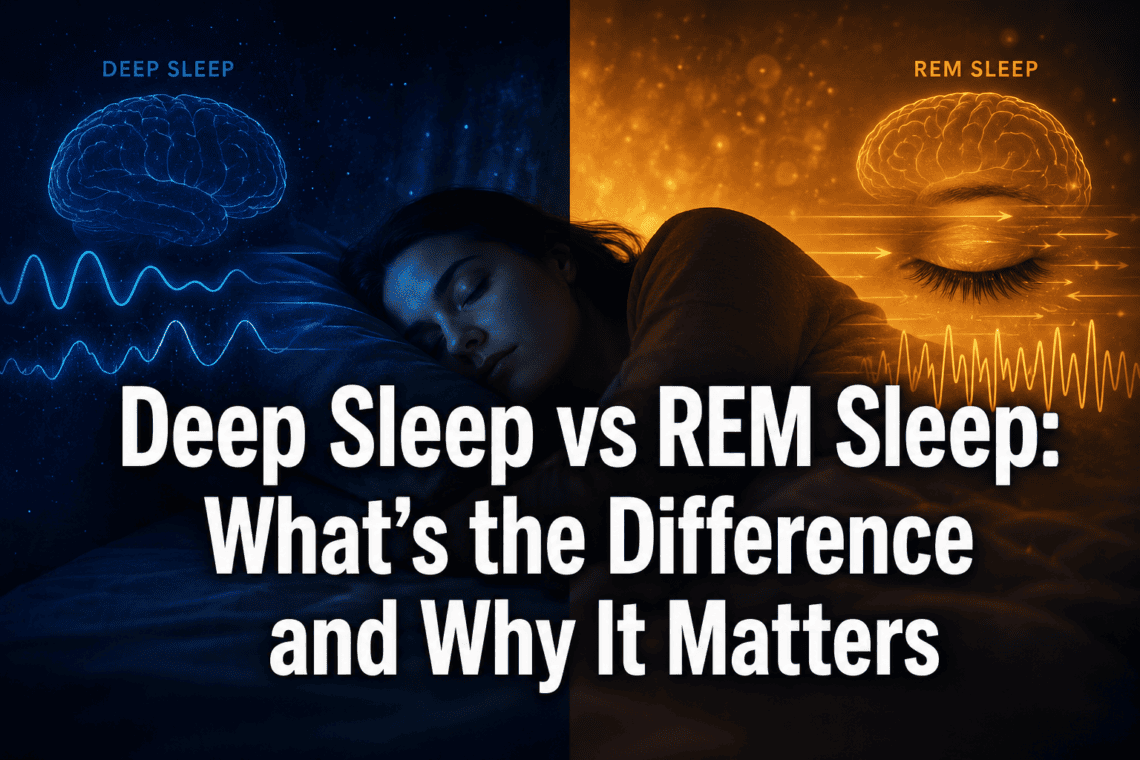
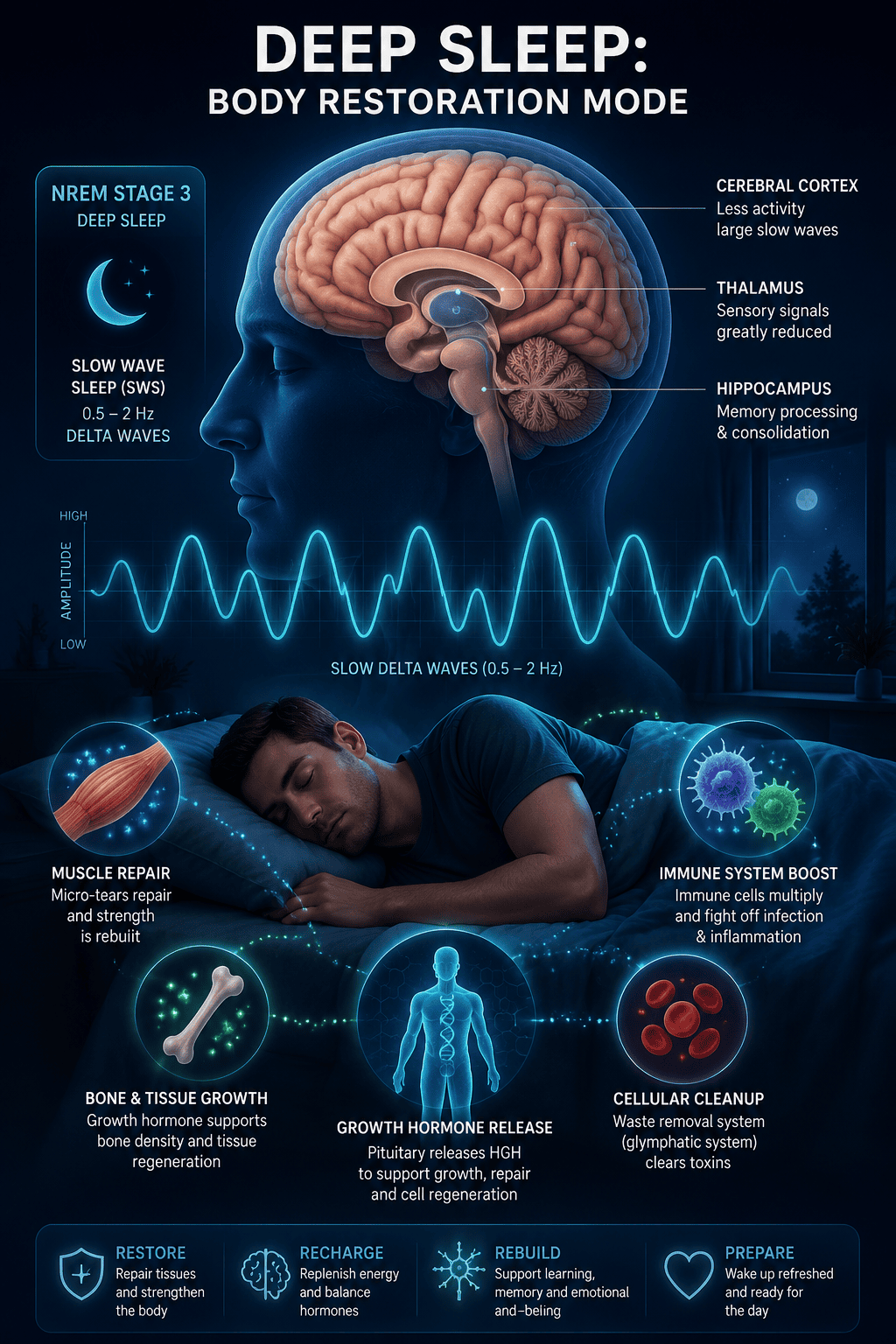
Deep sleep – also called slow-wave sleep or NREM Stage 3 – is the most physically restorative stage of the sleep cycle. During this stage, your brain produces slow delta waves, your heart rate and breathing drop to their lowest points, and your body goes to work repairing tissue, building bone and muscle, and releasing growth hormone [9].
This is also when your glymphatic system – your brain’s waste-clearance network – is most active. It flushes out metabolic byproducts, including amyloid-beta plaques associated with Alzheimer’s disease [10]. Here’s what the research actually says: a 2025 study covered by CNN found that people who got less deep sleep showed higher accumulation of these plaques over time, even when total sleep duration looked normal [10].
In practice, this means the quality of your sleep matters as much as the quantity. Eight hours of fragmented or shallow sleep will not give you the same deep sleep benefit as six hours of consolidated, undisturbed sleep.
What deep sleep does for you:
- Releases human growth hormone (critical for tissue repair)
- Strengthens immune function
- Clears metabolic waste from the brain
- Consolidates declarative memory (facts and events)
- Regulates blood sugar and appetite hormones
If you want to go deeper on what happens across all four stages, the full breakdown of the sleep cycle is worth reading first.
What Is REM Sleep and Why Is It Important
REM sleep – Rapid Eye Movement sleep – is the stage where most vivid dreaming happens, and it is critical for emotional regulation, creativity, and long-term memory consolidation [6]. Your brain during REM is nearly as active as when you’re awake, but your body is essentially paralyzed to prevent you from acting out your dreams.
The reason this matters is that REM sleep processes the emotional weight of your experiences – not just the events themselves. Research published in Current Biology found that REM sleep specifically helps strip the emotional charge from difficult memories, which is why sleep deprivation is so closely tied to anxiety and mood dysregulation [7].
Most of your REM sleep happens in the second half of the night. If you’re waking up at 4 or 5am and can’t get back to sleep, you’re cutting off a disproportionate amount of REM. That’s not a small loss.
What REM sleep does for you:
- Processes and regulates emotions
- Consolidates procedural and emotional memory
- Supports creative problem-solving
- Maintains mental health and mood stability
- Clears the emotional residue of stressful experiences
How Long Should Each Sleep Stage Last
For a typical adult sleeping 7-9 hours, deep sleep accounts for roughly 13-23% of total sleep time, and REM sleep accounts for 20-25% [6]. In real numbers, that means:
| Sleep Stage | % of Total Sleep | For 8 Hours of Sleep | When It Peaks |
|---|---|---|---|
| NREM Stage 1 (Light) | 5% | ~24 min | Sleep onset |
| NREM Stage 2 (Light) | 45-55% | ~3.5-4.5 hrs | Throughout night |
| NREM Stage 3 (Deep) | 13-23% | ~60-110 min | First half of night |
| REM Sleep | 20-25% | ~90-120 min | Second half of night |
Deep sleep cycles are longer and more intense early in the night. REM periods get progressively longer as the night goes on – the final REM cycle before waking can last 45-60 minutes on its own [9]. This is why both going to bed late and waking up early cut into your sleep quality in different ways.
Deep Sleep vs REM Sleep: Which One Is More Important
The honest version is: you need both, and they are not interchangeable. But if you’re asking which one most people who struggle with sleep are losing first – it’s usually deep sleep.
Deep sleep declines naturally with age, starting in your 30s. By the time most people reach their 40s, they may be getting significantly less deep sleep than they did at 20, even if total sleep time looks the same [9]. This is partly why sleep feels less restorative as you get older, even when you’re technically “getting enough hours.”
REM sleep, on the other hand, is more vulnerable to alcohol, antidepressants (particularly SSRIs), and early morning waking. Both stages matter – but they fail in different ways and for different reasons.
Choose to prioritize deep sleep if you wake up physically exhausted, get sick frequently, or feel like sleep never restores you.
Pay more attention to REM if you wake up emotionally dysregulated, have vivid or disturbing dreams, feel mentally foggy, or are dealing with anxiety and depression alongside sleep problems.
Why Am I Not Getting Enough Deep Sleep
Several common factors suppress deep sleep, and most of them are things you can actually change.
The biggest deep sleep disruptors:
- Alcohol – even moderate amounts suppress deep sleep in the second half of the night, even if it helps you fall asleep faster [6]
- Irregular sleep timing – your body produces the most deep sleep in the first 90-minute cycle; if that cycle is disrupted, you lose it
- Stress and high cortisol – cortisol is a light-sleep hormone; elevated levels at night actively block slow-wave sleep
- Sleep apnea – repeated micro-arousals fragment deep sleep without you knowing; if you snore or wake up exhausted, this is worth investigating
- Aging – natural reduction in slow-wave sleep begins in the 30s and accelerates after 60 [9]
- Stimulants too late in the day – caffeine has a half-life of 5-7 hours; a 3pm coffee is still 50% active at 8pm
If you’ve been dealing with this for a while and can’t identify a clear cause, it’s worth checking whether a sleep disorder might be involved. You can look at some of the silent signs of a sleep disorder that often go unnoticed for years.
📋 If you’re unsure whether your sleep problems go beyond lifestyle factors, this free anonymous test can help clarify things. It evaluates how you’ve felt over the past two weeks and takes only a few minutes: Take the free insomnia test here
What Causes Lack of REM Sleep
REM sleep is suppressed by a different set of factors than deep sleep – and this is where a lot of people get confused when they’re trying to fix their sleep.
The most common REM disruptors are:
- Alcohol – yes, again. Alcohol suppresses REM in the first half of the night, then causes REM rebound (intense, fragmented dreaming) in the second half
- Antidepressants (SSRIs and SNRIs) – these medications are known to significantly reduce REM sleep; if you’re on one and feel emotionally flat or have lost your dreams, this may be why
- Cannabis – regular use suppresses REM sleep; users often report vivid, intense dreams when they stop, which is REM rebound
- Sleep fragmentation – waking repeatedly interrupts REM cycles, which tend to be longer and more vulnerable in the second half of the night
- Stress and anxiety – hyperarousal keeps the nervous system in a state that’s incompatible with deep REM
For more on what’s driving your sleep problems specifically, the breakdown of common causes of lack of sleep covers a lot of ground.
Do You Dream More in Deep Sleep or REM Sleep
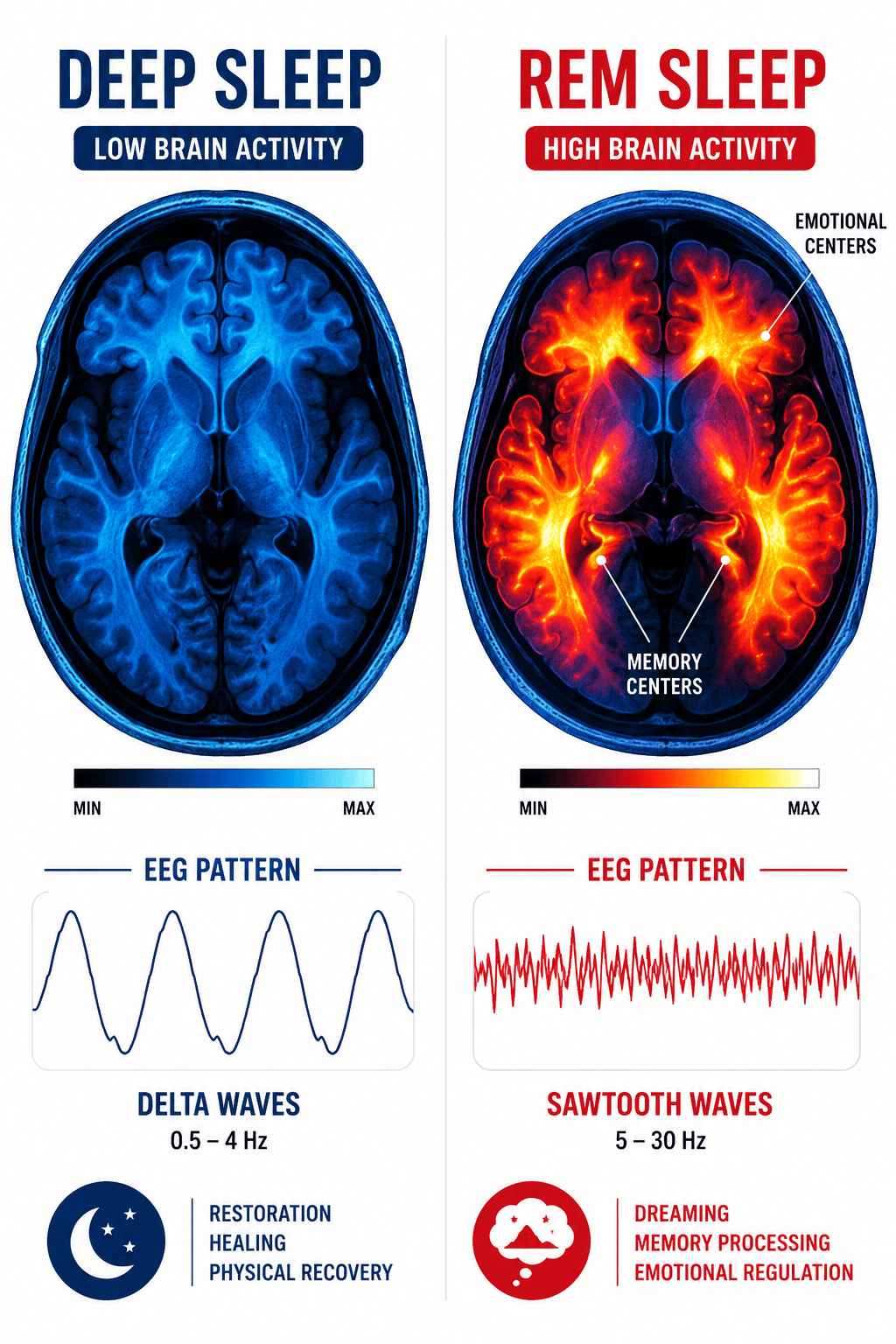
You dream almost exclusively in REM sleep – at least the vivid, narrative dreams you can remember. Deep sleep does involve some mental activity, but it’s typically fragmented, non-narrative, and rarely recalled [6].
REM dreams are characterized by strong emotional content, visual richness, and bizarre narrative logic. This is because the prefrontal cortex (the rational, inhibitory part of your brain) is largely offline during REM, while the amygdala (emotional processing) is highly active [7].
If you rarely remember your dreams, it doesn’t necessarily mean you’re not getting REM sleep – most dreams are forgotten within minutes of waking unless you wake directly from a REM cycle. But consistently having no dream recall at all, combined with emotional flatness or low mood, can be a sign that REM is being suppressed.
Can You Have REM Sleep Without Deep Sleep
Technically yes – your brain can cycle into REM without preceding deep sleep, particularly in naps or when sleep pressure is low. But in a full night of sleep, the architecture typically follows a predictable pattern: NREM stages first, then REM, cycling roughly every 90 minutes [9].
When deep sleep is chronically reduced (from age, alcohol, or sleep disorders), the body doesn’t simply replace it with more REM. The sleep cycle becomes shallower overall – more time in light NREM Stage 2, less in both deep and REM. This is the unrefreshing sleep pattern that so many people describe: technically sleeping for 7-8 hours but waking up feeling like they barely slept at all.
It’s not just you. This is a real physiological pattern, and it has real causes.
How to Increase Deep Sleep Naturally
Here’s what the research actually says works – not the generic sleep hygiene list you’ve already tried.
Evidence-supported approaches:
- Keep a consistent wake time – this is the single most powerful lever for deep sleep. Your circadian rhythm determines when deep sleep is released; a consistent anchor point trains it [6]
- Magnesium glycinate (200-400mg before bed) – magnesium supports GABA activity, which is the primary inhibitory neurotransmitter involved in slow-wave sleep. Worth trying if you’ve ruled out other causes
- Cool your bedroom – core body temperature needs to drop to initiate deep sleep; 65-68°F (18-20°C) is the commonly cited range
- Avoid alcohol 3+ hours before bed – even one drink measurably reduces deep sleep [6]
- Exercise regularly, but not within 2-3 hours of bed – moderate aerobic exercise increases slow-wave sleep in multiple studies
- Reduce late-night eating – digestion raises core body temperature and competes with sleep onset
This is what worked for me: cutting alcohol on weeknights made a more noticeable difference to how rested I felt than any supplement or sleep gadget I’d tried. I didn’t want to hear that, but the data was hard to argue with.
For a more detailed breakdown, the science-backed guide to improving deep sleep goes into the specifics of each approach.
What Happens If You Don’t Get Enough of Either
Chronic loss of deep sleep is linked to impaired immune function, increased risk of metabolic disease, and – increasingly – higher risk of neurodegenerative conditions including Alzheimer’s [10]. A 2026 study found that deep sleep quality was a stronger predictor of certain health outcomes than total sleep duration [2].
Chronic REM loss is linked to emotional dysregulation, increased anxiety and depression risk, impaired learning, and reduced ability to process trauma [7]. The research on REM sleep and mental health is some of the most compelling in sleep science right now.
The combination of both – shallow, fragmented sleep with little deep or REM – is what most people with chronic insomnia are actually experiencing. If that sounds familiar, the guide to fixing sleep deprivation is a practical place to start.
📋 If the symptoms above sound familiar and you’re not sure where to start, this free anonymous insomnia test evaluates how you’ve been feeling over the past two weeks and can point you toward the right next step: Take the test here
How Do Sleep Trackers Measure Deep Sleep and REM
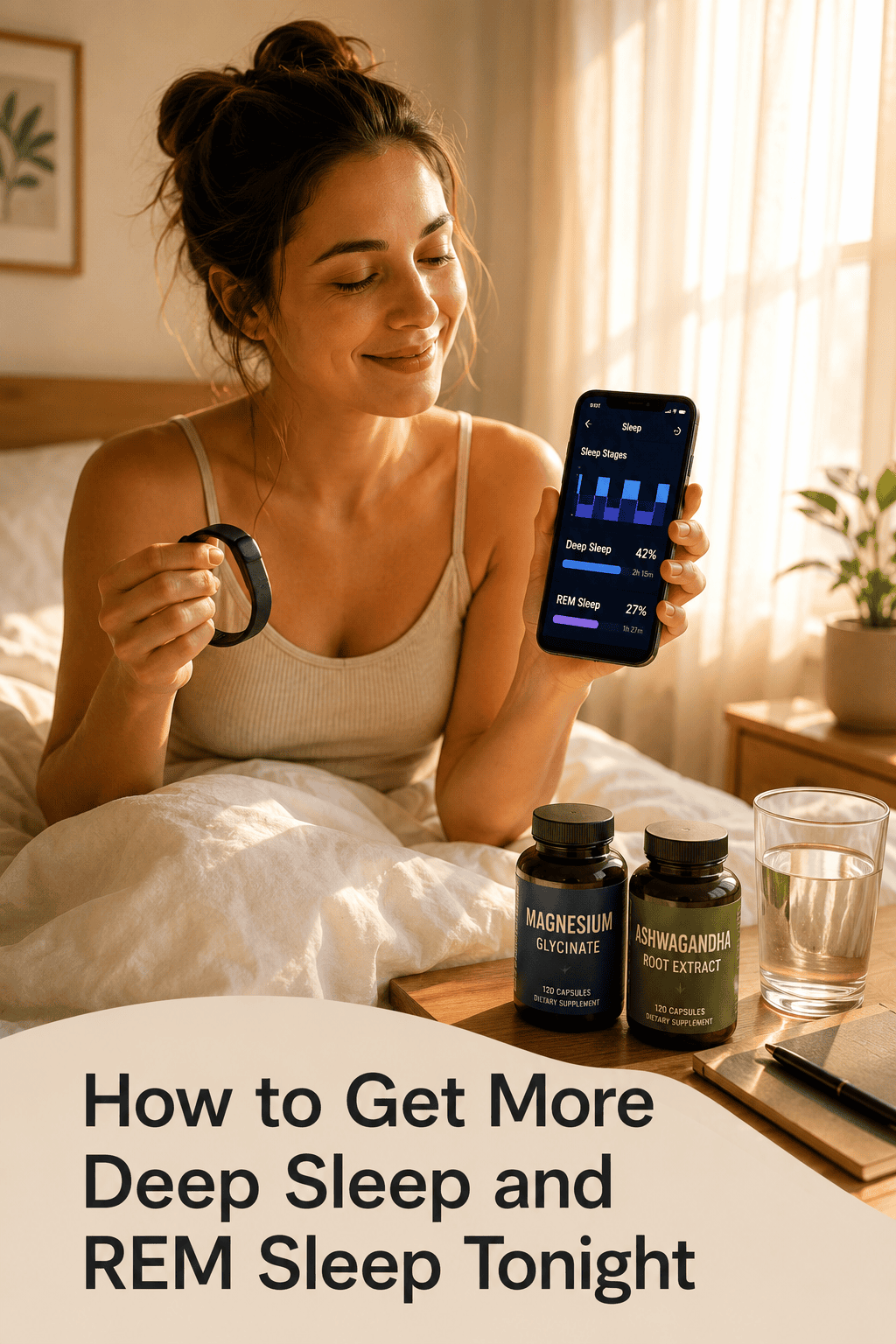
Consumer sleep trackers (Oura, Fitbit, Apple Watch, Garmin) estimate sleep stages using a combination of heart rate variability, movement, and sometimes skin temperature. They do not measure brain waves directly – that requires a polysomnography (PSG) lab test.
The honest version is: they’re useful for spotting trends, not for precise measurement. Studies comparing consumer trackers to PSG have found they’re reasonably accurate for detecting sleep vs. wake, but less reliable at distinguishing specific NREM stages [8]. Deep sleep in particular tends to be underestimated by some devices.
Use tracker data as a general signal – if your deep sleep percentage is consistently very low or your REM is near zero, that’s worth paying attention to. But don’t obsess over individual night readings. Tracker anxiety is a real phenomenon that can make sleep worse.
Best Supplements and Habits for Better Deep and REM Sleep
For deep sleep:
- Magnesium glycinate (not magnesium oxide – poor absorption)
- Consistent sleep/wake schedule
- Cold bedroom environment
- Reducing alcohol
For REM sleep:
- Addressing the underlying causes (alcohol, SSRIs if relevant – speak to your doctor before changing medication)
- Protecting the second half of your night – don’t set an alarm earlier than necessary
- Managing anxiety; the techniques for calming your mind before sleep are particularly relevant here
- Avoiding cannabis if you use it regularly
Worth trying if you’ve already handled the basics and still feel unrefreshed: a short course of magnesium glycinate combined with a strict wake time for two weeks. It won’t fix a sleep disorder, but it’s a low-risk starting point with some evidence behind it.
For a deeper look at improving REM specifically, the natural habits for better REM sleep covers more ground than I can here.
Medical disclaimer: Supplements mentioned are general wellness information only. Speak with a healthcare provider before starting any supplement, especially if you take medications or have a health condition.
Conclusion
Deep sleep and REM sleep are not competing priorities – they’re two halves of a complete night. Deep sleep rebuilds your body and clears your brain. REM sleep processes your emotions and consolidates your memory. Lose one chronically and you’ll feel it, even if you can’t name exactly what’s wrong.
If you wake up physically exhausted, focus on deep sleep first – sleep timing, alcohol, temperature, magnesium. If you wake up emotionally drained or mentally foggy, look at what’s cutting into your second half of the night.
Actionable next steps:
- Set a consistent wake time and hold it for two weeks – even on weekends
- Cut alcohol at least three nights a week and track how you feel
- Cool your bedroom to 65-68°F before bed
- If you’re on medication that affects sleep, have an honest conversation with your doctor about it
- If you’ve been dealing with this for a while and nothing is working, consider whether a sleep disorder might be involved – the silent signs of a sleep disorder are worth reviewing
You don’t have to fall asleep – you just have to rest. But if rest isn’t restoring you, that’s a signal worth listening to.
📋 Not sure if what you’re experiencing is clinical insomnia or situational sleep disruption? This free, anonymous test takes just a few minutes and evaluates your symptoms over the past two weeks: Take the insomnia test here
FAQ
What is the main difference between deep sleep and REM sleep?
Deep sleep (NREM Stage 3) is physically restorative – your body repairs tissue and clears brain waste. REM sleep is mentally restorative – your brain processes emotions and consolidates memories. Both are essential and serve different functions.
How much deep sleep do I need per night?
Most adults need 60-110 minutes of deep sleep per night, which is roughly 13-23% of total sleep time. Deep sleep naturally decreases with age, so older adults may get less without it indicating a problem [6].
Can I get too much REM sleep?
In practice, this is rare in healthy adults. Unusually high REM percentages can sometimes be associated with REM rebound after sleep deprivation or alcohol withdrawal, or with certain medications. If your tracker consistently shows very high REM, it may also be a measurement error.
Why do I wake up tired even after 8 hours of sleep?
This is often a sign of disrupted deep sleep – either from sleep apnea, alcohol, stress, or fragmented sleep architecture. Total hours in bed do not equal total restorative sleep. See why you might not be getting sleep even when you go to bed on time.
Does alcohol help or hurt sleep stages?
Alcohol helps you fall asleep faster but significantly suppresses REM sleep in the first half of the night and disrupts deep sleep in the second half [6]. The net effect is shallower, less restorative sleep overall.
Do I dream during deep sleep?
Rarely, and not vividly. Most memorable dreaming occurs during REM sleep, when the brain is highly active and the emotional centers are engaged [6]. Deep sleep involves minimal, fragmented mental activity.
What’s the best way to get more deep sleep?
The most evidence-supported approaches are: a consistent wake time, avoiding alcohol before bed, cooling your bedroom to 65-68°F, regular exercise, and magnesium glycinate supplementation. Consistency matters more than any single intervention.
Can anxiety cause loss of deep sleep or REM sleep?
Yes to both. Anxiety elevates cortisol and keeps the nervous system in a hyperaroused state that actively blocks slow-wave sleep. It also contributes to sleep fragmentation that disrupts REM cycles. Addressing anxiety is often as important as any sleep-specific intervention.
Are sleep trackers accurate for measuring deep sleep?
They’re useful for spotting trends but not precise. Consumer trackers estimate sleep stages from heart rate and movement data, not brain waves. They tend to be less accurate for deep sleep specifically [8]. Use them as a rough guide, not a diagnostic tool.
What happens to your brain during deep sleep?
During deep sleep, the brain produces slow delta waves, the glymphatic system activates to clear waste products (including Alzheimer’s-linked proteins), and the brain consolidates declarative memories. It is the most neurologically “quiet” stage of sleep [9][10].
References
[1] Pmc10968898 – https://pmc.ncbi.nlm.nih.gov/articles/PMC10968898/
[2] New Study Finds Deep Sleep Better Long Sleep – https://en.majalla.com/node/330457/science-technology/new-study-finds-deep-sleep-better-long-sleep
[6] Rem Sleep – https://www.sleepfoundation.org/stages-of-sleep/rem-sleep
[7] S0960982219308012 – https://www.sciencedirect.com/science/article/pii/S0960982219308012
[8] mdpi – https://www.mdpi.com/2076-3425/14/3/260
[9] Nbk526132 – https://www.ncbi.nlm.nih.gov/books/NBK526132/
[10] Deep Rem Sleep Alzheimers Wellness – https://www.cnn.com/2025/03/31/health/deep-rem-sleep-alzheimers-wellness