Post Disclaimer
This post contains affiliate links. If you buy something through these links, I may earn a small commission at no extra cost to you. Full disclosure.
This article is for informational purposes only and does not constitute medical advice. Always consult a healthcare professional for personal health concerns. Full disclaimer.
Last updated: June 23, 2026
Quick Answer: The insomnia tips that actually move the needle aren’t the ones you’ve already read a hundred times. They’re the ones that work with your nervous system instead of against it – things like stimulus control, sleep restriction, cognitive techniques, and environment changes that target the real reasons your brain won’t switch off at night.
Key Takeaways
- Lying in bed awake for long periods trains your brain to associate the bed with wakefulness – not sleep
- Sleep restriction therapy is uncomfortable at first but is one of the most evidence-backed insomnia treatments available
- A racing mind at bedtime is usually anxiety about sleep itself, not just stress from the day
- Caffeine has a half-life of around 5-6 hours – your 3pm coffee is still in your system at 9pm
- Consistency in wake time matters more than consistency in bedtime
- Body temperature drop is a key trigger for sleep onset – cooling your room and body helps
- “You don’t have to fall asleep – you just have to rest” is not just reassurance; it’s a real technique called paradoxical intention
- CBT-I (Cognitive Behavioral Therapy for Insomnia) outperforms sleep medication in long-term outcomes, according to the American Academy of Sleep Medicine
- Most people who struggle with sleep are dealing with a learned pattern, not a permanent condition
- If you’ve been dealing with this for a while, it’s worth getting a formal assessment – not just reading more tips
Why the Usual Insomnia Tips Stop Working
Most sleep advice is written for people who occasionally have a bad night. If you’re reading this, you’re probably not that person. You’ve already cut back on caffeine. You’ve tried melatonin. You’ve downloaded the apps. And you’re still staring at the ceiling at 2am wondering what’s wrong with you.
Nothing is wrong with you. But the advice you’ve been given is probably aimed at the wrong problem.
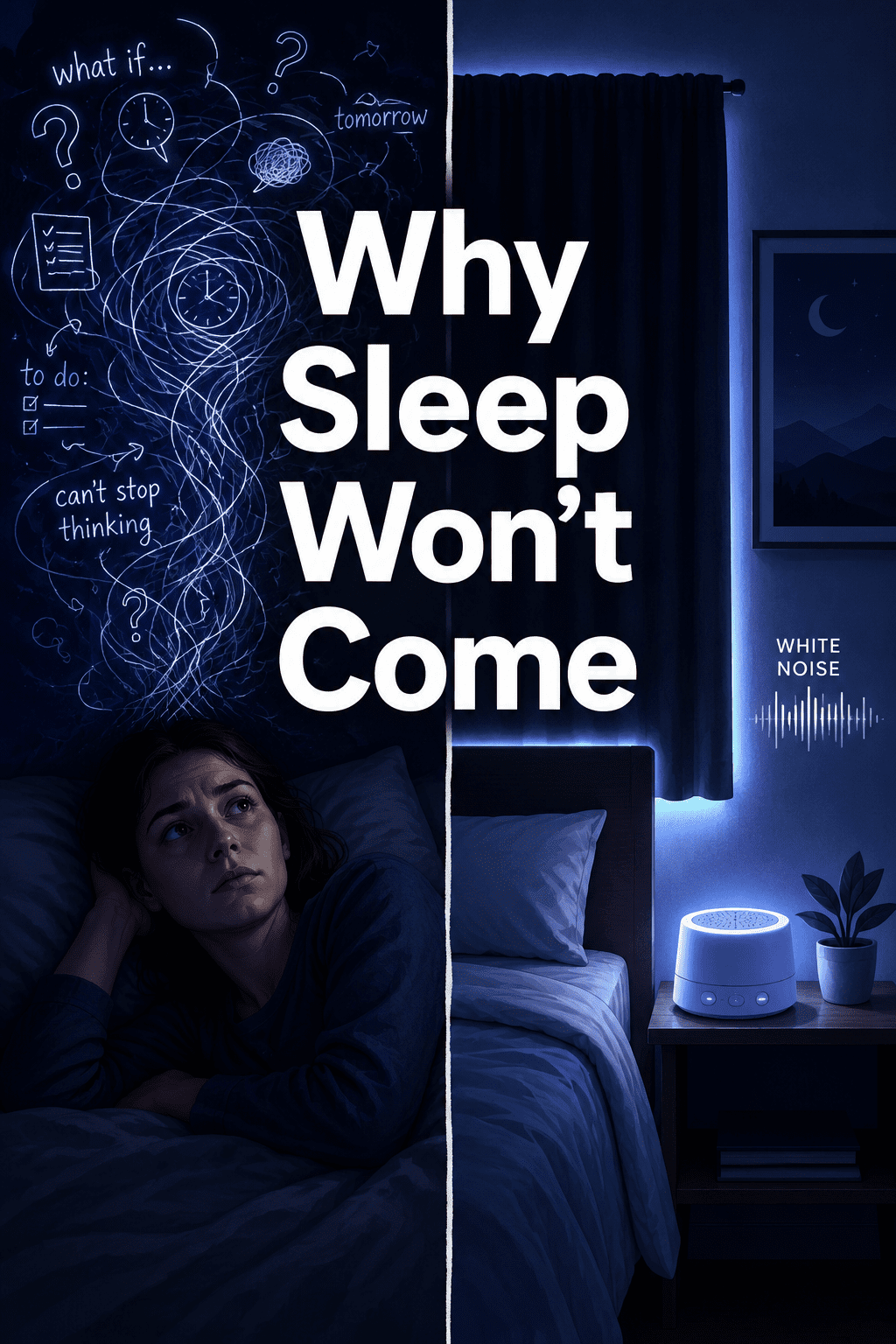
Here’s what the research actually says: chronic insomnia is largely a learned condition. Your brain has been trained – through weeks or months of bad nights – to treat the bedroom as a place of wakefulness and frustration. That’s not a mindset problem. It’s a conditioned response, and it needs to be unlearned, not just soothed.
The insomnia tips below are aimed at that deeper pattern. Some of them will feel counterintuitive. A few of them will be genuinely uncomfortable before they get better. That’s usually a sign they’re working on the right thing.
If you’re not sure whether what you’re experiencing is clinical insomnia or something else, it helps to understand why you might have insomnia and what your actual trigger is before diving into solutions.
The Insomnia Tips That Target Your Brain, Not Just Your Bedroom
These aren’t environment tweaks. These are the techniques that change how your brain relates to sleep.
1. Get out of bed when you can’t sleep
This is the one people resist most, and it’s also the most important. If you’ve been lying awake for more than 20 minutes, get up. Go to another room. Sit in dim light and do something quiet until you feel genuinely sleepy – not just tired, but actually drowsy. Then go back.
The reason this matters is stimulus control. Every minute you spend lying awake in bed teaches your brain that the bed is a place where you lie awake. Over time, getting into bed becomes a trigger for wakefulness instead of sleep. Breaking that association is slow, but it works [4].
2. Keep your wake time fixed, no matter what
This is the single most effective thing most people can do. Pick a wake time and stick to it – weekdays, weekends, even after a terrible night. Don’t try to “catch up” by sleeping in. It shifts your circadian rhythm and makes the next night harder.
The honest version is that this feels brutal after a bad night. You’ll be exhausted. That exhaustion is actually useful – it builds sleep pressure, which is what drives you to sleep the following night.
3. Try sleep restriction (it works, but it’s hard)
Sleep restriction therapy is one of the most evidence-backed insomnia treatments that exists, and almost no one talks about it. The idea is simple: you temporarily limit your time in bed to match how much you’re actually sleeping, then gradually extend it as your sleep efficiency improves.
If you’re spending 8 hours in bed but only sleeping 5, you’d start by only allowing yourself 5.5 hours in bed. It’s uncomfortable for the first week. But it consolidates your sleep, reduces the time you spend lying awake, and resets your brain’s association with the bed [5].
Worth trying if you’ve had insomnia for more than a few weeks and nothing else has shifted it.
4. Use paradoxical intention
This one sounds strange. Instead of trying to fall asleep, try to stay awake – with your eyes open, lying still, not doing anything stimulating. Just… try to stay awake.
You don’t have to fall asleep. You just have to rest. The performance anxiety around sleep is often what keeps people awake. Removing the goal of falling asleep removes the anxiety around failing to do it. Many people find they’re asleep within minutes.
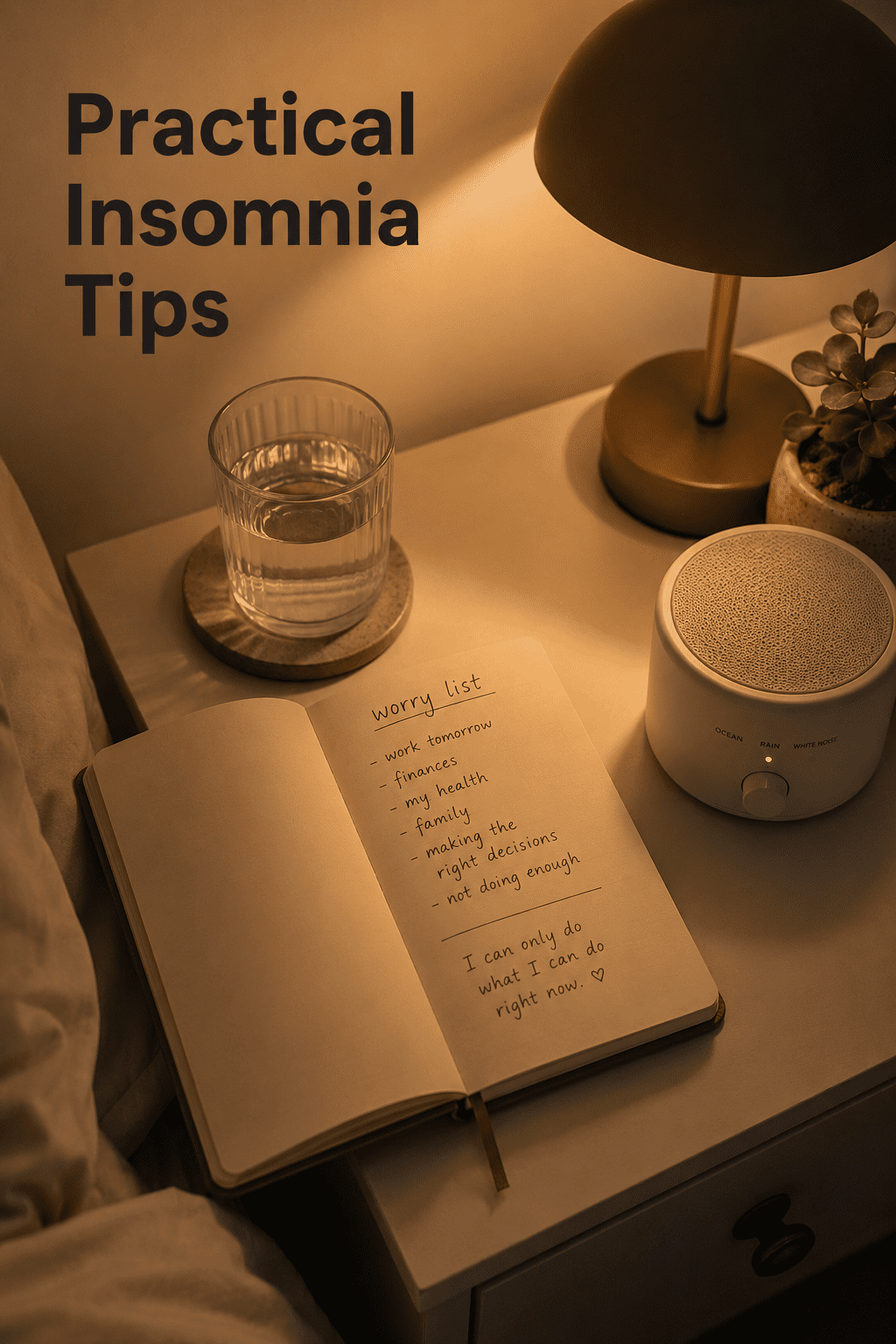
5. Write your worries down before bed
A 2018 study published in the Journal of Experimental Psychology found that spending 5 minutes writing a to-do list before bed – specifically tasks you need to do tomorrow, not things you’ve already done – helped people fall asleep significantly faster. The act of offloading the mental list seems to free up cognitive space.
This is different from journaling about your feelings. It’s more like clearing your mental RAM before you shut down for the night. If your mind races at bedtime, see the full breakdown of insomnia and overthinking and how to quiet your mind at night.
🔎 If you’ve been struggling with sleep for more than two weeks and these tips feel familiar but nothing is shifting, it’s worth taking a proper assessment.
Take this free, anonymous insomnia test – it evaluates how you’ve been feeling over the past two weeks and can help clarify whether what you’re dealing with needs more targeted support. It takes a few minutes and costs nothing.
Practical Insomnia Tips for Your Environment and Body
Your bedroom environment and daily habits affect sleep more than most people realize – but not always in the ways you’d expect.
6. Cool your room down
Your core body temperature needs to drop by about 1-2 degrees Fahrenheit to initiate sleep. A cool room – somewhere between 60-67°F (15-19°C) – supports that process. If your room is warm, your body has to work harder to cool itself, and sleep onset takes longer [4].
In practice this means: turn the thermostat down earlier in the evening, use lighter bedding, and consider a fan. If it’s hot weather causing the problem, sleep specialists recommend the “caveman method” – keep windows and curtains closed during the day to block heat, then open them once outside temperatures drop after sunset [3].
7. Take a warm shower 90 minutes before bed
This sounds like it would make you warmer, but it does the opposite. A warm shower draws blood to the surface of your skin. When you step out, heat dissipates quickly – and your core temperature drops faster than it would otherwise. That temperature drop signals to your brain that it’s time to sleep [3].
Timing matters here. Too close to bedtime and you won’t get the cooling effect in time. About 90 minutes before you want to sleep is the window that research supports.
8. Stop reading in bed
Reading in bed feels like a wind-down habit, but it can actually be part of what’s keeping you awake at 3am. When you read in bed regularly, you’re training your brain to be mentally active in that space. Sleep expert Dr. Jessica Weatherford has noted that reserving the bed exclusively for sleep – and removing other activities from it – is one of the most direct ways to strengthen the bed-sleep association [1].
If you love reading before bed, do it on the couch or in a chair. Then move to the bed when you’re actually drowsy.
9. Cut caffeine earlier than you think you need to
Caffeine has a half-life of roughly 5-6 hours in most adults. That means half of a 3pm coffee is still active in your system at 9pm. For people who metabolize caffeine slowly – which is genetic – it can be even longer.
The honest version is that most people who struggle with sleep are consuming caffeine too late in the day without realizing it. Moving your last cup to before noon is worth trying for at least two weeks before you decide it makes no difference.
10. Limit naps to 20 minutes, before 3pm
A short nap can restore alertness without disrupting nighttime sleep. A long one – especially late in the afternoon – reduces sleep pressure and makes it harder to fall asleep at night. If you need to nap, keep it under 20 minutes and set an alarm [4].
If you’re relying on long naps to function, that’s a sign your nighttime sleep is insufficient – not a reason to nap more.
Insomnia Tips for the Middle of the Night
Waking at 3am and not being able to get back to sleep is its own specific problem. It’s different from not being able to fall asleep in the first place, and it needs slightly different strategies. For a deeper look at this, 10 tips for sleeping through the night without waking up covers it in detail.
11. Don’t check the clock
This one is harder than it sounds. When you wake in the night, checking the time triggers a mental calculation – “I have four hours left, I need to get back to sleep now” – which immediately raises anxiety and makes sleep harder. Turn your clock away from you or put your phone face-down. Not knowing the time removes one layer of pressure.
12. Try the “invisible day” reset
A 24-hour digital detox – no screens, no social media, no news – has been described by medical professionals including Dr. Eric Zhou and Dr. Jessica Meers as a way to lower cortisol levels and reduce the nervous system activation that drives nighttime waking [2]. It won’t fix chronic insomnia on its own, but if you’re going through a period of high stress and poor sleep, a single screen-free day can interrupt the cycle.
This is what worked for me during a particularly bad stretch last year. I didn’t expect much from it. By the second night after the detox, I was sleeping through until 5am instead of waking at 2. It’s not a cure, but it’s worth trying if stress is clearly a factor.
13. Use alcohol differently than you think
Alcohol makes you drowsy, which is why a lot of people use it to fall asleep. But here’s what the research actually says: alcohol suppresses REM sleep in the first half of the night, then causes a rebound effect in the second half that leads to lighter, fragmented sleep and early waking [4]. The drink that helps you fall asleep is often the reason you’re awake at 3am.
If you’re waking in the early hours regularly and you drink in the evenings, this is the first variable to test.
🔎 Still not sure if what you’re experiencing is insomnia or something else?
This free, anonymous test asks you to evaluate how you’ve been feeling over the past two weeks. It takes a few minutes, it’s confidential, and it can help you figure out whether you need more than sleep hygiene adjustments.
When Insomnia Tips Aren’t Enough on Their Own
Sometimes the tips above aren’t enough because the underlying issue isn’t just a sleep habit – it’s anxiety, depression, an undiagnosed sleep disorder, or something physical. It’s not just you. A lot of people spend years trying to fix their sleep with behavioral changes when what they actually need is a proper assessment.
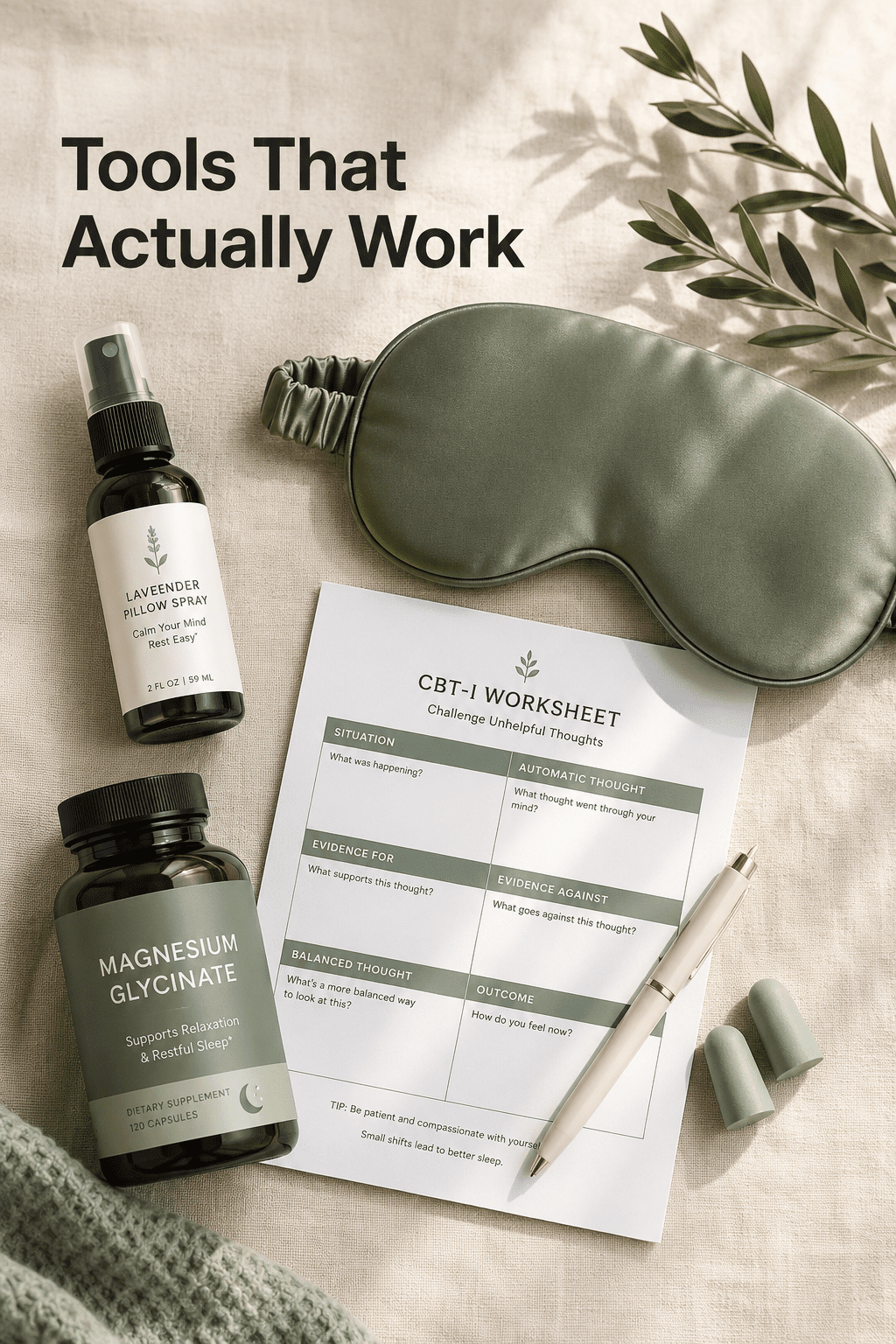
14. Look into CBT-I before medication
Cognitive Behavioral Therapy for Insomnia (CBT-I) is the first-line treatment recommended by the American Academy of Sleep Medicine – above sleep medication. It combines sleep restriction, stimulus control, cognitive restructuring, and relaxation techniques into a structured program. It’s not fast, but the results last [5].
You can access CBT-I through a therapist, through some primary care providers, and increasingly through digital programs. If you’ve been dealing with insomnia for a while and haven’t tried it, it’s worth asking about specifically.
15. Track your sleep to find your actual pattern
Most people with insomnia significantly underestimate how much they’re sleeping and overestimate how long they’re awake. A sleep diary – even just a simple notebook where you record bedtime, wake time, and rough quality – gives you real data to work with instead of a distorted perception built on your worst nights.
In practice this means keeping the diary for two weeks before drawing any conclusions. You might find your sleep is more variable than you thought – some nights genuinely bad, others better than you remembered. That variability is actually useful information. It means sleep is possible for you. It’s not fixed.
For more on building the kind of nightly routine that supports all of this, how to build a sleep routine that calms your brain is a good next step.
Conclusion
If you’ve been dealing with this for a while, you already know that a single tip rarely fixes it. What tends to work is a combination – usually stimulus control, consistent wake time, and some form of cognitive work around the anxiety that builds up after months of bad nights.
Start with the things that address behavior first: get out of bed when you can’t sleep, fix your wake time, and stop doing other activities in bed. Those three alone can shift things meaningfully within two to three weeks.
If they don’t, that’s useful information. It suggests the problem has a deeper root – anxiety, an underlying condition, or a pattern that needs proper CBT-I support rather than more self-help tips.
You’re not broken. You’ve just been dealing with something genuinely hard, with advice that was mostly written for people who don’t have the same problem you do.
Next steps:
- Pick two or three tips from this list and apply them consistently for two weeks before evaluating
- If you’re waking in the night specifically, start with tips for sleeping through the night
- If your mind races at bedtime, read the guide on insomnia and overthinking
- If you want to understand what’s actually causing your insomnia, start with why do I have insomnia
- If you’re ready for a proper assessment, take the free insomnia test here – it’s anonymous, it’s free, and it evaluates how you’ve been feeling over the past two weeks
Medical disclaimer: This article is for informational purposes only and does not constitute medical advice. If you have persistent sleep problems, please consult a qualified healthcare provider.
FAQ
What is the most effective insomnia tip for someone who has tried everything?
Sleep restriction therapy combined with stimulus control – the core components of CBT-I – has the strongest long-term evidence behind it. If you’ve tried basic sleep hygiene and it hasn’t worked, these behavioral approaches target the underlying learned pattern rather than just the surface symptoms.
How long does it take for insomnia tips to actually work?
Most behavioral changes take two to four weeks to show consistent results. Sleep restriction and stimulus control can feel worse before they get better. If you’re not seeing any change after four weeks of consistent application, that’s a sign to seek professional assessment.
Does melatonin help with insomnia?
Melatonin is most effective for circadian rhythm issues – jet lag, shift work, or delayed sleep phase – not for chronic insomnia caused by anxiety or conditioned wakefulness. It can help you shift your sleep timing but it won’t fix the underlying pattern that keeps you awake.
Why do I wake up at 3am every night?
Waking in the early hours is often linked to alcohol consumption, anxiety, blood sugar fluctuations, or the natural lightening of sleep in the second half of the night. It can also be a sign of depression. Tracking what you ate and drank before the nights you wake early can help identify the pattern.
Is it bad to lie in bed if you can’t sleep?
Yes, over time. Lying awake in bed trains your brain to associate the bed with wakefulness. The standard recommendation is to get up after 20 minutes of wakefulness and return only when you feel genuinely drowsy.
Can exercise help with insomnia?
Regular moderate exercise improves sleep quality and reduces the time it takes to fall asleep. The timing matters less than people think – exercising in the evening doesn’t necessarily disrupt sleep for most people, despite the common advice to avoid it.
What foods or drinks should I avoid for better sleep?
Caffeine (including tea, chocolate, and some medications), alcohol, and large meals close to bedtime are the main ones. Caffeine’s effects last longer than most people expect – up to 6 hours or more depending on your metabolism.
Is insomnia a mental health condition?
Insomnia has strong links to anxiety and depression – they often occur together and each can worsen the other. Chronic insomnia is recognized as a clinical condition in its own right, not just a symptom of something else. CBT-I addresses both the behavioral and cognitive components.
When should I see a doctor about insomnia?
If your sleep problems have lasted more than three months, are significantly affecting your daily functioning, or are accompanied by other symptoms like mood changes, persistent fatigue, or breathing issues during sleep, it’s time to see a doctor rather than continuing to self-manage.
Does a consistent bedtime matter more than a consistent wake time?
Wake time matters more. Your wake time anchors your circadian rhythm. Consistent bedtime is helpful, but if you’re not tired at your target bedtime, forcing it can increase anxiety. Focus on the wake time first.
References
[1] The Bedtime Reading Habit That Could Be Behind Your 3 A.M. Wake-Ups – https://www.tomsguide.com/wellness/sleep/the-bedtime-reading-habit-that-could-be-behind-your-3-a-m-wake-ups
[2] I Tried The Invisible Day Method To Stop Waking Up At 3 A.M. And It Worked – Doctors Explain Why – https://www.tomsguide.com/wellness/sleep/i-tried-the-invisible-day-method-to-stop-waking-up-3-a-m-and-it-worked-doctors-explain-why
[3] 5 Steps Heatwave Sleep Experts Take To Drop Off Fast And Avoid Sweaty 3 A.M. Wake-Ups – https://www.tomsguide.com/wellness/sleep/5-steps-heatwave-sleep-experts-take-to-drop-off-fast-and-avoid-sweaty-3-a-m-wake-ups
[4] Mayo Clinic – Insomnia: Symptoms and Causes – https://www.mayoclinic.org/health/sleep/HQ01387
[5] Healthline – Insomnia Treatments – https://www.healthline.com/health/insomnia-treatments