Post Disclaimer
This post contains affiliate links. If you buy something through these links, I may earn a small commission at no extra cost to you. Full disclosure.
This article is for informational purposes only and does not constitute medical advice. Always consult a healthcare professional for personal health concerns. Full disclaimer.
Last updated: June 28, 2026
Quick Answer: Too much sleep is usually a symptom, not the problem itself. What causes too much sleep ranges from undiagnosed sleep disorders like sleep apnea and hypersomnia, to depression, thyroid dysfunction, vitamin deficiencies, and certain medications. If you’re sleeping 9, 10, or even 12 hours and still waking up exhausted, your body is telling you something is wrong – not that you’re lazy.
Key Takeaways
- Sleeping more than 9 hours regularly as an adult is considered oversleeping by most sleep researchers [1]
- Hypersomnia is a clinical condition – it’s different from just being tired after a bad week
- Depression is one of the most common and overlooked causes of excessive sleep [1]
- Sleep apnea can make you sleep 10 hours and still feel wrecked – because the sleep quality is poor, not the quantity
- Medications including antidepressants, antihistamines, and certain pain relievers commonly cause daytime drowsiness [1]
- Iron deficiency and low vitamin D are two nutritional gaps that directly affect energy and sleep drive [4]
- “Social jet lag” – sleeping in on weekends – can make weekday fatigue significantly worse
- Oversleeping is associated with increased risk of metabolic issues, but it’s usually the underlying condition driving both [2]
- If excessive sleepiness has lasted more than a few weeks, it’s worth talking to a doctor – not just adjusting your bedtime
What Is Hypersomnia and How Is It Different From Just Being Tired?
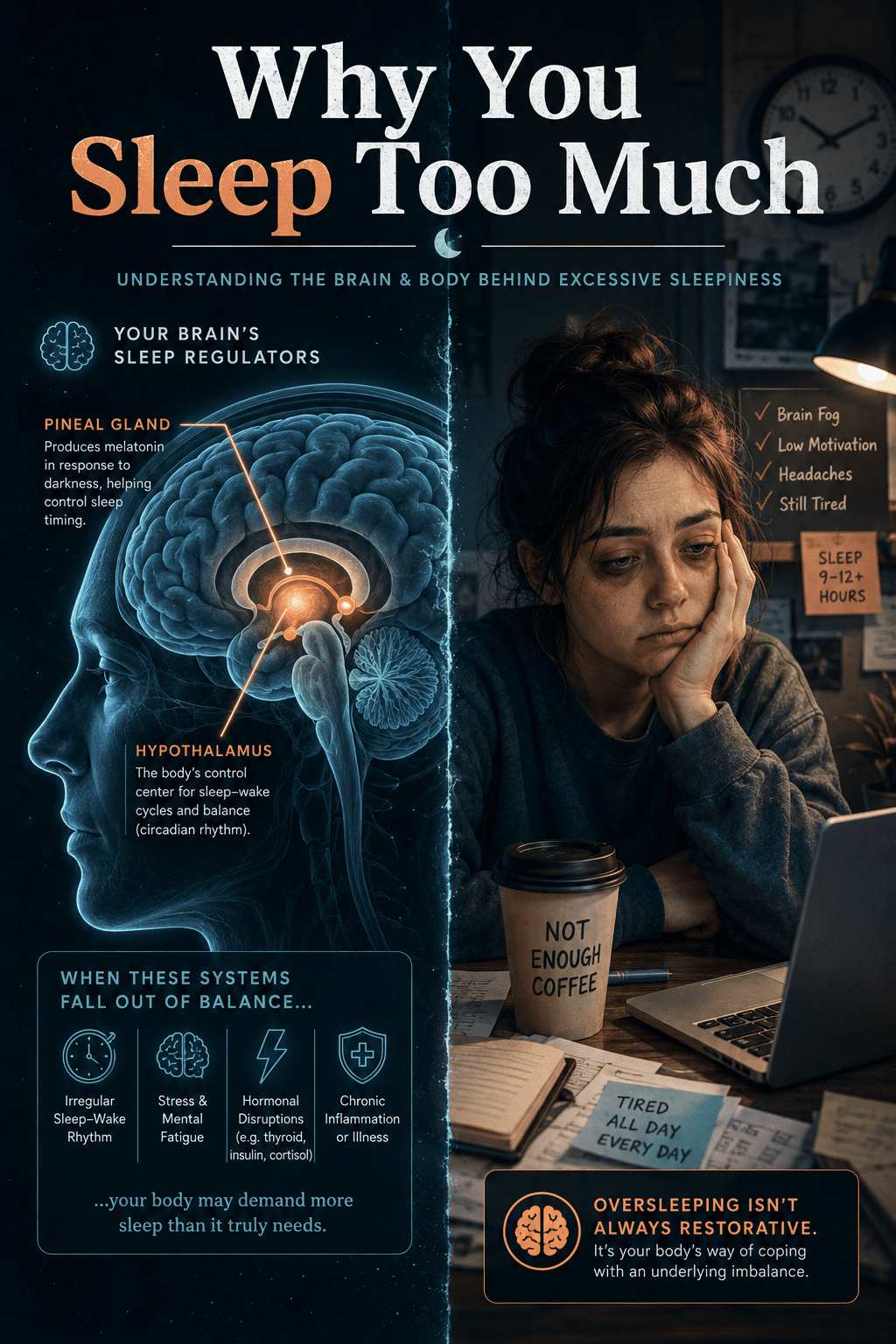
Hypersomnia is a medical condition characterized by excessive daytime sleepiness or sleeping unusually long hours at night – despite getting what should be adequate rest. It’s not the same as feeling tired after a stressful week or recovering from illness.
The honest version is that a lot of people who think they’re “just bad sleepers” or “always tired” are actually dealing with a diagnosable condition they’ve never been evaluated for. Hypersomnia affects roughly 5% of the population, according to the Sleep Foundation [1]. It can be primary (idiopathic hypersomnia, where no clear cause is found) or secondary, meaning it’s caused by something else – depression, a medication, a sleep disorder, or an underlying medical condition.
The key distinction: if you sleep a full night, take a nap, and still feel like you haven’t slept at all, that’s not normal tiredness. That’s a signal worth taking seriously.
If you’ve been dealing with this for a while and suspect it might be more than just fatigue, it’s worth taking a proper assessment.
Free Anonymous Sleep & Mood Test: If you recognize yourself in the symptoms described here, consider taking this free, anonymous online test. It evaluates how you’ve been feeling over the past two weeks and can help clarify whether what you’re experiencing goes beyond ordinary tiredness. It takes a few minutes and costs nothing.
How Much Sleep Is Actually Too Much for Adults?
Most adults need between 7 and 9 hours of sleep per night, according to the Sleep Foundation [1]. Consistently sleeping more than 9 hours – without an obvious reason like illness or physical recovery – is generally considered oversleeping.
That said, context matters. A few nights of long sleep after sleep deprivation is normal recovery. What causes too much sleep as a chronic pattern is different from a one-off catch-up weekend.
Here’s what the research actually says: regularly sleeping over 9 hours is associated with increased risk of certain health outcomes, but the relationship is complicated. In most cases, it’s not the long sleep causing the problem – it’s the underlying condition (depression, sleep apnea, thyroid issues) driving both the long sleep and the health risk [2].
Is Oversleeping a Sign of Depression or Mental Health Issues?
Yes – and this is one of the most underrecognized connections in sleep health. Depression doesn’t always look like insomnia. For many people, it shows up as sleeping 10 to 12 hours and still feeling empty, heavy, and unmotivated [1].
Atypical depression, in particular, is strongly associated with hypersomnia. Anxiety disorders can also disrupt sleep architecture in ways that leave you sleeping long but waking unrefreshed. The brain under chronic stress produces elevated cortisol, which interferes with deep sleep stages even when total sleep time appears adequate.
I’ve noticed this pattern in my own experience with sleep disruption – the nights I slept the longest were often the nights I felt the worst the next day. Not because sleep was the problem, but because something else was driving the whole cycle.
If you’re also dealing with low mood, loss of interest, or persistent fatigue that doesn’t improve with rest, understanding the root causes of your insomnia or fatigue is a useful starting point before assuming it’s just a sleep habit issue.
What Medical Conditions Cause Excessive Sleepiness?
Several medical conditions directly cause excessive sleepiness or increase sleep need – and many go undiagnosed for years [2].
The most common ones include:
- Hypothyroidism – an underactive thyroid slows metabolism and causes profound fatigue and increased sleep need
- Anemia – low iron means less oxygen delivery to tissues, which the body compensates for partly through increased rest
- Diabetes and blood sugar dysregulation – energy crashes from poor glucose control can mimic chronic sleepiness
- Chronic fatigue syndrome – characterized by unrefreshing sleep and post-exertional exhaustion
- Autoimmune conditions – lupus, multiple sclerosis, and rheumatoid arthritis all commonly cause fatigue and increased sleep drive
- Heart conditions – reduced cardiac output means the body works harder and tires faster
In practice, this means that if you’ve been told your sleep hygiene is fine but you’re still exhausted, a basic blood panel – thyroid function, iron, B12, blood glucose – is a reasonable next step before assuming it’s behavioral.
Can Oversleeping Be a Symptom of Sleep Apnea?
Yes. Sleep apnea is one of the most common reasons people sleep long hours and still feel exhausted – and it’s frequently missed, especially in people who don’t fit the stereotypical profile [1].
Sleep apnea causes repeated breathing interruptions during the night. Each interruption briefly wakes the brain, even if you don’t consciously register it. The result is fragmented sleep architecture – you might spend 10 hours in bed but get very little restorative deep or REM sleep.
The reason this matters is that your body then compensates by craving more sleep, making you feel like you need 10 or 11 hours just to function. You’re not sleeping too much because you’re lazy – you’re sleeping too much because the sleep you’re getting isn’t actually doing its job.
If you snore, wake with headaches, or feel genuinely unrefreshed no matter how long you sleep, a sleep study is worth pursuing. For more on why sleep quality matters as much as quantity, see how to improve deep sleep.
Can Certain Medications Make You Sleep Too Much?
Absolutely – and this is one of the most overlooked causes of what seems like excessive sleepiness [1].
Medications that commonly cause drowsiness or increased sleep need include:
- Antidepressants (especially tricyclics and some SSRIs like mirtazapine)
- Antihistamines (both prescription and over-the-counter allergy medications)
- Benzodiazepines and sleep aids – these can cause next-day grogginess that compounds over time
- Beta-blockers used for blood pressure
- Opioid pain medications
- Antipsychotics and mood stabilizers
- Muscle relaxants
If you started a new medication and noticed your sleep needs increased, that’s not a coincidence. Talk to your prescribing doctor – sometimes a dose adjustment or timing change makes a significant difference without needing to switch medications entirely.
Is Oversleeping Related to Vitamin Deficiencies or Nutritional Problems?
Yes. Nutritional gaps are a surprisingly common driver of chronic fatigue and increased sleep drive [4].
The most relevant deficiencies include:
- Iron deficiency – even without full anemia, low ferritin levels are associated with fatigue and poor sleep quality
- Vitamin D – low vitamin D is linked to daytime sleepiness and disrupted circadian signaling
- Vitamin B12 – deficiency causes neurological fatigue that doesn’t respond to sleep
- Magnesium – involved in sleep regulation; low levels are associated with poor sleep quality
- Folate – particularly relevant for people on certain medications that deplete it
The honest version is that most people who struggle with sleep and fatigue have never had a full nutritional panel done. A basic blood test can rule out several of these in one appointment.
Why Do I Sleep 10 Hours and Still Feel Exhausted?
This is one of the most frustrating experiences in sleep problems – and it’s more common than most people realize. It’s not just you.
The answer usually comes down to sleep quality, not sleep quantity. You can spend 10 hours in bed and still get very little slow-wave (deep) sleep or REM sleep if something is disrupting your sleep cycles – sleep apnea, alcohol, stress hormones, medications, or an underlying mood disorder [1].
Other contributing factors include:
- Chronic inflammation from illness or autoimmune conditions
- Poor sleep architecture – cycling through light sleep without reaching deeper stages
- Dehydration – even mild fluid deficits reduce energy and cognitive function [4]
- Sedentary lifestyle – counterintuitively, moving less makes you feel more tired, not less [4]
If you’re consistently waking up exhausted regardless of how long you sleep, the guide on how to stop waking up tired covers some of the less obvious reasons this happens.
Why Do I Sleep More on Weekends and Feel Worse?
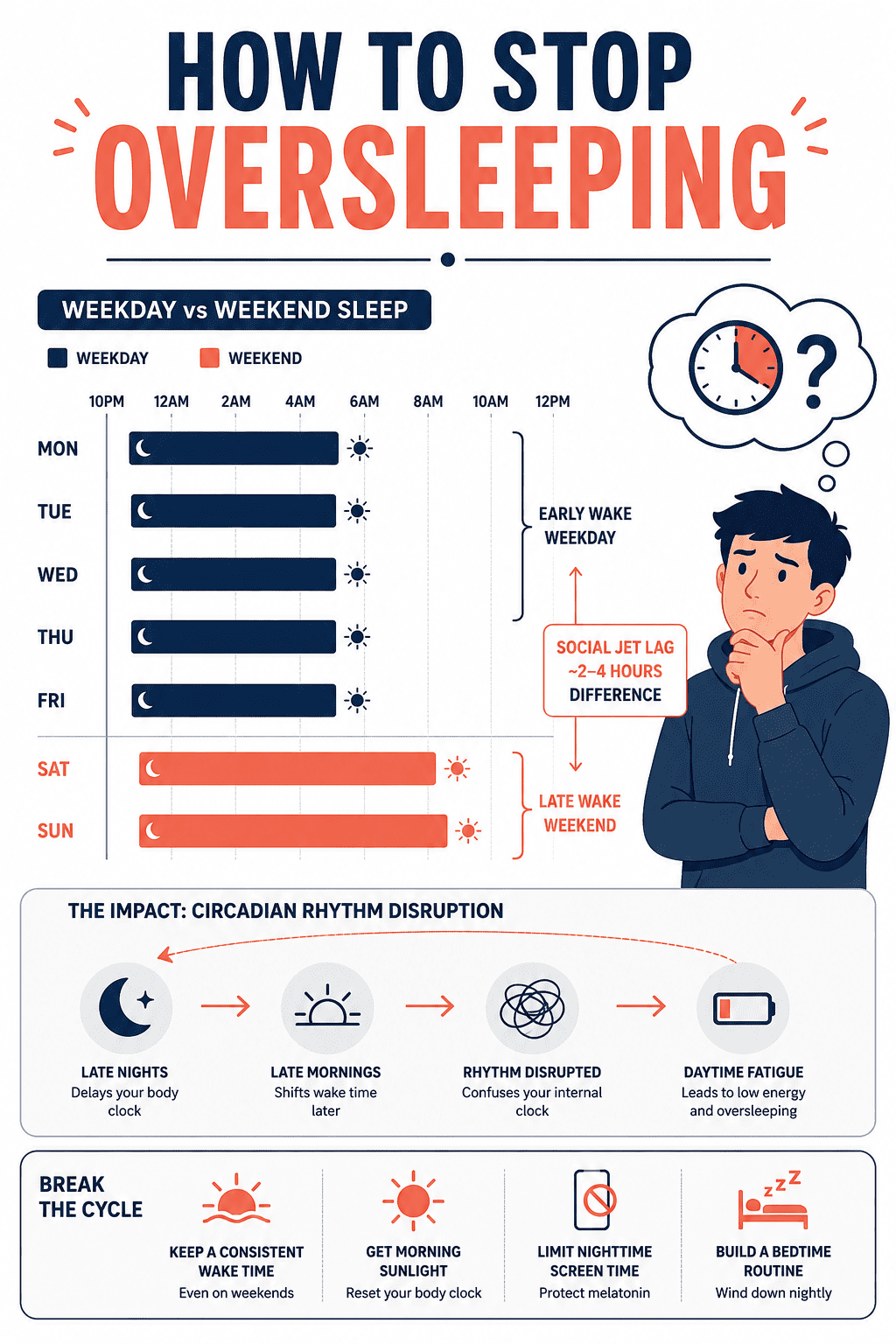
This is called social jet lag – and it’s a real, documented phenomenon. When you sleep in on weekends to “catch up,” you shift your circadian rhythm later, which makes it harder to fall asleep Sunday night and harder to wake up Monday morning [3].
The result is a weekly cycle of fatigue that feels like a sleep debt you can never fully repay. In practice, this means that sleeping two extra hours on Saturday might feel good in the moment but costs you two to three days of disrupted sleep afterward.
The fix isn’t to deprive yourself on weekends – it’s to keep your wake time consistent, even if you go to bed a little later. Your wake time anchors your circadian rhythm far more powerfully than your bedtime does. For a structured approach, see how to fix your sleep schedule in 7 days.
Can Oversleeping Mess Up Your Metabolism or Weight?
Research does show associations between long sleep duration and metabolic issues including obesity, type 2 diabetes, and cardiovascular disease [2]. But the relationship is more nuanced than “sleeping too much makes you gain weight.”
The more accurate picture is that the same underlying conditions – depression, sleep apnea, hypothyroidism, chronic inflammation – that cause excessive sleepiness also affect metabolism. Oversleeping is often a symptom of those conditions, not the direct cause of metabolic changes.
That said, spending excessive time in bed does reduce physical activity, which over time affects energy balance and metabolic rate. It’s a contributing factor, not the whole story.
What’s the Difference Between Oversleeping and Laziness?
This distinction matters more than people give it credit for. Oversleeping driven by a medical or psychological condition is not a character flaw – it’s a symptom.
Laziness implies a choice. Hypersomnia, depression-related fatigue, sleep apnea, and thyroid dysfunction don’t give you a choice. The exhaustion is physiological. Telling someone with untreated sleep apnea to “just get up earlier” is about as useful as telling someone with a broken leg to walk it off.
If you’ve been dealing with this for a while and have already tried fixing your sleep habits without success, the problem almost certainly isn’t discipline. It’s worth looking at the medical and psychological factors covered in this article before assuming it’s behavioral.
Not sure if what you’re experiencing is a clinical issue? Take this free anonymous test – it evaluates your symptoms over the past two weeks and can help you understand whether what you’re dealing with goes beyond normal tiredness. It’s completely free and anonymous.
What Are Quick Fixes to Stop Oversleeping?
There’s no single fix, because what causes too much sleep varies by person. But here are the approaches most likely to help, depending on your situation:
For circadian rhythm issues:
- Keep your wake time consistent 7 days a week – even on weekends
- Get bright light exposure within 30 minutes of waking
- Avoid long naps after 3pm
For sleep quality issues:
- Reduce alcohol – it fragments sleep architecture even in small amounts
- Look into whether a sleep study is warranted if you snore or wake unrefreshed
- Check how to improve REM sleep if you suspect your sleep cycles are disrupted
For medical/nutritional causes:
- Get a blood panel: thyroid, iron/ferritin, B12, vitamin D, blood glucose
- Review your medication list with your doctor
For mood-related oversleeping:
- If depression or anxiety is a factor, addressing that directly will do more for your sleep than any sleep hygiene tweak
- Cognitive behavioral therapy for insomnia (CBT-I) has strong evidence for both insomnia and hypersomnia related to mood disorders
Worth trying if you haven’t already: a consistent morning alarm with no snooze, combined with immediate light exposure. It sounds basic, but anchoring your wake time is the single most effective circadian intervention for most people.
When Should I See a Doctor About Sleeping Too Much?
See a doctor if:
- You’ve been sleeping more than 9 hours regularly for more than 2-3 weeks without an obvious cause
- You feel unrefreshed regardless of how long you sleep
- Excessive sleepiness is affecting your work, relationships, or daily functioning
- You have other symptoms – weight changes, low mood, snoring, headaches on waking, or cold intolerance
- You’ve tried improving sleep habits and nothing has changed
A GP can order a basic blood panel to rule out thyroid issues, anemia, and vitamin deficiencies. If those come back normal, a referral to a sleep specialist or a mental health assessment may be the next step.
You don’t have to fall asleep perfectly or wake up energized every day to have a good life – but if fatigue is running your schedule, that’s worth investigating properly.
Conclusion
What causes too much sleep is rarely one thing. It’s usually a combination of factors – a sleep disorder you haven’t been tested for, a medication side effect, a nutritional gap, or a mental health condition that’s been quietly draining your energy for months or years.
The most important thing to take away from this: excessive sleep is a symptom. Treating it like a discipline problem or a bad habit will keep you stuck. The people who actually get better are the ones who stop blaming themselves and start asking the right questions – what’s driving this, and what can actually be done about it.
If you’re not sure where to start, a blood panel and an honest conversation with your doctor about your sleep patterns is the most practical first step. If mood or anxiety is part of the picture, understanding your insomnia triggers can help you figure out what to bring to that appointment.
One more resource: If you’ve been experiencing persistent fatigue, low mood, or sleep problems for more than two weeks, this free anonymous test can help you evaluate your symptoms and get a clearer picture of what you’re dealing with. It’s a useful starting point before or alongside seeing a doctor.
FAQ
Q: Is sleeping 10 hours a night bad for you?
Occasionally, no. Regularly, it depends on why it’s happening. If you sleep 10 hours and feel rested, your body may simply need more sleep. If you sleep 10 hours and still feel exhausted, something else is likely driving it – sleep apnea, depression, or a medical condition are the most common causes.
Q: Can oversleeping cause headaches?
Yes. Sleeping too long – especially past your usual wake time – can trigger tension headaches and migraines in some people. This is partly due to changes in serotonin levels and partly due to dehydration from extended time without fluids.
Q: Is it normal to need more sleep as you get older?
Sleep needs don’t dramatically increase with age, but sleep architecture changes. Older adults often get less deep sleep, which can increase total time in bed needed to feel rested. Excessive sleepiness in older adults should still be evaluated, as it can signal cardiovascular or neurological issues.
Q: Can anxiety cause you to sleep too much?
Yes. While anxiety more commonly causes insomnia, some people with anxiety use sleep as avoidance – sleeping more to escape worry or overwhelm. This is particularly common in people who also have depressive symptoms alongside anxiety.
Q: Does caffeine make oversleeping worse?
Indirectly, yes. Heavy caffeine use disrupts deep sleep quality, which can increase your total sleep need and make you feel like you need more hours to feel rested. Cutting back on caffeine – especially after noon – often improves sleep quality enough that total sleep time decreases naturally.
Q: What’s the fastest way to reset a disrupted sleep schedule?
Keep your wake time fixed and get bright light immediately after waking. Do this consistently for 5-7 days. Avoid naps longer than 20 minutes. This is the most evidence-backed approach for resetting circadian rhythm without medication.
Q: Can dehydration make you sleep more?
Dehydration doesn’t directly cause oversleeping, but it does cause fatigue and reduced cognitive function that can be mistaken for sleepiness [4]. Staying well-hydrated during the day is a simple variable worth ruling out before assuming your sleep need is the issue.
Q: Should I take a sleep test if I’m always tired?
If fatigue has been persistent for more than a few weeks, yes – both a blood panel and potentially a sleep study are worth pursuing. Many sleep disorders, including sleep apnea and restless legs syndrome, are only diagnosable through proper testing [1].
References
[1] Causes of Excessive Sleepiness – https://www.sleepfoundation.org/excessive-sleepiness/causes
[2] Why Am I So Tired – https://health.clevelandclinic.org/why-am-i-so-tired
[3] Why You Are Always Tired – https://www.forbes.com/health/wellness/why-you-are-always-tired/
[4] 10 Reasons You Are Tired – https://www.healthline.com/nutrition/10-reasons-you-are-tired