Post Disclaimer
This post contains affiliate links. If you buy something through these links, I may earn a small commission at no extra cost to you. Full disclosure.
This article is for informational purposes only and does not constitute medical advice. Always consult a healthcare professional for personal health concerns. Full disclaimer.
Last updated: June 30, 2026
Quick Answer: Sleep anxiety is a specific fear or dread about not being able to sleep – and it’s different from general stress. It creates a self-reinforcing loop where worrying about sleep makes sleep harder, which gives you more to worry about. The good news is that this cycle is well understood and genuinely breakable, using approaches like CBT-I, targeted relaxation techniques, and – when needed – short-term medication support.
Key Takeaways
- Sleep anxiety and insomnia often overlap but are not the same thing – anxiety about sleep can exist without a clinical insomnia diagnosis
- The worry-poor sleep-more worry loop is the core mechanism, and breaking it requires targeting the anxiety directly, not just sleep hygiene
- Physical symptoms like a racing heart and muscle tension at bedtime are real physiological responses, not just “being in your head”
- CBT-I (Cognitive Behavioral Therapy for Insomnia) is the most evidence-backed long-term treatment – more effective than sleep medication for most people [2]
- Breathing techniques and body-based relaxation can interrupt the anxiety response in real time
- Sleep anxiety rarely resolves completely on its own if it’s been going on for weeks or months – it usually needs active intervention
- Medication can help short-term but doesn’t fix the underlying pattern
- Children experience sleep anxiety differently than adults, and the approach needs to match the age
What Is Sleep Anxiety and How Is It Different From Insomnia
Sleep anxiety is the fear, dread, or nervousness specifically about sleep itself – whether you’ll fall asleep, stay asleep, or function the next day if you don’t. It’s not just general anxiety that happens to affect your sleep. It’s anxiety that has made sleep its target.
Insomnia is the inability to sleep. Sleep anxiety is often what drives that inability.
The Cleveland Clinic describes sleep anxiety as a pattern where people feel nervous or afraid about not sleeping, lie awake monitoring whether they’re falling asleep yet, and experience racing thoughts and physical tension specifically in the context of bed and bedtime [1]. You can have insomnia without sleep anxiety – caused by pain, medication, or circadian disruption – but for a lot of people, the anxiety and the insomnia are feeding each other in a loop that’s hard to separate.
The honest version is: most people who struggle with sleep have some degree of both. The insomnia starts for some reason, the anxiety about it develops, and then the anxiety becomes its own cause.
Why Does Anxiety Keep You Awake at Night
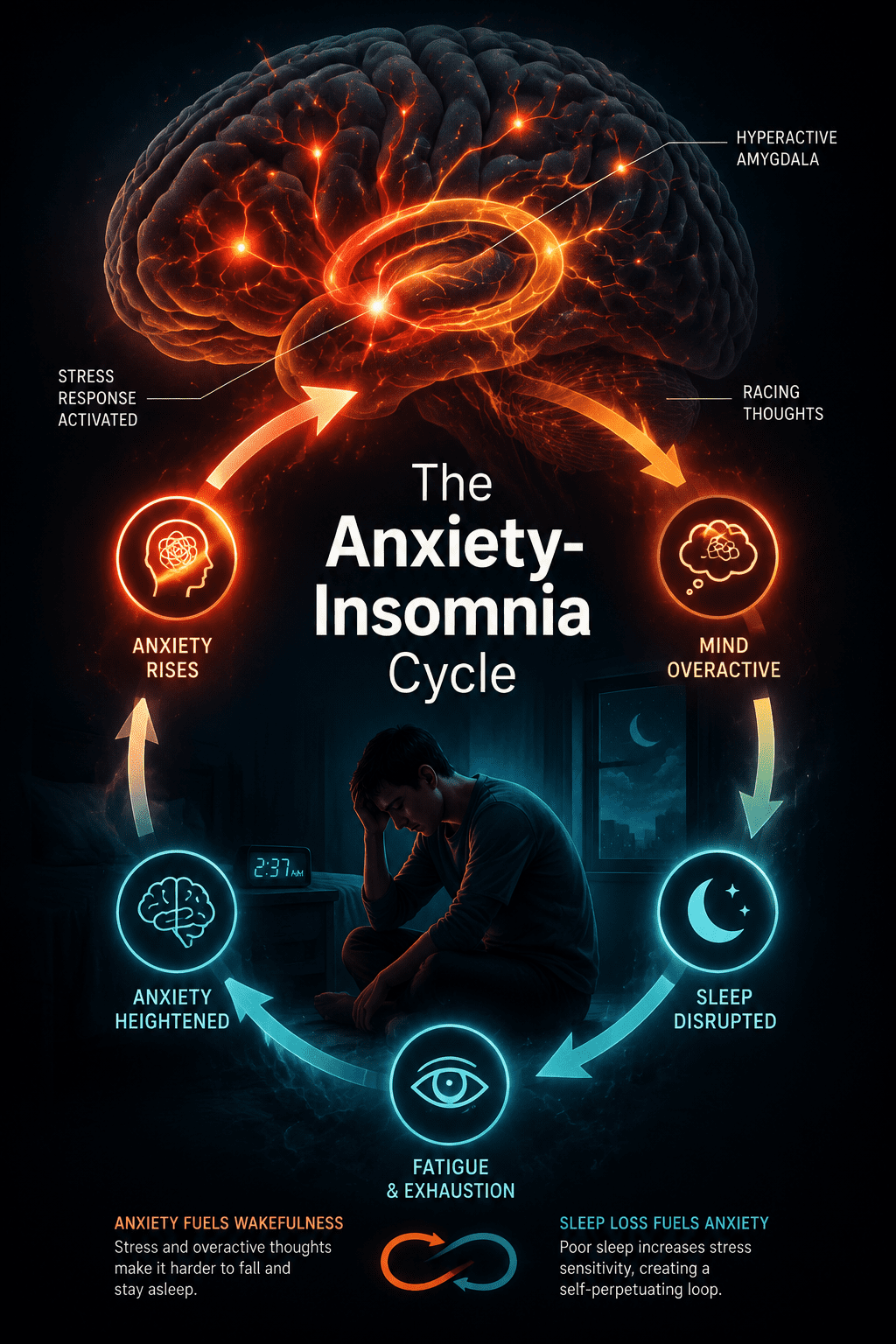
Anxiety activates your nervous system’s threat response – the same one that would wake you up if there was a noise outside. When your brain perceives a threat (even an abstract one like “what if I can’t sleep”), it releases cortisol and adrenaline, raises your heart rate, and shifts your body into alert mode. That’s the opposite of what sleep needs.
The Sleep Foundation notes that anxiety and sleep have a bidirectional relationship – anxiety disrupts sleep, and poor sleep amplifies anxiety [2]. Each night of bad sleep makes the anxiety worse the next evening, which makes the next night harder. That’s the cycle.
The cruel part is that the act of trying to sleep can become the trigger. You get into bed and your brain registers it as the place where you lie awake and worry. Over time, the bed itself becomes associated with wakefulness rather than rest. This is called conditioned arousal, and it’s one of the main reasons basic sleep hygiene advice stops working after a while.
If you’ve been dealing with this for a while, you probably know exactly what I mean. The moment your head hits the pillow, something switches on.
What Are the Physical Symptoms of Sleep Anxiety
Sleep anxiety isn’t just mental. The physical symptoms are real and they can be intense enough to feel alarming.
Common physical signs include:
- Racing or pounding heart at bedtime
- Muscle tension, especially in the jaw, shoulders, and chest
- Shallow or rapid breathing
- A feeling of restlessness – like you physically can’t get comfortable
- Sweating or feeling hot even in a cool room
- Stomach tightness or nausea
- A sudden jolt of alertness just as you start to drift off (hypnic jerks)
These aren’t imaginary. They’re your sympathetic nervous system doing exactly what it’s designed to do when it perceives a threat [1]. The problem is that the “threat” is bedtime.
If you’re experiencing several of these regularly, it’s worth taking a closer look at what’s actually going on. If you’re unsure whether what you’re experiencing crosses into clinical territory, this free anonymous insomnia and anxiety test can help you evaluate your symptoms over the past two weeks. It takes a few minutes and gives you a clearer picture of where you stand.
How Do You Know If It’s Sleep Anxiety or Just Stress
Stress affects sleep. But sleep anxiety is a specific pattern that stress alone doesn’t fully explain.
Ask yourself these questions:
- Do you feel fine during the day but start dreading bedtime as the evening progresses?
- Do you lie awake specifically worrying about not sleeping, rather than worrying about the thing that’s stressing you?
- Do you feel anxious in bed even on nights when nothing particular is wrong?
- Have you started avoiding sleep – staying up late because going to bed feels worse than being tired?
If you answered yes to most of those, you’re likely dealing with sleep anxiety specifically, not just general stress spilling into your nights. The distinction matters because the fix is different. Stress management helps with stress-driven sleep problems. Sleep anxiety usually needs something more targeted – like the CBT-I approach covered below.
For a broader look at what might be driving your sleep problems, this guide on what causes lack of sleep covers a wider range of contributing factors.
What Causes Sleep Anxiety and Why Does It Happen
Sleep anxiety usually develops after a period of bad sleep – illness, a stressful life event, shift changes, a new baby – that then doesn’t resolve when the original cause goes away. Your brain has learned to associate bed with wakefulness and threat, and it keeps responding that way even after the initial trigger is gone.
Research published in Nature Human Behaviour found that sleep loss amplifies anxiety reactivity in the brain, particularly in the amygdala – the region responsible for threat detection [10]. In practice this means that even a few nights of poor sleep can make you more anxious, which then makes sleep harder. The cycle builds quickly.
Other contributing factors include:
- Pre-existing anxiety disorders (generalized anxiety, panic disorder)
- Perfectionism or high need for control – people who struggle to “let go” at night
- A history of trauma, which can make the vulnerable state of sleep feel unsafe
- Chronic stress without adequate recovery time
- Overuse of stimulants like caffeine, especially in the afternoon
It’s not just you. A survey by the American Academy of Sleep Medicine found that a majority of Americans report that stress, anxiety, or depression disrupts their sleep [4]. This is common. That doesn’t make it less exhausting, but it does mean there’s a lot of research behind what actually helps.
Best Ways to Calm Sleep Anxiety Before Bed
The most effective pre-bed strategies target the nervous system directly – not just the environment.
Stimulus control is one of the most evidence-backed behavioral changes: only use your bed for sleep (and sex), and get out of bed if you’ve been awake for more than 20 minutes. It feels counterintuitive, but it gradually breaks the conditioned association between bed and wakefulness.
Progressive muscle relaxation works by systematically tensing and releasing muscle groups, which gives your nervous system something concrete to do instead of spiraling. Studies show it reduces pre-sleep arousal [9].
Cognitive defusion – a technique from acceptance-based therapy – means observing your anxious thoughts without engaging them. Instead of arguing with “what if I can’t sleep,” you notice the thought and let it pass. This is harder than it sounds, but it gets easier with practice.
Worth trying if you haven’t yet: a consistent wind-down routine that starts 45-60 minutes before bed. Not because routine is magic, but because it gives your nervous system a reliable signal that the threat-monitoring part of the day is over. This bedtime routine guide for adults who struggle to wind down has some practical structure for building one.
You don’t have to fall asleep – you just have to rest. That reframe alone takes some pressure off, and pressure is exactly what keeps sleep anxiety going.
Breathing Exercises and Relaxation Techniques for Nighttime Anxiety
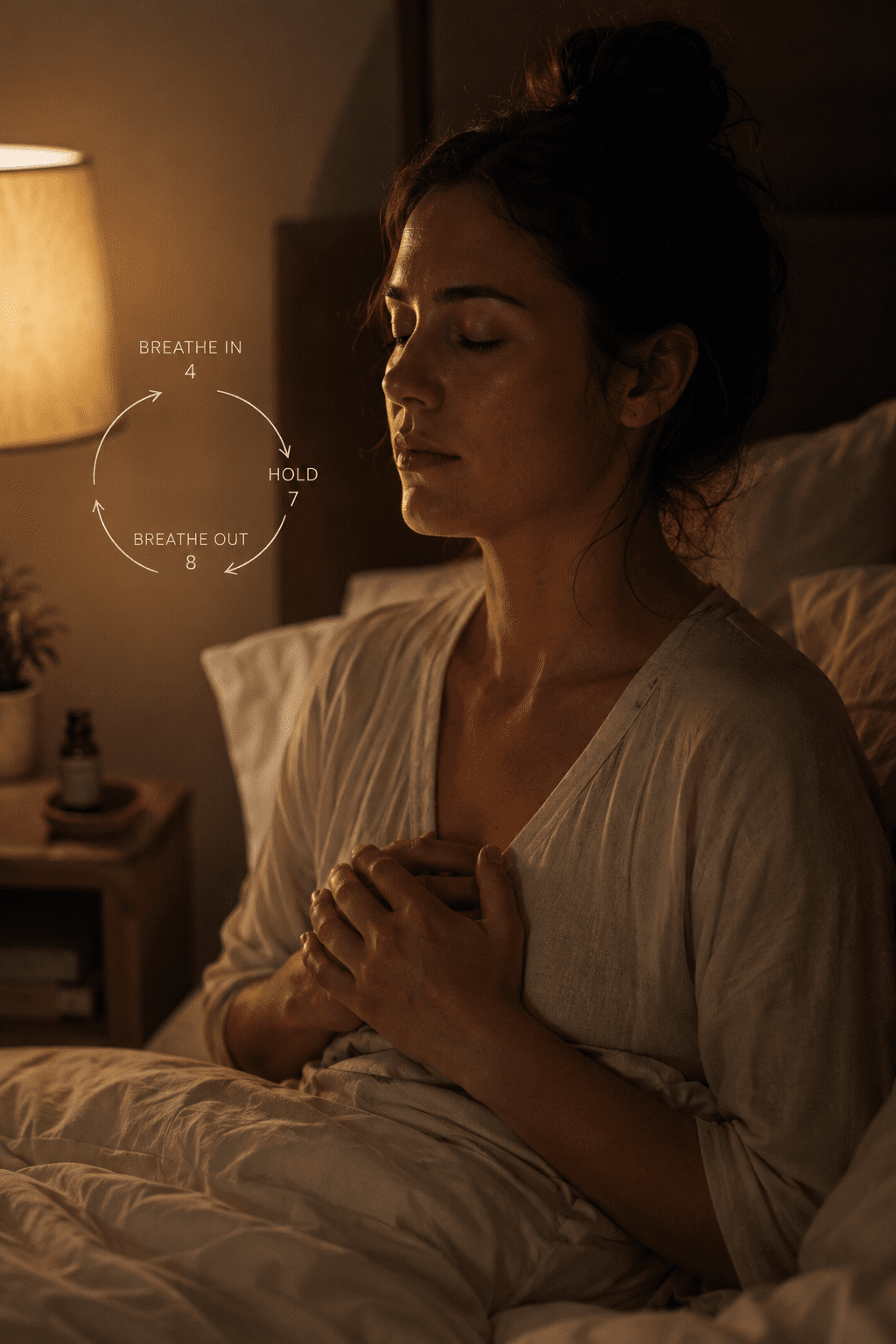
Slow, controlled breathing directly activates the parasympathetic nervous system – the “rest and digest” state that sleep requires. This isn’t wellness fluff. It’s basic physiology.
The 4-7-8 method: Inhale for 4 counts, hold for 7, exhale for 8. The long exhale is the key – it’s what triggers the vagal response and slows your heart rate. Do 3-4 cycles.
Box breathing: Inhale for 4, hold for 4, exhale for 4, hold for 4. Repeat. This one is used in high-stress military training for a reason – it works even when your nervous system is significantly activated.
Body scan: Lie still and slowly move your attention from your feet upward, noticing (not judging) each area. It redirects attention away from anxious thoughts and toward physical sensation.
This is what worked for me in the worst stretches of my own sleep disorder: I stopped trying to force sleep and started using the time in bed to practice breathing instead. Removing the performance pressure – even slightly – changed the experience of lying awake.
For more structured techniques, the military sleep method guide covers a full body-relaxation sequence that uses similar principles.
Cognitive Behavioral Therapy for Sleep Anxiety – How Does It Work
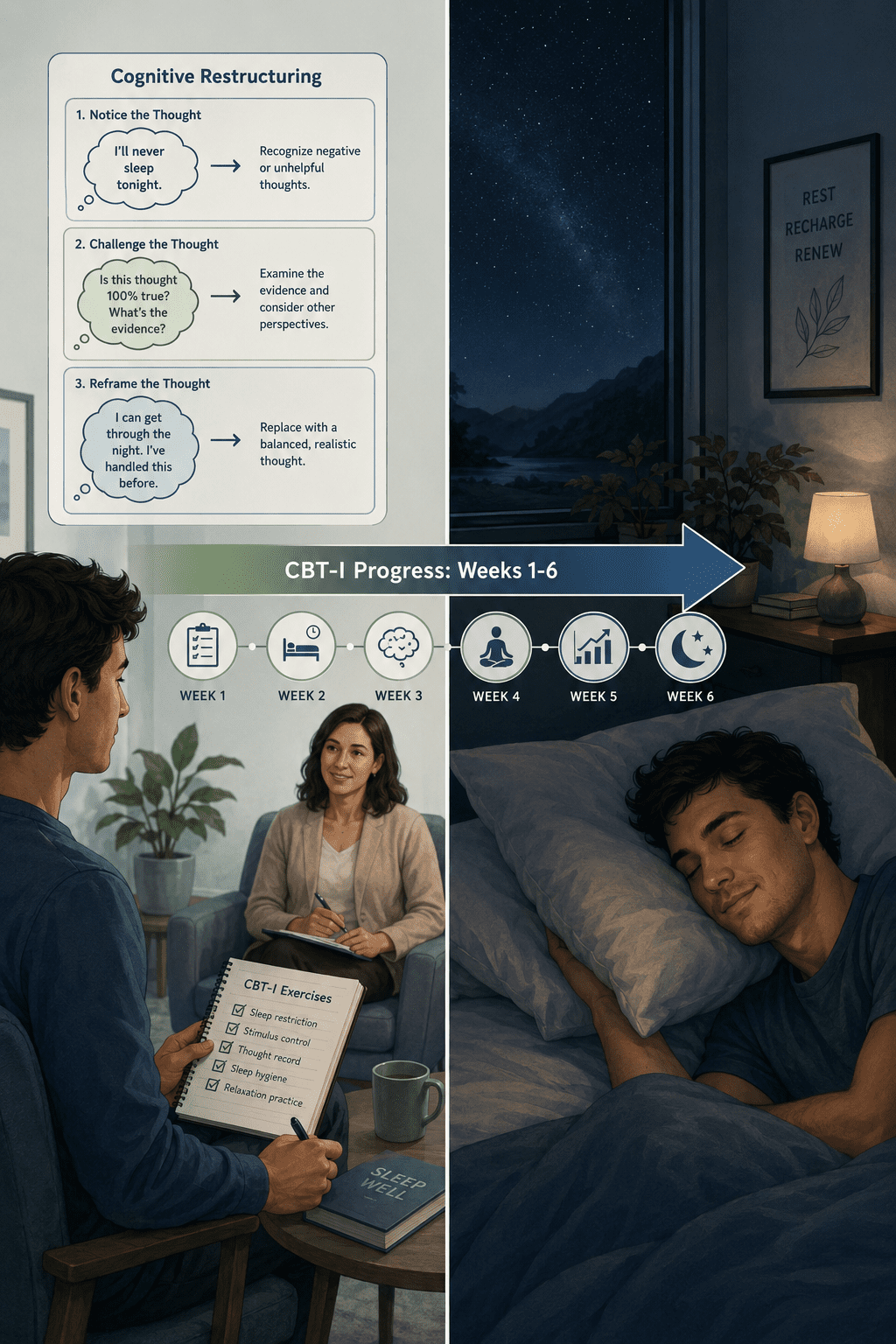
CBT-I (Cognitive Behavioral Therapy for Insomnia) is the most evidence-supported treatment for sleep anxiety and insomnia combined. The American College of Physicians recommends it as the first-line treatment before medication [2].
It works by targeting both the thoughts and the behaviors that maintain the sleep-anxiety cycle. The main components are:
- Sleep restriction therapy – temporarily limiting time in bed to consolidate sleep and rebuild sleep drive (this is uncomfortable at first but highly effective)
- Stimulus control – rebuilding the association between bed and sleep
- Cognitive restructuring – identifying and challenging the specific thoughts that fuel nighttime anxiety (“I’ll be useless tomorrow if I don’t sleep 8 hours”)
- Relaxation training – the breathing and body-based techniques above
- Sleep education – understanding how sleep actually works, which reduces catastrophizing
A PubMed-indexed study found that CBT-I produces significant, lasting improvements in sleep quality and anxiety symptoms, with effects that persist after treatment ends [3]. Medication, by contrast, tends to work only while you’re taking it.
CBT-I is available through therapists, but also through digital programs – which research published in 2025 suggests can be nearly as effective for mild to moderate cases [5].
If you’re also dealing with overthinking specifically, the insomnia overthinking guide covers the cognitive side in more detail.
Sleep Anxiety Medication Options and What to Know
Medication can be a useful short-term tool, but it’s not a long-term solution for sleep anxiety on its own.
Common options include:
- Benzodiazepines (like lorazepam or temazepam) – effective short-term, but carry real risks of dependence and rebound anxiety
- Non-benzodiazepine sleep aids (like zolpidem/Ambien) – help with sleep onset but don’t address the anxiety component
- SSRIs/SNRIs – often prescribed for the underlying anxiety disorder, which then improves sleep as a secondary effect; takes weeks to work
- Low-dose antihistamines (like diphenhydramine) – available over the counter, but tolerance builds quickly and they don’t improve sleep quality
- Melatonin – helps with circadian timing but doesn’t directly address anxiety-driven wakefulness
Here’s what the research actually says: a PBS/NOVA report on sleep deprivation and anxiety found that while medication can interrupt the acute cycle, it doesn’t rewire the conditioned responses that drive sleep anxiety long-term [6]. CBT-I does.
If you’re considering medication, talk to a doctor who understands sleep specifically – not just general anxiety treatment. The combination of short-term medication with concurrent CBT-I tends to produce better outcomes than either alone.
Medical disclaimer: This article is for informational purposes only and does not constitute medical advice. Always consult a qualified healthcare provider before starting or stopping any medication.
Can Sleep Anxiety Go Away on Its Own
Sometimes, yes – if it’s situational and short-lived. A few bad nights during a stressful week, followed by relief when the stressor passes, usually resolves without intervention.
But if sleep anxiety has been going on for more than two to four weeks, it’s unlikely to fully resolve without active work. The conditioned arousal pattern becomes more entrenched over time. Stanford research on sleep and mental health published in 2025 found that untreated sleep-anxiety cycles can contribute to longer-term mood and cognitive problems [8].
The longer it goes on, the more your brain has practiced the anxiety response at bedtime – and the more it needs deliberate repatterning to change.
If you’ve been struggling for more than a few weeks, this free anonymous test is worth taking. It evaluates how you’ve felt over the past two weeks and can help you decide whether to seek professional support.
How Long Does It Take to Fix Sleep Anxiety
Most people doing CBT-I see meaningful improvement within 4-8 weeks. That’s not a guarantee, and it depends on consistency and severity, but it’s a realistic timeframe based on clinical outcomes [2].
Breathing and relaxation techniques can produce noticeable effects within a few nights – not curing the anxiety, but reducing the acute activation enough to make sleep more accessible.
Medication works faster (days) but doesn’t fix the underlying pattern.
The honest version is: there’s no quick fix that lasts. But 6-8 weeks of consistent effort with the right approach is a reasonable investment for something that’s been making your life harder for months or years.
Sleep Anxiety in Kids vs. Adults – What’s Different
In children, sleep anxiety often shows up as bedtime resistance, repeated requests for a parent to stay, nighttime fears, and difficulty separating. It’s developmentally normal in younger children but can become problematic when it persists or intensifies.
In adults, the pattern is more internalized – racing thoughts, catastrophizing about tomorrow, monitoring the body for signs of sleepiness. Adults are also more likely to develop secondary behaviors like late-night phone use or staying up to delay the anxiety of trying to sleep.
The treatment principles overlap (gradual exposure, reducing avoidance, building positive sleep associations) but the delivery is different. For children, parental involvement and behavioral consistency are central. For adults, cognitive work is usually necessary alongside the behavioral changes.
If you’re dealing with a child’s sleep problems specifically, this guide on insomnia in children covers signs, causes, and what parents can actually do.
What Makes Sleep Anxiety Worse – and What Genuinely Helps
What makes it worse:
- Clock-watching (checking the time when you wake up amplifies the anxiety)
- Spending time in bed awake outside of sleep – reading, scrolling, worrying
- Catastrophizing (“I’ll be destroyed tomorrow if I don’t sleep”)
- Irregular sleep and wake times, which weaken sleep drive
- Caffeine after midday
- Alcohol – it fragments sleep in the second half of the night, which then feeds the anxiety
What genuinely helps:
- A consistent wake time, even after a bad night – this is the single most impactful behavioral change
- Getting out of bed when you can’t sleep, rather than lying there fighting it
- Reducing the meaning you attach to a bad night – one bad night won’t break you
- Treating the anxiety directly, not just the sleep
- Keeping a sleep diary to identify patterns (not to judge yourself, but to see what’s actually happening)
NPR’s 2026 reporting on insomnia and anxiety recovery highlighted that people who stopped fighting wakefulness and instead adopted an accepting, curious stance toward their sleep – rather than a fearful one – had significantly better outcomes [7].
For a broader look at habits that actually move the needle, the 15 insomnia tips that work when nothing else has covers a range of approaches beyond the basics.
Conclusion
Sleep anxiety is exhausting in a specific way – not just because it steals your sleep, but because it makes you dread the one thing you need most. If you’ve been dealing with this for a while, you already know that telling yourself to “just relax” doesn’t work.
What does work is understanding the cycle and targeting it directly. Start with your wake time – keep it consistent no matter how the night went. Add a breathing practice to your pre-bed routine. Work on breaking the conditioned association between bed and wakefulness. And if you’ve been at this for more than a month without improvement, look into CBT-I, either with a therapist or through a digital program.
Not sure where you fall on the spectrum? Take this free anonymous insomnia and anxiety test – it evaluates your symptoms over the past two weeks and takes just a few minutes. It won’t diagnose you, but it’ll give you a clearer starting point.
You don’t have to fix everything tonight. You just have to rest.
Frequently Asked Questions
What is the difference between sleep anxiety and insomnia?
Insomnia is the inability to sleep. Sleep anxiety is the fear or dread about sleep that often drives insomnia. They frequently co-occur, but treating only the insomnia without addressing the anxiety usually produces limited results.
Can sleep anxiety cause panic attacks at night?
Yes. Nighttime panic attacks are a recognized feature of anxiety disorders and can be triggered by the hyperarousal state that sleep anxiety creates. If you’re experiencing these, it’s worth speaking to a doctor or therapist.
Is sleep anxiety a diagnosable condition?
Sleep anxiety isn’t a standalone DSM diagnosis, but it’s a recognized symptom pattern associated with anxiety disorders and insomnia disorder. A clinician can assess whether it meets criteria for either or both.
Does melatonin help with sleep anxiety?
Melatonin helps regulate circadian timing but doesn’t directly address anxiety. It may help if your sleep anxiety has disrupted your sleep schedule, but it won’t calm the anxiety response itself.
How do I stop my mind from racing at bedtime?
Scheduled worry time earlier in the evening – writing down concerns and setting them aside – can reduce bedtime rumination. Breathing techniques and body-based relaxation also help interrupt the racing-thought pattern in real time.
Is CBT-I available online?
Yes. Several digital CBT-I programs have clinical evidence behind them. They’re not a replacement for working with a therapist in complex cases, but research suggests they’re effective for mild to moderate sleep anxiety and insomnia [5].
What’s the fastest way to calm sleep anxiety tonight?
Box breathing (4 counts in, hold 4, out 4, hold 4) is one of the quickest ways to activate the parasympathetic nervous system. Combined with getting out of bed if you’ve been awake more than 20 minutes, it can reduce acute activation enough to make sleep more accessible.
Should I see a doctor or a therapist for sleep anxiety?
Both can help, but for most people, a therapist trained in CBT-I is the most effective first step. A doctor is important if you’re also dealing with a physical condition, if medication is being considered, or if you suspect an underlying sleep disorder like sleep apnea.
References
[1] Sleep Anxiety – https://my.clevelandclinic.org/health/diseases/21543-sleep-anxiety
[2] Anxiety And Sleep – https://www.sleepfoundation.org/mental-health/anxiety-and-sleep
[3] PubMed – https://pubmed.ncbi.nlm.nih.gov/34979437/
[4] Stress Anxiety And Depression Survey Shows Mental Health Conditions Disrupt A Majority Of Americans Sleep – https://aasm.org/stress-anxiety-and-depression-survey-shows-mental-health-conditions-disrupt-a-majority-of-americans-sleep/
[5] PMC12103868 – https://pmc.ncbi.nlm.nih.gov/articles/PMC12103868/
[6] Sleep Deprivation Anxiety – https://www.pbs.org/wgbh/nova/article/sleep-deprivation-anxiety/
[7] Beat Anxiety Insomnia Get Back To Sleep – https://www.npr.org/2026/01/15/nx-s1-5611117/beat-anxiety-insomnia-get-back-to-sleep
[8] Sleep Mental Health Connection What Science Says – https://med.stanford.edu/news/insights/2025/08/sleep-mental-health-connection-what-science-says.html
[9] PMC3181635 – https://pmc.ncbi.nlm.nih.gov/articles/PMC3181635/
[10] S41562-019-0754-8 – https://www.nature.com/articles/s41562-019-0754-8