Post Disclaimer
This post contains affiliate links. If you buy something through these links, I may earn a small commission at no extra cost to you. Full disclosure.
This article is for informational purposes only and does not constitute medical advice. Always consult a healthcare professional for personal health concerns. Full disclaimer.
Last updated: June 28, 2026
Quick Answer: A sleep disorder isn’t always obvious. Beyond the classic “can’t fall asleep” complaint, many people live with undiagnosed conditions for years because the signs – brain fog, mood swings, waking up tired – look like ordinary stress or a busy life. If you’ve been brushing off these symptoms, this guide will help you connect the dots.
Key Takeaways
- Roughly 50 to 70 million Americans have an ongoing sleep disorder, yet most go undiagnosed for years [1]
- You can have sleep apnea without ever snoring loudly [3]
- Daytime brain fog, irritability, and constant fatigue are among the most commonly missed sleep disorder symptoms [2]
- About 20% of Americans report feeling sleepy during the day – a potential sign of an underlying condition [6]
- Insomnia and sleep apnea are different conditions with different causes and treatments
- A sleep study (polysomnography) is the gold standard for diagnosis, but online screening tools are a useful first step
- Anxiety and sleep disorders frequently overlap and can make each other worse
- Lifestyle changes alone can resolve mild sleep issues, but moderate to severe disorders usually need professional care
- Sleep disorders cost the U.S. economy an estimated $411 billion annually in lost productivity [5]
- You don’t have to wait until you’re exhausted every day – earlier action leads to better outcomes
What Are the Early Warning Signs of a Sleep Disorder?
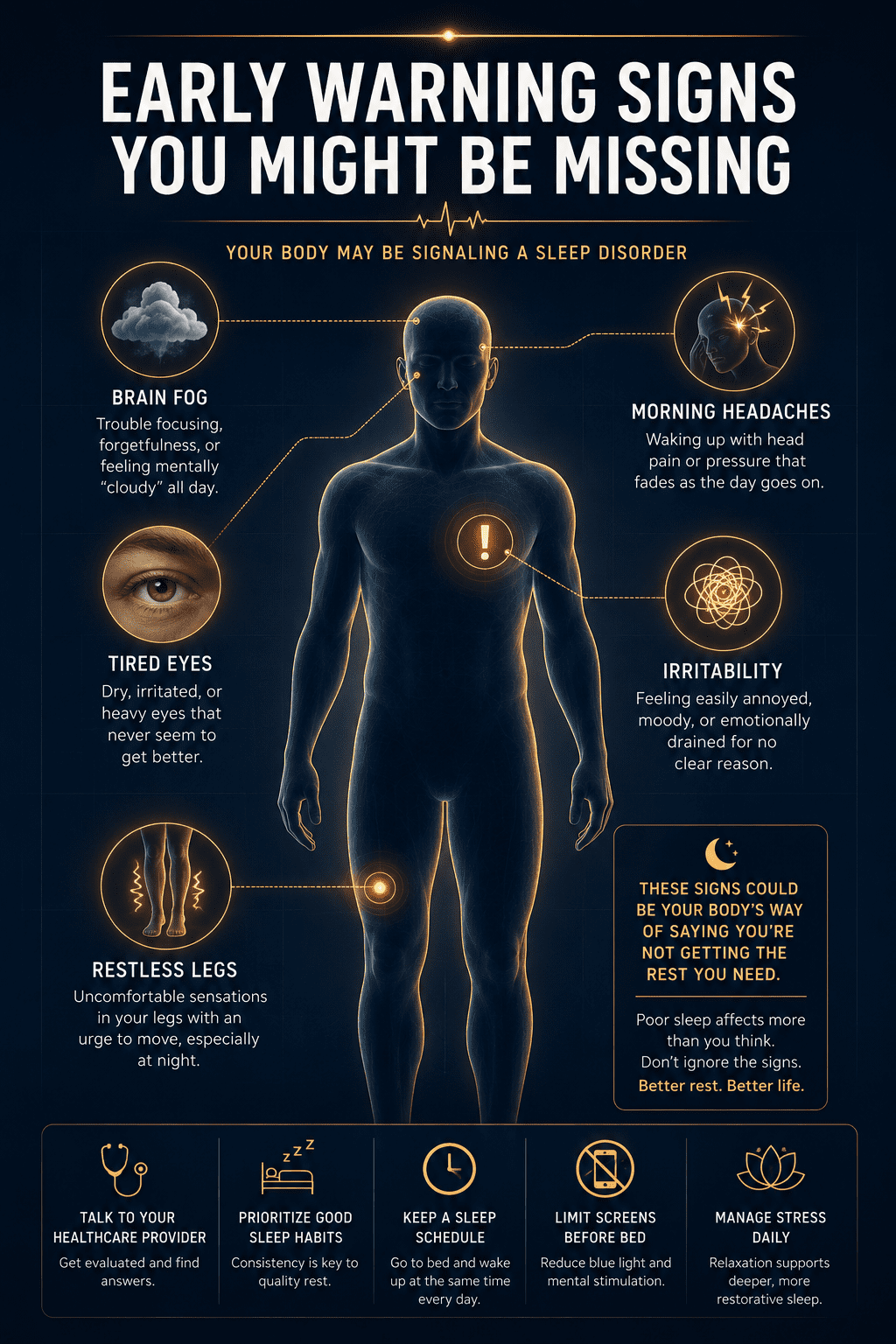
The earliest signs of a sleep disorder are easy to dismiss because they don’t always happen at night. Difficulty concentrating at work, snapping at people for small reasons, or needing a nap by 2pm can all point to disrupted sleep – even if you think you slept “fine.”
Here are the warning signs worth paying attention to:
- Waking up unrefreshed even after 7-8 hours in bed
- Persistent brain fog – slow thinking, poor memory, trouble focusing
- Mood changes – irritability, low motivation, or mild depression
- Craving sugar or caffeine to get through the afternoon
- Falling asleep within minutes of sitting down (this isn’t a superpower – it’s a red flag)
- Morning headaches that fade after an hour or two
- Frequent nighttime urination that wakes you up
- Restless or disheveled sheets in the morning, suggesting you moved a lot during sleep [7]
Most people chalk these up to stress or aging. Sometimes that’s true. But when these symptoms show up together or persist for more than a few weeks, a sleep disorder is worth considering.
How Do I Know If I Have a Sleep Disorder or Just Bad Sleep Habits?
Bad sleep habits and a sleep disorder can look almost identical on the surface – but the distinction matters because the fix is different. Bad habits (like scrolling your phone until midnight or drinking coffee at 6pm) usually improve quickly when you change the behavior. A sleep disorder persists even when your habits are solid.
Ask yourself these questions:
- Have you followed a consistent sleep schedule for at least 2-3 weeks with little improvement?
- Do you feel tired even after nights when you genuinely slept 7-9 hours?
- Does your partner say you snore, gasp, or stop breathing at night?
- Do you feel an uncontrollable urge to move your legs at rest, especially in the evenings?
- Have you fallen asleep in situations where you needed to stay awake (meetings, driving, conversations)?
If you answered yes to two or more of these, it’s less likely to be a habit problem and more likely to be something worth evaluating properly.
For a good starting point on improving habits while you figure this out, check out this sleep hygiene guide for adults – it covers the basics that genuinely move the needle.
“The problem isn’t always what you’re doing wrong at bedtime. Sometimes your brain or airway is working against you regardless of your habits.”
What Symptoms of Sleep Disorders Do People Usually Miss?
The most commonly missed symptoms are the ones that happen during the day, not at night. People tend to look for sleep problems in the bedroom – but the real clues often show up at the office, in the car, or at the dinner table.
Symptoms that frequently get overlooked:
| Symptom | Why It Gets Missed | What It Might Signal |
|---|---|---|
| Brain fog / slow thinking | Blamed on stress or aging | Sleep apnea, insomnia |
| Waking up with a dry mouth | Assumed to be dehydration | Sleep apnea (mouth breathing) |
| Morning headaches | Attributed to tension or posture | Oxygen drops during sleep |
| Mood swings or low mood | Labeled as anxiety or depression | Chronic sleep deprivation |
| Frequent nighttime waking | Dismissed as “light sleeping” | Sleep apnea, insomnia |
| Low libido | Blamed on relationship or hormones | Disrupted sleep cycles |
| Gaining weight despite diet | Attributed to metabolism | Sleep deprivation affects hunger hormones |
Women, in particular, tend to underreport sleep symptoms. Research shows women are more likely than men to have trouble falling and staying asleep, and less likely to wake up feeling rested [4]. Yet their symptoms are more often attributed to anxiety or stress rather than a sleep disorder.
If you recognize several of these symptoms in yourself, it may be worth taking a proper screening. We recommend this free, anonymous insomnia test – just evaluate the statements based on how you’ve felt over the past two weeks. It takes only a few minutes and could give you real clarity.
Can Sleep Disorders Cause Daytime Problems Like Brain Fog?
Yes – and this is one of the most underappreciated effects of a sleep disorder. When your sleep is fragmented or insufficient, your brain doesn’t complete the memory consolidation and cellular repair it needs overnight. The result shows up as mental sluggishness, poor decision-making, and emotional reactivity during the day.
Specific daytime effects include:
- Cognitive slowing – tasks take longer, errors increase
- Short-term memory gaps – forgetting conversations, losing items
- Emotional dysregulation – overreacting to minor frustrations
- Reduced motivation – everything feels harder than it should
- Microsleeps – brief 1-5 second sleep episodes you may not notice
About 20% of Americans report significant daytime sleepiness, which can be a silent indicator of an underlying sleep disorder [6]. If you’re constantly relying on caffeine to function, that’s not just a lifestyle quirk – it may be your body compensating for sleep debt.
For more on why tiredness lingers even after a full night, read why you can’t stop waking up tired.
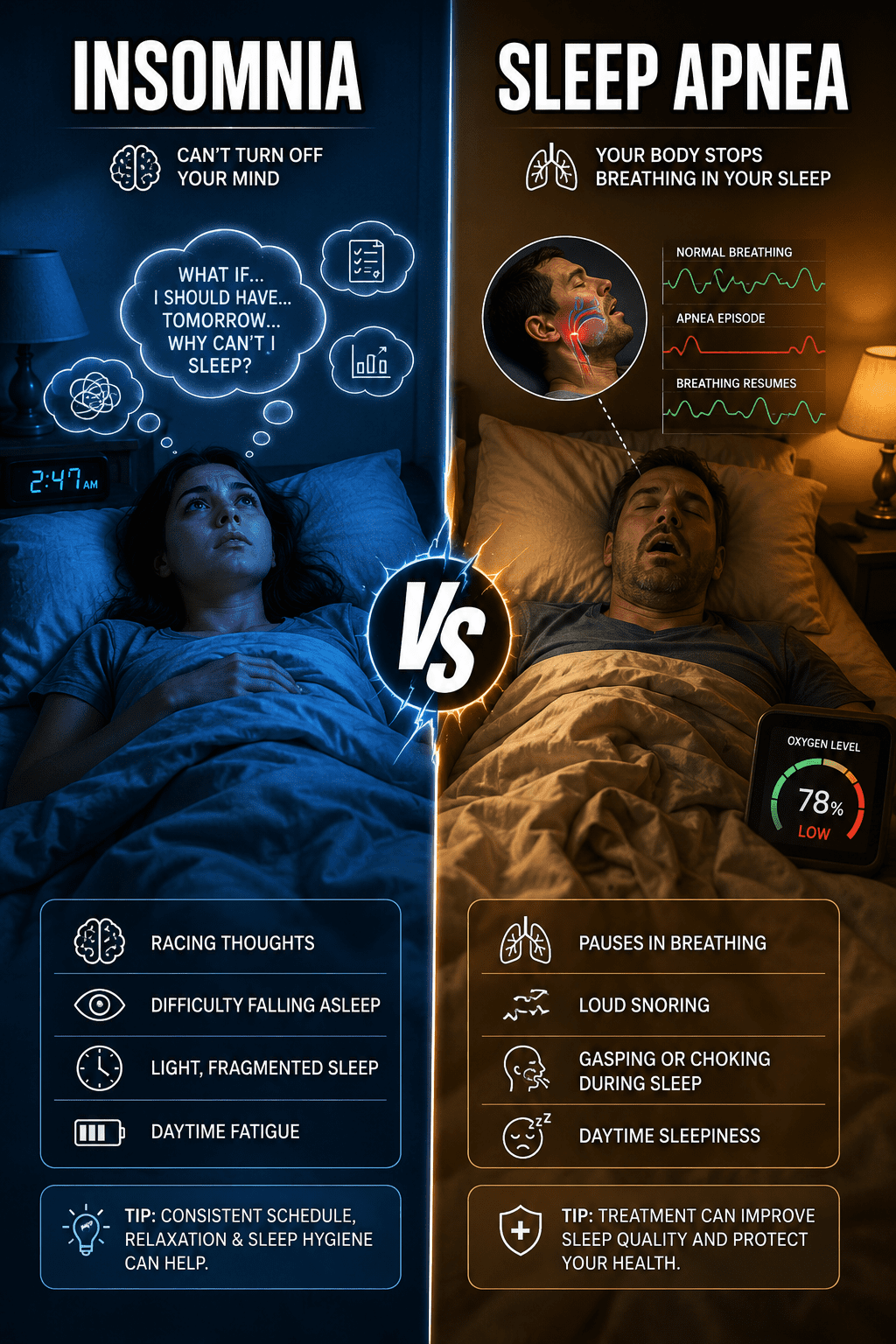
What’s the Difference Between Insomnia and Sleep Apnea?
Insomnia and sleep apnea are both common sleep disorders, but they have different causes and require different treatments. Confusing them leads to years of ineffective self-treatment.
Insomnia is difficulty falling asleep, staying asleep, or waking too early – despite having the opportunity and environment to sleep. It’s often driven by anxiety, racing thoughts, poor sleep habits, or underlying mental health conditions.
Sleep apnea is a physical condition where your airway partially or fully collapses during sleep, causing repeated breathing interruptions. You may not know it’s happening – your bed partner might notice it before you do.
| Feature | Insomnia | Sleep Apnea |
|---|---|---|
| Main problem | Can’t fall or stay asleep | Breathing stops during sleep |
| Aware of it? | Usually yes | Often no |
| Snoring? | Rarely | Common, but not always [3] |
| Daytime sleepiness | Possible | Very common |
| Treatment | CBT-I, sleep hygiene, therapy | CPAP, positional therapy, weight loss |
| Who it affects | More common in women | More common in men, but rising in women |
You can have both at the same time, which is called “comorbid insomnia and sleep apnea” (COMISA) – and it’s more common than most people realize.
If insomnia is your main concern, this guide on why you have insomnia and how to find your trigger is a solid next read.
Are There Sleep Disorders That Don’t Involve Snoring?
Absolutely. Snoring is associated with sleep apnea, but it’s not required for a diagnosis – and many sleep disorders have nothing to do with snoring at all [3].
Common sleep disorders beyond snoring:
- Insomnia – difficulty sleeping, no snoring involved
- Restless Legs Syndrome (RLS) – uncomfortable crawling sensations in the legs that worsen at rest, especially at night
- Periodic Limb Movement Disorder (PLMD) – repetitive leg movements during sleep that you may not feel but that disrupt your sleep cycles
- Circadian Rhythm Disorders – your internal clock is shifted, making it impossible to sleep at normal hours
- Narcolepsy – sudden, uncontrollable sleep attacks during the day, sometimes with muscle weakness (cataplexy)
- REM Sleep Behavior Disorder – physically acting out dreams, which can be dangerous
Silent sleep apnea is also real. You can have obstructive sleep apnea without loud snoring – symptoms may include excessive daytime sleepiness, morning headaches, and waking up multiple times at night [3]. Women with sleep apnea are especially likely to present this way, which is one reason the condition gets missed.
Can Anxiety Cause Sleep Disorder Symptoms?
Yes – anxiety and sleep disorders have a bidirectional relationship. Anxiety can cause or worsen insomnia, and chronic poor sleep can trigger or amplify anxiety. This loop is one of the main reasons people stay stuck.
When you’re anxious, your nervous system stays in a low-level alert state. Cortisol and adrenaline remain elevated, making it hard for your brain to transition into sleep. Over time, you may develop “sleep anxiety” – a fear of not sleeping that itself keeps you awake.
Signs that anxiety is driving your sleep problems:
- Racing thoughts the moment you lie down
- Dread about going to bed
- Waking at 3-4am with your mind immediately active
- Physical tension (tight jaw, clenched fists, shallow breathing)
That said, anxiety alone doesn’t explain all sleep symptoms. If you’re doing everything right for anxiety management and still sleeping poorly, a separate sleep disorder may be present.
For help with the overthinking-at-night pattern specifically, see how to quiet your mind when insomnia and overthinking collide.
If you’re experiencing anxiety alongside sleep problems, consider taking this free insomnia screening test. It’s anonymous, takes just minutes, and asks you to reflect on how you’ve felt over the past two weeks – a useful first step before speaking to a professional.
How Is a Sleep Disorder Diagnosed?
A sleep disorder is diagnosed through a combination of symptom history, questionnaires, and in some cases, a sleep study. You don’t need to wait until things are severe – earlier evaluation leads to faster relief.
Steps in the diagnostic process:
- Self-reporting – Your doctor asks about sleep patterns, daytime symptoms, and medical history
- Screening questionnaires – Tools like the Epworth Sleepiness Scale or Pittsburgh Sleep Quality Index
- Sleep diary – Tracking sleep and wake times for 1-2 weeks
- Polysomnography (sleep study) – An overnight test in a sleep lab that monitors brain waves, oxygen levels, heart rate, and breathing
- Home sleep apnea test (HSAT) – A simpler at-home version used specifically to screen for sleep apnea
Recent research has shown that EEG-based deep learning methods can distinguish healthy from disordered sleep with up to 95% accuracy, pointing toward faster and more precise diagnosis tools in the near future [8].
How much does a sleep study cost? In the U.S., an in-lab polysomnography typically costs between $1,000 and $3,500 without insurance. With insurance, out-of-pocket costs vary widely. Home sleep tests are cheaper, often $150-$500 out of pocket. Many insurance plans cover sleep studies when there’s documented clinical need.
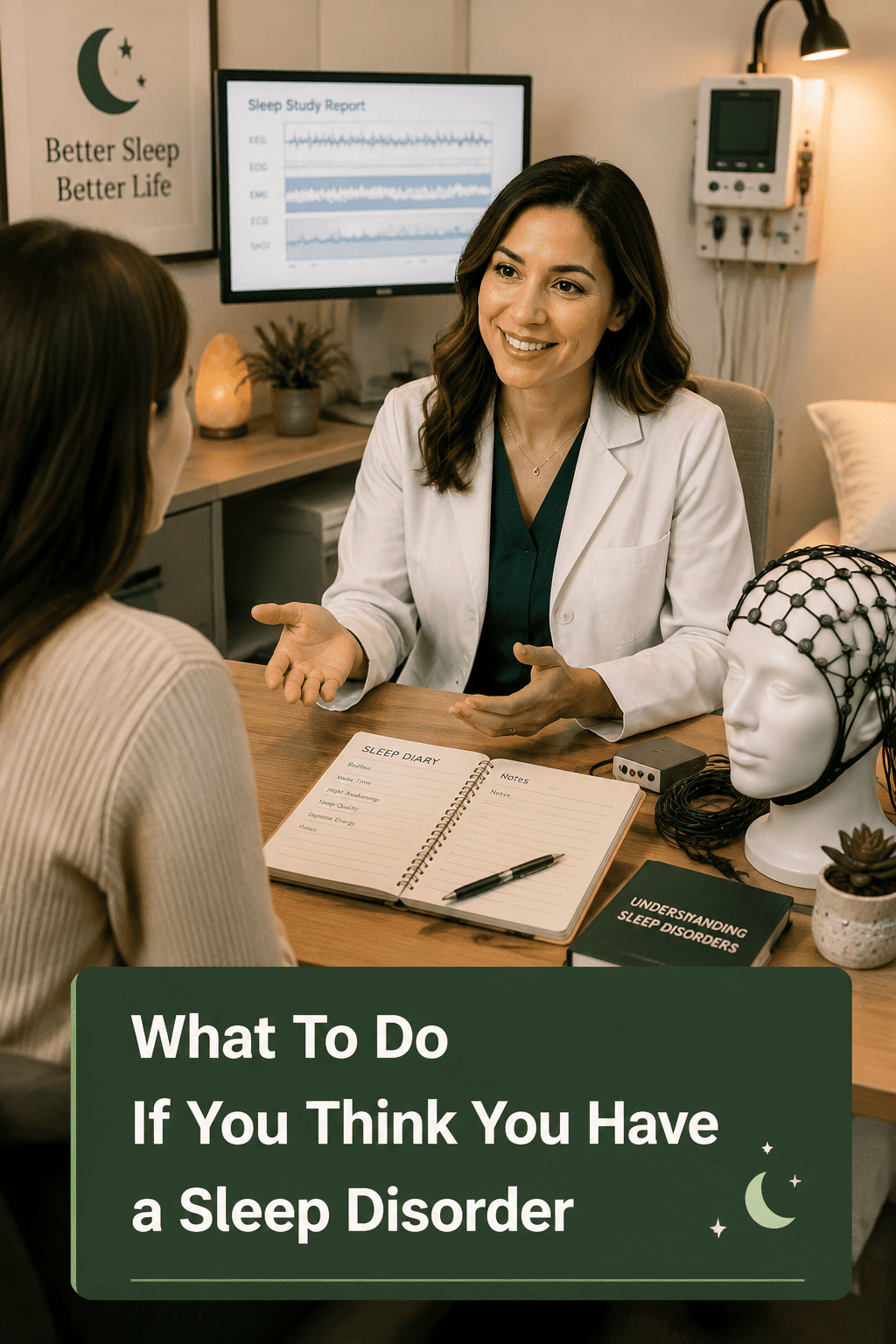
What Should I Do If I Think I Have a Sleep Disorder?
Start by documenting your symptoms, then talk to your primary care doctor. Don’t wait for things to get worse – sleep disorders are treatable, and the sooner you act, the faster your quality of life improves.
Practical steps to take right now:
- Keep a sleep diary for 7-14 days (bedtime, wake time, how you felt)
- Note daytime symptoms – energy, mood, focus, caffeine use
- Ask your bed partner if they’ve noticed anything unusual (snoring, gasping, movement)
- Take a validated online screening tool to bring to your appointment
- Book an appointment with your GP or a sleep specialist
For sleep habits you can start improving tonight while you wait for an appointment, this guide on how to build a calming sleep routine is practical and evidence-based.
Can Sleep Disorders Go Away on Their Own, or Do I Need Treatment?
Some mild, short-term sleep disruptions resolve on their own – usually within a few days to weeks when the trigger (stress, travel, illness) passes. But a true sleep disorder rarely fixes itself without some form of intervention.
When it might resolve on its own:
- Acute insomnia tied to a specific stressor that has since passed
- Jet lag or shift work disruption after your schedule normalizes
When you likely need treatment:
- Symptoms lasting more than 3 months (chronic insomnia criteria)
- Any level of sleep apnea (this is a physical airway issue)
- Restless legs syndrome affecting your daily life
- Narcolepsy or circadian rhythm disorders
The good news is that effective treatments exist for all major sleep disorders. Cognitive Behavioral Therapy for Insomnia (CBT-I) is the first-line treatment for chronic insomnia and has strong evidence behind it. Sleep apnea responds well to CPAP therapy. RLS often improves with iron supplementation or medication.
What Lifestyle Changes Help With Sleep Disorders?
Lifestyle changes are the foundation of sleep disorder management – even when medication or devices are also needed. They work best when applied consistently over weeks, not days.
High-impact changes:
- Consistent wake time – same time every day, including weekends (this anchors your circadian rhythm)
- Limit alcohol – it fragments sleep architecture even if it helps you fall asleep faster
- Cut caffeine after 1-2pm – caffeine has a half-life of 5-7 hours
- Cool, dark bedroom – core body temperature needs to drop to initiate sleep
- Exercise – regular moderate exercise improves sleep quality, but avoid intense workouts within 2-3 hours of bed
- Reduce screen exposure at night – blue light suppresses melatonin
For a deeper look at habits that genuinely work, see 15 night habits that make falling asleep effortless and this guide on improving deep sleep with science-backed fixes.
When Should I See a Doctor About Sleep Problems?
See a doctor if your sleep problems have lasted more than 3-4 weeks, are affecting your work or relationships, or if you have any symptoms that suggest sleep apnea (waking gasping, morning headaches, excessive daytime sleepiness despite adequate time in bed).
Don’t wait if you:
- Fall asleep while driving or in dangerous situations
- Have been told you stop breathing at night
- Wake up with severe headaches regularly
- Feel depressed or anxious and suspect sleep is a factor
- Have tried sleep hygiene changes for a month with no improvement
FAQ
Q: Can you have a sleep disorder and not know it?
Yes. Many people with sleep apnea, for example, have no idea they stop breathing at night. The only clues may be daytime fatigue, morning headaches, or a partner’s observations.
Q: Is waking up at 3am a sign of a sleep disorder?
Waking occasionally is normal. Waking at the same time most nights and struggling to fall back asleep can be a sign of insomnia or anxiety-related sleep disruption. See why you keep waking up at 3am for a detailed breakdown.
Q: Can children have sleep disorders?
Yes. Insomnia, sleep apnea, and parasomnias (like sleepwalking) affect children too. Symptoms often look different – behavioral problems, hyperactivity, and poor school performance are common signs.
Q: Is it normal to feel tired even after 8 hours of sleep?
Not consistently. If you regularly wake up unrefreshed after a full night, something is disrupting your sleep quality – most commonly sleep apnea or insomnia.
Q: Does melatonin treat sleep disorders?
Melatonin helps with circadian rhythm issues (like jet lag or delayed sleep phase disorder) but is not an effective treatment for insomnia or sleep apnea. It’s a timing signal, not a sedative.
Q: How long does it take to treat insomnia with CBT-I?
Most people see significant improvement within 4-8 weeks of CBT-I. It’s considered more effective than sleep medication for long-term results.
Q: Are sleep disorders more common in women?
Women are more likely than men to report difficulty falling and staying asleep, and are less likely to wake up feeling rested [4]. Sleep disorders affect 39-60% of women during and after menopause [1].
Q: Can a sleep disorder cause weight gain?
Yes. Poor sleep disrupts leptin and ghrelin (hunger hormones), increasing appetite and cravings for high-calorie foods. Sleep apnea is also independently associated with metabolic issues.
Q: What’s the fastest way to find out if I have a sleep disorder?
Start with a validated online screening tool, track your symptoms for 1-2 weeks, and book an appointment with your doctor. An online test won’t diagnose you, but it gives you and your doctor a useful starting point.
Q: Is snoring always a sign of sleep apnea?
No. Snoring can occur without sleep apnea. Conversely, you can have sleep apnea without snoring [3]. Snoring alone isn’t diagnostic – other symptoms and a sleep study are needed.
Conclusion
A sleep disorder doesn’t always announce itself with dramatic symptoms. More often, it shows up quietly – as a foggy afternoon, a short temper, a headache you can’t explain, or a body that just never feels rested. The problem is that these signs are easy to normalize, especially when life is busy.
Here’s what to do next:
- Honestly assess whether your symptoms have been present for more than a month
- Talk to someone who sleeps next to you – they may have noticed things you haven’t
- Start a simple sleep diary this week
- Take the free anonymous insomnia screening test – it evaluates how you’ve felt over the past two weeks and takes just a few minutes. It could be the first real step toward understanding what’s going on.
- Book an appointment with your doctor if symptoms are affecting your daily life
Sleep disorders are common, treatable, and not something you have to just push through. The sooner you take them seriously, the sooner you can actually wake up feeling like yourself again.
References
[1] Sleep Facts Statistics – https://www.sleepfoundation.org/how-sleep-works/sleep-facts-statistics?utm_source=openai
[2] Sleep Disorders Warning Signs – https://www.healthline.com/health/sleep-disorders-warning-signs?utm_source=openai
[3] Can You Have Sleep Apnea Without Snoring – https://health.clevelandclinic.org/can-you-have-sleep-apnea-without-snoring?utm_source=openai
[4] CDC NCHS Blog – https://blogs.cdc.gov/nchs/2026/04/29/7896/?utm_source=openai
[5] Sleep Disorder Statistics – https://worldmetrics.org/sleep-disorder-statistics/?utm_source=openai
[6] Sleep Statistics – https://www.helpguide.org/wellness/sleep/sleep-statistics?utm_source=openai
[7] 4 Signs You Might Have Sleep Apnea – https://www.hopkinsmedicine.org/health/wellness-and-prevention/4-signs-you-might-have-sleep-apnea?linkId=47576094&utm_source=openai
[8] EEG Deep Learning Sleep Diagnosis Research – https://arxiv.org/abs/2509.00208?utm_source=openai


![7 Best Sleep Positions That Finally End Morning Back & Neck Pain Last updated: July 12, 2026 Quick Answer: The best sleep positions for back and neck pain are side sleeping with a pillow between your knees and back sleeping with a pillow under your knees. Both keep your spine in a neutral alignment, which reduces pressure on muscles and joints overnight. Stomach sleeping is the one position most consistently linked to worsening pain, and it's worth avoiding if you can. Key Takeaways Side sleeping with knee support is the most widely recommended position for lower back pain [1] Back sleeping with a pillow under the knees maintains the spine's natural curve [1] Stomach sleeping strains the neck and lumbar spine - it's the position to avoid [1] Your pillow height matters as much as your position - wrong pillow height causes neck pain regardless of how you sleep [2] Left-side sleeping is the best position during pregnancy and also helps with acid reflux Snoring and sleep apnea improve significantly with side sleeping compared to back sleeping It takes most people 2-4 weeks to adjust to a new sleep position consistently Mattress firmness should match your sleep position - side sleepers need softer, back sleepers need medium-firm Waking up with neck pain is almost always a pillow problem, not just a position problem [3] You can train yourself to stay in a new position using body pillows or rolled towels as physical barriers What Are the Best Sleep Positions for Back Pain? Side sleeping with a pillow between your knees is the single most recommended position for back pain, followed closely by back sleeping with a pillow under your knees. Both positions reduce spinal compression and help your muscles actually relax overnight instead of working to compensate for poor alignment. Here's what the research actually says: according to the Mayo Clinic, sleeping on your side with your legs slightly drawn toward your chest and a pillow between your knees helps align the spine, pelvis, and hips, taking pressure off the lower back [1]. Back sleeping with a pillow under the knees maintains the natural lumbar curve and lets the back muscles decompress [1]. The honest version is that there's no single "perfect" position for everyone. Back pain has different causes - disc issues, muscle tightness, SI joint problems - and what helps one person may not help another. But these two positions are the safest starting point for most people. The 7 positions, ranked from most to least back-friendly: Side sleeping with pillow between knees - best for most lower back pain Back sleeping with pillow under knees - best for maintaining lumbar curve Fetal position (side sleeping, knees drawn up) - good for disc herniation Side sleeping with full body pillow - reduces hip and shoulder pressure Back sleeping flat - neutral but less effective than with knee support Reclined back sleeping (adjustable base or wedge) - helpful for spinal stenosis Stomach sleeping with hip pillow - last resort if you can't change positions [1] Side Sleeping vs Back Sleeping - Which Is Actually Better? For most people, side sleeping wins - but back sleeping is better for specific conditions like sleep apnea or facial pressure issues. Side sleeping is the most common position worldwide, and it has real advantages: it reduces snoring, is the safest option during pregnancy, and keeps the airway more open. The downside is that it can create shoulder and hip pressure if your mattress is too firm, and it can cause neck pain if your pillow isn't the right height. Back sleeping is better for keeping your face and neck in neutral alignment, which is why some physical therapists prefer it for neck pain specifically [3]. The problem is that it worsens snoring and is actively dangerous for people with untreated sleep apnea. In practice this means: if you snore, have acid reflux, or are pregnant, side sleeping is the better choice. If you have chronic neck pain and don't snore, back sleeping with proper pillow support may serve you better. How Do I Know If My Sleep Position Is Causing Neck Pain? If your neck pain is worse in the morning and improves within an hour of getting up, your sleep position - or your pillow - is almost certainly the cause. The pattern matters here. Pain that's worst right after waking and fades during the day points directly to something happening during sleep. Pain that builds throughout the day is more likely posture or tension-related. Signs your position is the problem: Stiffness on one side only (usually the side you sleep on) Pain that's worse after longer sleep, not less Headaches at the base of the skull in the morning Numbness or tingling in your arm or hand when you wake up Harvard Health notes that the wrong pillow is one of the most overlooked causes of chronic neck pain - specifically, a pillow that's too high or too low forces your neck into a bent position for hours [2]. Even a good sleep position won't help if your pillow is working against you. If you've been dealing with this for a while and nothing seems to fix it, the pillow is usually where I'd look first. I spent months adjusting my sleep position before realizing my pillow was the actual problem. What's the Best Pillow for Side Sleepers? Side sleepers need a firmer, higher pillow that fills the gap between the shoulder and the head - typically 4 to 6 inches, depending on shoulder width. The reason this matters is that when you lie on your side, your shoulder pushes your head upward. A pillow that's too flat lets your head drop, straining the neck muscles on the upper side. A pillow that's too thick pushes your head up and strains the opposite side. What to look for: Height: Should keep your head level with your spine - not tilted up or down Firmness: Medium-firm to firm so it doesn't compress flat under your head's weight Material: Memory foam or latex holds its shape better than down or polyester fill Width: Wide enough that shifting slightly doesn't take you off the pillow The Sleep Foundation recommends that side sleepers also consider a body pillow between the knees to prevent the hips from rotating and pulling the spine out of alignment [3]. This is one of those small changes that makes a noticeable difference faster than you'd expect. Can Sleeping on Your Stomach Cause Problems? Yes - stomach sleeping is the most problematic position for both neck and back health. It forces your neck to rotate to one side for hours, compresses the lumbar spine, and puts your back muscles in a shortened, strained position all night [1]. Most people who struggle with morning stiffness and can't figure out why are stomach sleepers. It's not just you - this position is genuinely hard on the body. If you can't break the habit, the Mayo Clinic suggests placing a pillow under your hips and lower abdomen - not under your head - to reduce the arch in your lower back [1]. Skip the head pillow entirely if you're a stomach sleeper, or use a very thin one, to reduce how far your neck has to rotate. Worth trying if you're a committed stomach sleeper: a body pillow placed along your side can give you the pressure sensation you're used to while gradually shifting you toward a side-sleeping position. What Sleep Position Is Best for Snoring? Side sleeping is the most effective position for reducing snoring. Back sleeping causes the tongue and soft palate to fall backward into the airway, which is what creates the snoring sound. The difference can be significant. For people with mild to moderate snoring, switching to side sleeping alone sometimes eliminates it entirely. For people with obstructive sleep apnea, it reduces severity but isn't a substitute for a CPAP or other treatment. If you keep rolling onto your back at night: Sew a tennis ball into the back of a sleep shirt (old trick, but it works) Use a body pillow behind your back as a barrier Try a wedge pillow that elevates your upper body slightly Consider a positional sleep device designed specifically for this If snoring is affecting your sleep quality or your partner's, it's worth checking out the silent signs of a sleep disorder - snoring is sometimes the first visible sign of something that needs medical attention. Best Sleep Position for Pregnancy Left-side sleeping is the recommended position during pregnancy, particularly in the second and third trimesters. It improves circulation to the fetus, reduces pressure on the liver, and helps with kidney function. The reason left side specifically matters is that the inferior vena cava - the large vein that returns blood to the heart - runs along the right side of the spine. Lying on the left side keeps the uterus from compressing it as pregnancy progresses. A full-length body pillow or a pregnancy pillow that supports both the belly and the back makes left-side sleeping significantly more comfortable. If you're struggling with sleep during pregnancy more broadly, the insomnia during pregnancy guide covers what actually helps beyond just position. Sleep Positions to Avoid If You Have Arthritis For arthritis, the position to avoid depends on which joints are affected - but stomach sleeping is almost universally problematic, and sleeping with joints in a bent, compressed position worsens morning stiffness. General rules by joint: Hip arthritis: Avoid side sleeping on the affected hip - use a pillow between knees to reduce joint compression Knee arthritis: Avoid sleeping with knees fully bent - a small pillow under the knees in back sleeping helps Shoulder arthritis: Avoid sleeping on the affected shoulder - back sleeping or opposite-side sleeping is better Spinal arthritis (spondylitis): Back sleeping with minimal pillow height keeps the spine in the most neutral position The goal with arthritis is to keep affected joints in a mid-range, unloaded position overnight. Joints that are compressed or held at end-range for hours will be stiffer and more painful in the morning. What Sleep Position Helps With Acid Reflux? Left-side sleeping is the best position for acid reflux. It keeps the stomach below the esophagus, which makes it physically harder for stomach acid to travel upward. Back sleeping with the head elevated (using a wedge pillow, not just stacking pillows) is the second-best option. Elevating the upper body by 6 to 8 inches reduces reflux episodes significantly for most people. Right-side sleeping is the worst position for reflux - it relaxes the lower esophageal sphincter and makes reflux more likely. If you're waking up with a burning sensation in your chest or throat, your sleep position is worth examining before anything else. How Long Does It Take to Adjust to a New Sleep Position? Most people need 2 to 4 weeks to feel comfortable in a new sleep position, and up to 8 weeks before it becomes their default. The first few nights are usually the hardest - you'll wake up having rolled back to your old position, which is normal. The adjustment is partly physical (your body adapting to different pressure points) and partly habitual. Using a body pillow or a rolled towel as a physical barrier speeds up the process by making it uncomfortable to roll back. If you're also struggling to fall asleep during the transition, it's worth reading through these science-backed fixes for feeling tired but unable to sleep - position changes sometimes temporarily disrupt sleep onset before things improve. How to Train Yourself to Sleep on Your Back Back sleeping is one of the harder positions to adopt if you're a natural side or stomach sleeper, but it's trainable with the right setup. Step-by-step approach: Place a pillow under your knees before you get in bed - this makes back sleeping immediately more comfortable Use two body pillows, one on each side, to prevent rolling Keep your arms at your sides or on your chest - not above your head, which strains the shoulders [3] Start by trying to fall asleep on your back, even if you end up moving during the night Gradually, your body will spend more time in the position as it becomes familiar It's not just about willpower. The physical setup matters more than the intention. Best Mattress Firmness for Different Sleep Positions Your mattress firmness should match your primary sleep position. Using the wrong firmness is one of the most common reasons people wake up with pain even when their position is technically correct. Sleep Position Recommended Firmness Why Side sleeper Soft to medium (3-5/10) Allows shoulder and hip to sink in, keeping spine level Back sleeper Medium to medium-firm (5-7/10) Supports lumbar curve without excessive sinking Stomach sleeper Firm (7-8/10) Prevents hips from sinking and arching the spine Combination sleeper Medium (5/10) Balances needs across positions The reason this matters is simple: a side sleeper on a very firm mattress has their spine bowing upward because the shoulder and hip can't sink in. A back sleeper on a very soft mattress has their hips sinking too deep, which exaggerates the lumbar curve. Is It Bad to Sleep in the Same Position Every Night? Sleeping in the same position every night isn't inherently bad - as long as it's a good position. The problems arise when that position is stomach sleeping, or when you're sleeping on a surface that creates consistent pressure on the same joints. If you're a committed side sleeper, alternating sides periodically helps prevent shoulder and hip imbalances. Some people develop one-sided neck or shoulder tightness from always sleeping on the same side. For people who wake up stiff and sore, the issue is usually not the position itself but the combination of position, pillow, and mattress firmness. Fixing one without the others often doesn't solve the problem. 🔎 If you're waking up exhausted regardless of how you sleep, it may be worth looking deeper. Take this free, anonymous insomnia test to evaluate your symptoms over the past two weeks - it only takes a few minutes and can help you understand what's actually going on. Why Do I Wake Up With Neck Pain? Morning neck pain is almost always caused by one of three things: a pillow that's the wrong height, sleeping on your stomach, or sleeping with your arm under your head. The pillow height issue is the most common and the most overlooked. Harvard Health specifically notes that a pillow that doesn't support the natural curve of the neck - whether too high or too flat - puts the neck in a strained position for the entire night [2]. For back sleepers, a rounded, contoured pillow under the neck with a flatter section for the head works better than a standard flat pillow [2]. For side sleepers, the pillow needs to be thick enough to keep the head level with the spine. Most standard pillows are too thin for side sleeping, which is why so many side sleepers end up with one-sided neck pain. The Sleep Foundation also points out that back sleepers should keep their hands at their sides or on their chest - not raised above the head, which rotates and strains the neck and upper back [3]. If you've sorted out your pillow and position and still wake up with neck pain, applying heat or cold to the neck for 10 to 15 minutes before bed can help reduce existing tension before it compounds overnight [3]. Conclusion Morning back and neck pain isn't something you just have to accept. Most of the time, it comes down to a few specific, fixable things: your sleep position, your pillow height, and your mattress firmness. The most practical starting points: Switch to side sleeping with a pillow between your knees, or back sleeping with a pillow under your knees Check your pillow height - it should keep your head level with your spine, not tilted in either direction If you're a stomach sleeper, place a pillow under your hips and work gradually toward side sleeping Give any new position at least 3 to 4 weeks before deciding it doesn't work This is what worked for me: fixing the pillow height made more difference than any position change I tried. I'd been adjusting everything else for months before I realized the pillow I'd been using for years was too flat for side sleeping. If you're dealing with pain that doesn't improve with position changes, it's worth looking at the bigger picture. Poor sleep quality overall - not just position - affects how much pain you feel. You might find it useful to look at how to improve deep sleep or work through a proper bedtime routine for adults that helps your nervous system actually wind down before bed. And if you're not sure whether what you're experiencing goes beyond position-related discomfort, these 15 insomnia tips cover the situations where sleep problems run deeper than any single fix. You don't have to fall asleep perfectly every night. You just have to rest - and making your sleep position work for your body instead of against it is one of the more reliable ways to get there. 🔎 Still waking up exhausted no matter what you try? Take this free anonymous insomnia test - it evaluates your symptoms over the past two weeks and takes only a few minutes. It's a useful first step in understanding what's actually driving your sleep problems. Medical disclaimer: The information in this article is for educational purposes only and does not constitute medical advice. If you have chronic pain, a diagnosed sleep disorder, or symptoms that aren't improving, please consult a qualified healthcare provider. FAQ Q: What is the single best sleep position for lower back pain?Side sleeping with a pillow between the knees is the most consistently recommended position for lower back pain. It aligns the spine, hips, and pelvis and reduces pressure on the lumbar region [1]. Q: Is it okay to sleep on your back every night?Yes, back sleeping is one of the healthiest positions for spinal alignment. The key is using a pillow under the knees to maintain the natural lumbar curve. It's not recommended for people with untreated sleep apnea or heavy snorers [1]. Q: Why does my neck hurt more on the side I sleep on?This usually means your pillow is too thin. When side sleeping, the pillow needs to fill the space between your shoulder and your head. If it's too flat, your head drops toward the mattress, straining the neck muscles on the upper side [2]. Q: Can the wrong mattress cause back pain even with a good sleep position?Yes. A mattress that's too soft allows the hips to sink too far, misaligning the spine regardless of position. A mattress that's too firm creates pressure points on the hips and shoulders. Matching firmness to your sleep position matters [3]. Q: What's the best sleep position for people with acid reflux?Left-side sleeping is best for acid reflux. It keeps the stomach positioned below the esophagus, making it harder for acid to travel upward. Right-side sleeping is the worst position for reflux. Q: How do I stop rolling onto my back when I'm trying to side sleep?Use a body pillow behind your back as a physical barrier. You can also try the tennis ball method - sewing a tennis ball into the back of a sleep shirt makes rolling uncomfortable enough to disrupt the habit within a few weeks. Q: Is stomach sleeping always bad?It's the most problematic position for most people, particularly for neck and lower back health. If you can't change the habit, placing a pillow under the hips and lower abdomen reduces the strain significantly [1]. Q: What pillow is best for back sleepers with neck pain?A contoured or cervical pillow that supports the neck's natural curve while keeping the head relatively flat. Harvard Health recommends a rounded pillow under the neck with a flatter section for the head, rather than a single thick pillow that pushes the head forward [2]. Q: Does sleep position affect snoring?Yes, significantly. Back sleeping causes the tongue and soft palate to fall backward into the airway. Side sleeping keeps the airway more open and reduces snoring for most people. Q: How long before a new sleep position stops feeling uncomfortable?Most people adjust within 2 to 4 weeks. The first few nights are the hardest. Using pillows as physical barriers and being consistent about starting in the new position speeds up the process. References [1] Sleeping Positions for Back Pain - https://www.mayoclinic.org/diseases-conditions/back-pain/in-depth/sleeping-positions/art-20546852 [2] Say Good Night to Neck Pain - https://www.health.harvard.edu/pain/say-good-night-to-neck-pain [3] Best Sleeping Position for Neck Pain - https://www.sleepfoundation.org/sleeping-positions/best-sleeping-position-for-neck-pain 🔎 Not sure if your sleep issues go beyond position? Take this free, anonymous insomnia test - evaluate how you've felt over the past two weeks and get a clearer picture of what might be keeping you from real rest. Meta Title: 7 Best Sleep Positions to End Back & Neck Pain (2026) Meta Description: Waking up stiff and sore? These 7 best sleep positions are backed by research and fix the real causes of morning back and neck pain. Find out which works for you. Tags: best sleep positions, sleep positions for back pain, neck pain sleep position, side sleeping benefits, back sleeping tips, sleep posture, pillow for side sleepers, acid reflux sleep position, pregnancy sleep position, snoring sleep position, mattress firmness, insomnia tips](https://napsology.com/wp-content/uploads/2026/07/slot-0-1783848052926-500x330.png)